

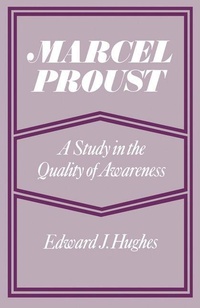
Marcel Proust
A Study in the Quality of Awareness
Published on 25. November 2010
Book
Paperback/Softback
228 pages
978-0-521-15504-5 (ISBN)
Description
Proust's work may sometimes offer a picture of intellectual confidence. But not enough had previously been said about the crisis of hypersensitivity in many of Proust's characters. This 1983 book attempted to fill that gap, and as such should interest all students of Proust. In A la recherche, Proust deliberates on the separation between the troubled artist and the simple, sometimes primitive sensibility of others. It is a separation that many critics have viewed as inevitable. In this book, however, Dr Hughes shows that Proust is constantly exploring the divide, and finally succeeds in harmonising simplicity and complexity - in the unlikely form of music. In this way, several areas of Proust's novel are brought into prominence that would usually have been ignored - for example, his nostalgic depictions of animal life. This book provides a synthesis of these and related experiences: as such it offers a reappraisal of Proust's view of human awareness.
More details
Language
English
Place of publication
Cambridge
United Kingdom
Target group
College/higher education
Product notice
Paperback (trade)
Illustrations
Worked examples or Exercises
Dimensions
Height: 216 mm
Width: 140 mm
Thickness: 14 mm
Weight
328 gr
ISBN-13
978-0-521-15504-5 (9780521155045)
Copyright in bibliographic data and cover images is held by Nielsen Book Services Limited or by the publishers or by their respective licensors: all rights reserved.
Schweitzer Classification
Other editions
Additional editions

Book
03/1983
Cambridge University Press
€49.52
Article exhausted; check for reprint
Previous edition
Book
03/1983
Cambridge University Press
€49.52
Article exhausted; check for reprint
Content
Acknowledgements; Abbreviations; Preliminary notes; Introduction; 1. Proust's early work; 2. Beteween Jean Santeuil and A la recherche; 3. The narrator's childhood and adolescence: formative influences; 4. Characterisation: the functioning of a law of opposites; 5. Albertine as captive of the narrator; 6. The realisation of an artistic vocation; Conclusion; Notes; Bibliography; Index.