

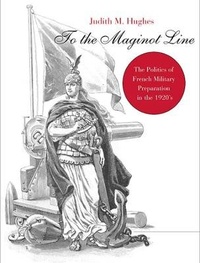
To the Maginot Line
The Politics of French Military Preparation in the 1920's
Published on 1. September 2006
Book
Paperback/Softback
312 pages
978-0-674-02386-4 (ISBN)
Description
"[A] stimulating and excellently documented book...Individual personalities are particularly well handled. Foch and Petain, Poincare and Blum-all emerge with veritable life in them. The trends of French interwar history are deftly carried through onto these pages with an unobtrusive lucidity and persuasiveness."-Michael Hurst, American Historical Review
"Admirable...Instead of working backward from 1940, seeking causes and culprits of collapse in the 1930s, Ms. Hughes has wisely chosen to begin in 1918 and to focus upon the 1920s. This chronology has given her a fresher perspective and a wider scope for sympathy than other commentators of the period. It is the great merit of this book that it passes judgments with compassion and restraint. Indeed, Professor Hughes insists upon viewing French military policy in the broadest possible context of international developments, domestic politics, economic problems, and intellectual moods; from these elements, she weaves a dilemma of tragic dimensions in which the confusions and mistakes of individuals are reviewed with kindness and realism."-Charles C. Bright, Political Science Quarterly
The decision to fortify northeastern France has usually been considered a tragic mistake, an example of bad planning and missed opportunities. Not so, says Judith M. Hughes, who provides a convincing view of how France's military and political leaders tried to safeguard their nation-and why they failed.
"Admirable...Instead of working backward from 1940, seeking causes and culprits of collapse in the 1930s, Ms. Hughes has wisely chosen to begin in 1918 and to focus upon the 1920s. This chronology has given her a fresher perspective and a wider scope for sympathy than other commentators of the period. It is the great merit of this book that it passes judgments with compassion and restraint. Indeed, Professor Hughes insists upon viewing French military policy in the broadest possible context of international developments, domestic politics, economic problems, and intellectual moods; from these elements, she weaves a dilemma of tragic dimensions in which the confusions and mistakes of individuals are reviewed with kindness and realism."-Charles C. Bright, Political Science Quarterly
The decision to fortify northeastern France has usually been considered a tragic mistake, an example of bad planning and missed opportunities. Not so, says Judith M. Hughes, who provides a convincing view of how France's military and political leaders tried to safeguard their nation-and why they failed.
Reviews / Votes
[A] stimulating and excellently documented book...Individual personalities are particularly well handled. Foch and Petain, Poincare and Blum-all emerge with veritable life in them. The trends of French interwar history are deftly carried through onto these pages with an unobtrusive lucidity and persuasiveness. -- Michael Hurst * American Historical Review * [An] admirable little monograph...[Hughes] has demonstrated what can be done to overcome obstacles of official secrecy through resourcefulness in collecting evidence and ingenuity in interpretation. Moreover, instead of working backward from 1940, seeking causes and culprits of collapse in the 1930s, Ms. Hughes has wisely chosen to begin in 1918 and to focus upon the 1920s. This chronology has given her a fresher perspective and a wider scope for sympathy than other commentators of the period. It is the great merit of this book that it passes judgments with compassion and restraint. Indeed, Professor Hughes insists upon viewing French military policy in the broadest possible context of international developments, domestic politics, economic problems, and intellectual moods; from these elements, she weaves a dilemma of tragic dimensions in which the confusions and mistakes of individuals are reviewed with kindness and realism. -- Charles C. Bright * Political Science Quarterly * Dr. Judith Hughes has devised a modest title for her very wide sweep of interbellum French military history. Not content with penetrating analyses of the post war 'population problem,' the intricacies of politico-military relations, the unfolding formulation of strategic-tactical concepts in light of 1914-1918, the intermeshing of foreign and military policy, and, on title-target, the political alignments in legislating army reform and frontier organization (Maginot Line), Dr. Hughes offers an epilogue on the implication of the 1920s for the 1930s and even for May-June 1940. If at times Dr. Hughes covers familiar ground, she does so with the same thoroughness and perception she exhibits in more 'original' sections of this well-researched book. -- Donald J. Harvey * Military Affairs *More details
Series
Language
English
Place of publication
Cambridge, Mass
United States
Target group
Professional and scholarly
US School Grade: College Graduate Student
Dimensions
Height: 197 mm
Width: 140 mm
Thickness: 19 mm
Weight
363 gr
ISBN-13
978-0-674-02386-4 (9780674023864)
Copyright in bibliographic data and cover images is held by Nielsen Book Services Limited or by the publishers or by their respective licensors: all rights reserved.
Schweitzer Classification
Other editions
Additional editions

E-Book
07/2009
Harvard University Press
€25.09
Available for download
Person
Judith M. Hughes is Professor of History at the University of California, San Diego.