

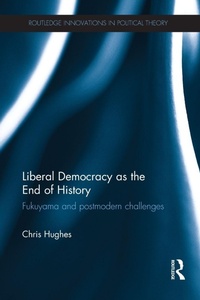
Liberal Democracy as the End of History
Fukuyama and Postmodern Challenges
1st Edition
Published on 14. October 2024
Book
Paperback/Softback
236 pages
978-1-032-92577-6 (ISBN)
Description
Francis Fukuyama claims that liberal democracy is the end of history. This book provides a theoretical re-examination of this claim through postmodernist ideas.
The book argues that postmodern ideas provide a valuable critique to Fukuyama's thesis, and poses the questions: can we talk about a universal and teleological history; a universal human nature; or an autonomous individual? It addresses whether postmodern theories - concerning the movement of time, what it means to be human, and what it means to be an individual/subject - can be accommodated within a theory of a history that ends in liberal democracy.
The author argues that incorporating elements of postmodern thought into Fukuyama's theory makes it possible to produce a stronger and more compelling account of the theory that liberal democracy is the end of history. The result of this is to underpin Fukuyama's theory with a more complex understanding of the movement of time, the human and the individual, and to show that postmodern concepts can, paradoxically, be used to strengthen Fukuyama's theory that the end of history is liberal democracy. The book will be of interest to students and scholars of political theory, postmodernism and the work of Francis Fukuyama.
The book argues that postmodern ideas provide a valuable critique to Fukuyama's thesis, and poses the questions: can we talk about a universal and teleological history; a universal human nature; or an autonomous individual? It addresses whether postmodern theories - concerning the movement of time, what it means to be human, and what it means to be an individual/subject - can be accommodated within a theory of a history that ends in liberal democracy.
The author argues that incorporating elements of postmodern thought into Fukuyama's theory makes it possible to produce a stronger and more compelling account of the theory that liberal democracy is the end of history. The result of this is to underpin Fukuyama's theory with a more complex understanding of the movement of time, the human and the individual, and to show that postmodern concepts can, paradoxically, be used to strengthen Fukuyama's theory that the end of history is liberal democracy. The book will be of interest to students and scholars of political theory, postmodernism and the work of Francis Fukuyama.
More details
Series
Language
English
Place of publication
London
United Kingdom
Publishing group
Taylor & Francis Ltd
Target group
College/higher education
Professional and scholarly
Academic, Postgraduate, and Undergraduate
Dimensions
Height: 234 mm
Width: 156 mm
Weight
440 gr
ISBN-13
978-1-032-92577-6 (9781032925776)
Copyright in bibliographic data and cover images is held by Nielsen Book Services Limited or by the publishers or by their respective licensors: all rights reserved.
Schweitzer Classification
Other editions
Additional editions
E-Book
02/2012
1st Edition
Routledge
€54.99
Available for download
E-Book
02/2012
1st Edition
Routledge
€55.49
Available for download
Book
09/2011
1st Edition
Routledge
€231.70
Shipment within 15-20 days
Person
Chris Hughes currently teaches at the University of Liverpool and the University of Manchester, UK.
Content
Introduction 1. Methodology - An Approach to Philosophical Analysis 2. Fukuyama I - The Concept of a History with Universal Direction and End Point 3. Fukuyama II - Why does History end in Liberal Democracy? 4. Postmodern Perspectives on the Flow of Time 5. Questioning the Universality of Human Nature - A Politics without a Concept of the "Human" 6. The Myth of the Individual - How "I" is Constructed and Gives an Account of Itself 7. A Theory of a History which Ends in Liberal Democracy Through a Reading of Fukuyama and Postmodernism Postscript: Limitations and Outcomes of The Study Bibliography