

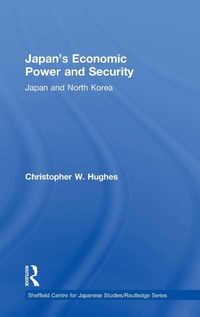
Japan's Economic Power and Security
Japan and North Korea
1st Edition
Published on 3. June 1999
Book
Hardback
256 pages
978-0-415-20183-4 (ISBN)
Description
Is Japan re-emerging as a normal, or even a great, military power in regional and global security affairs? This Adelphi Paper assesses the overall trajectory of Japan's security policy over the last decade, and the impact of a changing Japanese military posture on the stability of East Asia.
The paper examines Japan's evolving security debate, set against the background of a shifting international environment and domestic policymaking system; the status of Japan's national military capabilities and constitutional prohibitions; post-Cold War developments in the US Japan alliance; and Japan's role in multilateral regional security dialogue, UN PKO, and US-led coalitions of the willing. It concludes that Japan is undoubtedly moving along the trajectory of becoming a more assertive military power, and that this trend has been accelerated post-9/11. Japan is unlikely, though, to channel its military power through greatly different frameworks than at present. Japan will opt for the enhanced, and probably inextricable, integration of its military capabilities into the US Japan alliance, rather than pursuing options for greater autonomy or multilateralism. Japan's strengthened role as the defensive shield for the offensive sword of US power projection will only serve to bolster US military hegemony in East Asia and globally.
The paper examines Japan's evolving security debate, set against the background of a shifting international environment and domestic policymaking system; the status of Japan's national military capabilities and constitutional prohibitions; post-Cold War developments in the US Japan alliance; and Japan's role in multilateral regional security dialogue, UN PKO, and US-led coalitions of the willing. It concludes that Japan is undoubtedly moving along the trajectory of becoming a more assertive military power, and that this trend has been accelerated post-9/11. Japan is unlikely, though, to channel its military power through greatly different frameworks than at present. Japan will opt for the enhanced, and probably inextricable, integration of its military capabilities into the US Japan alliance, rather than pursuing options for greater autonomy or multilateralism. Japan's strengthened role as the defensive shield for the offensive sword of US power projection will only serve to bolster US military hegemony in East Asia and globally.
More details
Series
Language
English
Place of publication
London
United Kingdom
Publishing group
Taylor & Francis Ltd
Target group
College/higher education
Dimensions
Height: 240 mm
Width: 161 mm
Thickness: 19 mm
Weight
555 gr
ISBN-13
978-0-415-20183-4 (9780415201834)
Copyright in bibliographic data and cover images is held by Nielsen Book Services Limited or by the publishers or by their respective licensors: all rights reserved.
Schweitzer Classification
Other editions
Additional editions
E-Book
01/2013
1st Edition
Routledge
€60.49
Available for download
E-Book
01/2013
1st Edition
Routledge
€60.49
Available for download
Person
Christopher W. Hughes is British Academy Postdoctoral Fellow at the Centre for the Study of Globalisation and Regionalisation, University of Warwick.
Content
Introduction; Chapter 1 Global and Japanese conceptions of power and security policy in the post-Cold War era; Chapter 2 Theory of economic power and security; Chapter 3 Military and economic conceptions of the North Korean security problem; Chapter 4 Japanese economic power and North Korea; Chapter 5 The Japanese policy-making process and economic versus military security policy; conclusion Conclusion;