

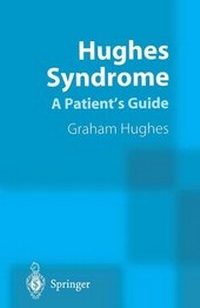
Hughes Syndrome
A Patient's Guide
Published on 2. April 2001
Book
Paperback/Softback
VIII, 64 pages
978-1-85233-457-4 (ISBN)
Description
As with any delicate machine, the human body can be profoundly affected by its supply of vital running materials. Thus, the tendency for the blood to clot excessively has the potential to cut off the oxygen supply to any organ of the body. In 1983, Dr Graham Hughes and his team in London described a syndrome and subsequently developed simple blood tests to diagnose the condition. This syndrome is characterised by thrombosis (both in limbs and internal organs), headaches, memory loss, strokes and, in pregnant women, placental clotting and recurrent miscarriage. The syndrome, now known worldwide as Hughes Syndrome, or the anti-phospholipid syndrome, is common - being responsible for example, for up to 1 in 5 cases of young stroke. More important, it is treatable. This book provides the first in-depth description of the syndrome for patients.
More details
Edition
2001
Language
English
Place of publication
London
United Kingdom
Target group
College/higher education
Professional and scholarly
Professional/practitioner
Product notice
Paperback (trade)
Illustrations
14 s/w Abbildungen
14 black & white illustrations, biography
Dimensions
Height: 20.5 cm
Width: 13.3 cm
Thickness: 4 mm
Weight
230 gr
ISBN-13
978-1-85233-457-4 (9781852334574)
DOI
10.1007/978-1-4471-0323-3
Schweitzer Classification
Other editions
New editions
Book
05/2016
2nd Edition
Springer
€85.59
Shipment within 10-15 days
Additional editions
Content
1.Sticky Blood: the Disease Is Common.- 2.Main Clinical Features.- 3.Clotting in Veins.- 4.Stroke.- 5.Memory Loss and "Alzheimers".- 6.Headaches, Migraine and Fits.- 7.The Spinal Cord and "Multiple Sclerosis".- 8.The Heart and Arteries.- 9.Internal Organs.- 10.The "Catastrophic" Antiphospholipid Syndrome.- 11.Pregnancy and Fetal Loss.- 12.Hughes' Syndrome and Lupus.- 13.Treatment.- 14.The Outlook.- 15.What Blood Tests Do We Use?.- 16.Research.- 17.Background.- 18.Further Reading and Websites.