

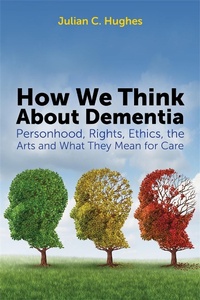
How We Think About Dementia
Personhood, Rights, Ethics, the Arts and What They Mean for Care
Published on 21. July 2014
Book
Paperback/Softback
248 pages
978-1-84905-477-5 (ISBN)
Description
Exploring concepts of ageing, personhood, capacity, liberty, best interests and the nature and ethics of palliative care, this book will help those in the caring professions to understand and engage with the thoughts and arguments underpinning the experience of dementia and dementia care.
Dementia is associated with ageing: what is the significance of this? People speak about person-centred care, but what is personhood and how can it be maintained? What is capacity, and how is it linked with the way a person with dementia is cared for as a human being? How should we think about the law in relation to the care of older people? Is palliative care the right approach to dementia, and if so what are the consequences of this view? What role can the arts play in ensuring quality of life for people with dementia?
In answering such questions, Julian Hughes brings our attention back to the philosophical and ethical underpinnings of dementia care, shedding new light on the significance and implications for those in the caring professions, academics and researchers, and those living with dementia and their families.
Dementia is associated with ageing: what is the significance of this? People speak about person-centred care, but what is personhood and how can it be maintained? What is capacity, and how is it linked with the way a person with dementia is cared for as a human being? How should we think about the law in relation to the care of older people? Is palliative care the right approach to dementia, and if so what are the consequences of this view? What role can the arts play in ensuring quality of life for people with dementia?
In answering such questions, Julian Hughes brings our attention back to the philosophical and ethical underpinnings of dementia care, shedding new light on the significance and implications for those in the caring professions, academics and researchers, and those living with dementia and their families.
Reviews / Votes
In this book, Julian Hughes makes a powerful and compelling case for a revolution in the treatment of people with dementia. He underscores the need to summon immediately the personal and political will to engage people with dementia as people who respond positively to the solicitude and open engagement provided by those deemed healthy. Viewing dementia and ageing in the broad scope of human life, yet without romanticising illness, Hughes challenges professional and lay carers to open their minds and hearts to create what Buber called, "I-Thou" relationships with people diagnosed with dementia, so as to improve the lives of all concerned. He does this on philosophically, ethically, sophisticated grounds as a philosopher, on medically sophisticated grounds as an old age psychiatrist, and on aesthetically sophisticated grounds as a humane, spiritually alive human being. This book will benefit many audiences, including, perhaps most importantly, people with dementia. -- Steven R. Sabat, Ph.D., Professor of Psychology at Georgetown University and author of The Experience of Alzheimer's Disease: Life Through a Tangled Veil Julian Hughes uses a rich combination of science, law, history, ethics and philosophy to illustrate the complex nature of dementia and how we view it. Through a series of fascinating case studies illustrating real life complex scenarios, and with superb clarity of writing, he gently challenges our current approaches to people with dementia - above all emphasising the need to see through the narrow illness to the broader person within. An excellent and stimulating book. -- John T. O'Brien, DM, F Med Sci, Foundation Professor of Old Age Psychiatry, University of Cambridge How We Think About Dementia is a book directed at professionals or people who are familiar with research and medical terminology... Hughes identifies ethical concerns through the use of case studies. Within these case studies, circumstances are shared that bring to light challenges that may be encountered by caregivers... Services, ethical considerations, methods and barriers to care are covered well in the book from a professional perspective... the majority of the book provides a sense of direction for professionals (medical doctors, psychologists, psychiatric nurses, occupational therapists, etcetera) in caring for a patient with dementia. -- Lynne Trevisan, Assistant Professor, College of Health, Human Services, and Sciences, Ashford University * metapsychology online reviews *More details
Language
English
Place of publication
London
United Kingdom
Target group
Professional and scholarly
Product notice
Paperback (UK-trade)
Illustrations
2 black and white photographs
Dimensions
Height: 228 mm
Width: 151 mm
Thickness: 20 mm
Weight
375 gr
ISBN-13
978-1-84905-477-5 (9781849054775)
Copyright in bibliographic data and cover images is held by Nielsen Book Services Limited or by the publishers or by their respective licensors: all rights reserved.
Schweitzer Classification
Other editions
Additional editions
Julian C. Hughes
How We Think About Dementia
Personhood, Rights, Ethics, the Arts and What They Mean for Care
E-Book
07/2014
Jessica Kingsley Publishers
€31.99
Available for download
Person
Professor Julian C. Hughes is Consultant in Old Age Psychiatry for Northumbria Healthcare NHS Foundation Trust and Honorary Professor of Philosophy of Ageing at the Policy, Ethics and Life Sciences (PEALS) Research Centre, Newcastle University. He is co-author of Ethical Issues in Dementia Care: Making Difficult Decisions, also published by JKP. He lives in Newcastle, UK.
Content
Preface. Introduction. Part I: Ageing. 1. Our Changing Expectations of Life: What Do We Really Want? 2. Research, Ageing and Dementia. Part II: Personhood. 3. Memory: Inner or Outer? 4. I am still the same person. 5. The Body in Dementia. Part III: Capacity and Incapacity. 6. 'Capacity': What is it and so what? 7. Capacity Legislation in Practice: Balancing Personal and Polis. 8. Incapacity and Mental Disorder. Part IV: Palliative and Supportive Care. 9. Beyond Hypercognitivism. 10. Understanding the Language of Distress. 11. Ethics, Patterns, Causes and Pathways: In Pursuit of Good Palliative Care. 12. Intentions and Best Interests: Dying and Killing. Part V: Arts. 13. The Art and Practice of Memory and Forgetting co-authored with Ashley McCormick, artist, curator and educator. 14. In Praise of 'Negative Capability': Keats and Killick. Conclusion: Care - Solicitude and Solidarity. References and Further Reading. Index.