

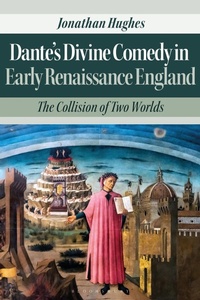
Dante's Divine Comedy in Early Renaissance England
The Collision of Two Worlds
Published on 24. February 2022
Book
Hardback
440 pages
978-1-350-14628-0 (ISBN)
Description
Dante's Divine Comedy in Early Renaissance England compares the intellectual, emotional, and religious world of Dante in 13th-century Florence with that of a group of English intellectuals gathered around Humphrey, Duke of Gloucester, uncle of the King, Henry VI.
Here, Jonathan Hughes establishes that there was a Renaissance in 15th-century England, encouraged by the discovery and translations of works of Greek philosophers and developments in science and medicine; and that vernacular writers in Gloucester's circle, such as John Lydgate and Robert Hoccleve, were of fundamental importance in exploring the meaning of the self and man's relationship with the natural world and the classical past. However, the appearance in 15th-century England of Dante's 'Commedia', the most popular work of the Middle Ages, served to remind writers and readers of the cost of intellectual enquiry: the loss of faith in a harmonious and beautiful world; the redemptive power of the love of a woman; and the tangible presence of an afterlife.
Engagingly written and meticulously researched, this innovative study shines a new perspective on Dante scholarship as well as offering a unique anaylsis of intellectual thought and culture in 15th-century England.
Here, Jonathan Hughes establishes that there was a Renaissance in 15th-century England, encouraged by the discovery and translations of works of Greek philosophers and developments in science and medicine; and that vernacular writers in Gloucester's circle, such as John Lydgate and Robert Hoccleve, were of fundamental importance in exploring the meaning of the self and man's relationship with the natural world and the classical past. However, the appearance in 15th-century England of Dante's 'Commedia', the most popular work of the Middle Ages, served to remind writers and readers of the cost of intellectual enquiry: the loss of faith in a harmonious and beautiful world; the redemptive power of the love of a woman; and the tangible presence of an afterlife.
Engagingly written and meticulously researched, this innovative study shines a new perspective on Dante scholarship as well as offering a unique anaylsis of intellectual thought and culture in 15th-century England.
Reviews / Votes
Jonathan Hughes's Dante's Divine Comedy in Early Renaissance England details how we might view an earlier Renaissance occurring in fifteenth-century England through interesting connections to Dante's world... the book offers fascinating new insights into these connections between Italy and England. * Journal of British Studies *More details
Language
English
Place of publication
London
United Kingdom
Publishing group
Bloomsbury Publishing PLC
Target group
College/higher education
Illustrations
12 bw illus
Dimensions
Height: 162 mm
Width: 257 mm
Thickness: 33 mm
Weight
816 gr
ISBN-13
978-1-350-14628-0 (9781350146280)
Copyright in bibliographic data and cover images is held by Nielsen Book Services Limited or by the publishers or by their respective licensors: all rights reserved.
Schweitzer Classification
Person
Jonathan Hughes is Honorary Research Fellow at the University of Exeter, UK. He is also Guest Lecturer at the Exeter Centre for the Study of Esotericism, UK. His books include Pastors and Visionaries: Religion and Secular Life in Late Medieval Yorkshire (1988), The Religious Life of Richard III (1997) and Arthurian Myths and Alchemy: The Kingship of Edward IV (2002).
Content
List of Illustrations
Acknowledgements and Foreword
Introduction
1. Mercury: The Arrival of Dante in England 1370-1450
2. Jupiter: Ancient Rome
3. Apollo (the Sun): The Legacy of Ancient Greece
4. Venus: Nature and Science
5. The Fixed Stars: Fortune
6. Luna (the Moon): Women
7. The Primum Mobile and the Empyrean: Love and the Afterlife
8. Saturn: Melancholia
9. Terram (the Earth): Conclusion and the Afterlife of The Divine Comedy
Bibliography
Index
Acknowledgements and Foreword
Introduction
1. Mercury: The Arrival of Dante in England 1370-1450
2. Jupiter: Ancient Rome
3. Apollo (the Sun): The Legacy of Ancient Greece
4. Venus: Nature and Science
5. The Fixed Stars: Fortune
6. Luna (the Moon): Women
7. The Primum Mobile and the Empyrean: Love and the Afterlife
8. Saturn: Melancholia
9. Terram (the Earth): Conclusion and the Afterlife of The Divine Comedy
Bibliography
Index