

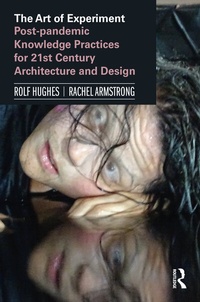
The Art of Experiment
Post-pandemic Knowledge Practices for 21st Century Architecture and Design
1st Edition
Published on 21. December 2020
Book
Paperback/Softback
156 pages
978-1-138-47957-9 (ISBN)
Description
A handbook for navigating our troubled and precarious times intended to help readers imagine and make their world anew.
In search of new knowledge practices that can help us make the world livable again, this book takes the reader on a journey across time-from the deep past to the unfolding future. The authors search beyond human knowledge to establish negotiated partnerships with forms of knowledge within the planet itself, examining how we have manipulated these historically through an anthropocentric focus. The book explores the many different kinds of knowledge, and the diversity of instruments needed to invoke and actuate the potency of human and nonhuman agencies. Four key phases in our ways of knowing are identified: material, strengthening, reconfiguring and extending, which are exemplified through case studies that take the form of worlding experiments.
This pioneering work will inspire architects, artists and designers as well as students, teachers and researchers across arts and design disciplines.
In search of new knowledge practices that can help us make the world livable again, this book takes the reader on a journey across time-from the deep past to the unfolding future. The authors search beyond human knowledge to establish negotiated partnerships with forms of knowledge within the planet itself, examining how we have manipulated these historically through an anthropocentric focus. The book explores the many different kinds of knowledge, and the diversity of instruments needed to invoke and actuate the potency of human and nonhuman agencies. Four key phases in our ways of knowing are identified: material, strengthening, reconfiguring and extending, which are exemplified through case studies that take the form of worlding experiments.
This pioneering work will inspire architects, artists and designers as well as students, teachers and researchers across arts and design disciplines.
More details
Language
English
Place of publication
London
United Kingdom
Publishing group
Taylor & Francis Ltd
Target group
College/higher education
Illustrations
20 s/w Abbildungen, 20 s/w Photographien bzw. Rasterbilder
20 Halftones, black and white; 20 Illustrations, black and white
Dimensions
Height: 234 mm
Width: 156 mm
Weight
300 gr
ISBN-13
978-1-138-47957-9 (9781138479579)
Copyright in bibliographic data and cover images is held by Nielsen Book Services Limited or by the publishers or by their respective licensors: all rights reserved.
Schweitzer Classification
Other editions
Additional editions
Rolf Hughes | Rachel Armstrong
The Art of Experiment
Post-pandemic Knowledge Practices for 21st Century Architecture and Design
Book
12/2020
1st Edition
Routledge
€230.27
Shipment within 10-20 days
Rolf Hughes | Rachel Armstrong
The Art of Experiment
Post-pandemic Knowledge Practices for 21st Century Architecture and Design
E-Book
12/2020
1st Edition
Routledge
€52.49
Available for download
Rolf Hughes | Rachel Armstrong
The Art of Experiment
Post-pandemic Knowledge Practices for 21st Century Architecture and Design
E-Book
12/2020
1st Edition
Routledge
€52.49
Available for download
Persons
Rolf Hughes is professor in the epistemology of design-driven research at the Department of Architecture, KU Leuven, and director of artistic research for the Experimental Architecture Group. An interdisciplinary artist and performer, his writing spans creative and critical genres.
Rachel Armstrong is professor of experimental architecture at Newcastle University and visiting professor at KU Leuven. She pioneers the interdisciplinary field of "living architecture," which engages the material and technological potency of life within spatial agendas.
Rachel Armstrong is professor of experimental architecture at Newcastle University and visiting professor at KU Leuven. She pioneers the interdisciplinary field of "living architecture," which engages the material and technological potency of life within spatial agendas.
Content
1. Introduction 2. Material Knowledge 3. Strengthening Knowledge 4. Reconfiguring Knowledge 5. Extending Knowledge 6. Worlding Case Studies 7. Conclusion 8. Epilogue Index