

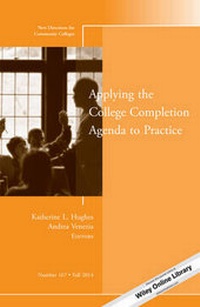
Applying the College Completion Agenda to Practice
New Directions for Community Colleges, Number 167
Published on 2. October 2014
Book
Paperback/Softback
112 pages
978-1-118-97636-4 (ISBN)
Description
This volume profiles some of the innovative reforms community college practitioners are engaged in, focusing on supporting students through to graduation. While much has been written at the federal and state levels about the need to improve student completion rates, this volume translates that imperative into action at the campus level. It presents the practitiners' voices and experiences in:
Changing academic content
Pedagogy
Student support services
And other critical components of community colleges.
Each chapter focuses on either a particular campus-based reform or on a cross-cutting approach or set of issues relevant for most campuses. The volume highlights opportunities, describes challenges and how they were overcome, and provides guidance that can be used by other postsecondary practitioners involved in large-scale-campus, multi-campus, or system-level-reforms that aim to increase student success.
This is the 167th volume of this Jossey-Bass quarterly report series. Essential to the professional libraries of presidents, vice presidents, deans, and other leaders in today's open-door institutions, New Directions for Community Colleges provides expert guidance in meeting the challenges of their distinctive and expanding educational mission.
Changing academic content
Pedagogy
Student support services
And other critical components of community colleges.
Each chapter focuses on either a particular campus-based reform or on a cross-cutting approach or set of issues relevant for most campuses. The volume highlights opportunities, describes challenges and how they were overcome, and provides guidance that can be used by other postsecondary practitioners involved in large-scale-campus, multi-campus, or system-level-reforms that aim to increase student success.
This is the 167th volume of this Jossey-Bass quarterly report series. Essential to the professional libraries of presidents, vice presidents, deans, and other leaders in today's open-door institutions, New Directions for Community Colleges provides expert guidance in meeting the challenges of their distinctive and expanding educational mission.
More details
Series
Language
English
Place of publication
New York
United States
Publishing group
John Wiley & Sons Inc
Target group
Professional and scholarly
Dimensions
Height: 229 mm
Width: 150 mm
Thickness: 8 mm
Weight
159 gr
ISBN-13
978-1-118-97636-4 (9781118976364)
Copyright in bibliographic data and cover images is held by Nielsen Book Services Limited or by the publishers or by their respective licensors: all rights reserved.
Schweitzer Classification
Other editions
Additional editions
Katherine L. Hughes | Andrea Venezia
Applying the College Completion Agenda to Practice
New Directions for Community Colleges, Number 167
E-Book
09/2014
Jossey-Bass
€22.99
Available for download
Katherine L. Hughes | Andrea Venezia
Applying the College Completion Agenda to Practice
New Directions for Community Colleges, Number 167
E-Book
09/2014
Jossey-Bass
€22.99
Available for download
Persons
Issue Editors:
Katherine L. Hughes is the executive director of Community College and Higher Education Initiatives at the College Board.
Andrea Venezia is an associate professor of public policy and administration and the executive director of the Institute for Higher Education Leadership & Policy at California State University, Sacramento.
Series Editor in Chief:
Arthur M. Cohen is professor emeritus at the UCLA Graduate School of Education & Information Studies.
Katherine L. Hughes is the executive director of Community College and Higher Education Initiatives at the College Board.
Andrea Venezia is an associate professor of public policy and administration and the executive director of the Institute for Higher Education Leadership & Policy at California State University, Sacramento.
Series Editor in Chief:
Arthur M. Cohen is professor emeritus at the UCLA Graduate School of Education & Information Studies.
Content
EDITORS' NOTES 1
Katherine L. Hughes and Andrea Venezia
1. Redesigning Arithmetic for Student Success: Supporting Faculty to Teach in New Ways 5
Susan Bickerstaff, Barbara Lontz, Maria Scott Cormier, Di Xu
This chapter describes a promising new approach to teaching developmental arithmetic and prealgebra, and presents research findings that demonstrate how a faculty support network helped instructors adopt new teaching strategies and gain confidence in teaching the reformed course.
2. Steps and Missteps: Redesigning, Piloting, and Scaling a Developmental Writing Program 15
Peter Adams, Donna McKusick
This chapter tells a story of course reform, describing in a fresh and candid way the steps taken toward change and the results achieved. The authors emphasize that instructors need considerable support in order to teach differently, as well as underscore the need to consider scalability of reform even at the pilot stage.
3. The California Acceleration Project: Reforming Developmental Education to Increase Student Completion of College-Level Math and English 27
Katie Hern, with Myra Snell
This chapter describes how the authors are using data and professional learning to mobilize change in developmental English and mathematics curricula and pedagogy across multiple community colleges in
California.
4. Strategies for Integrating Student Supports and Academics 41
Mina Dadgar, Thad Nodine, Kathy Reeves Bracco, Andrea Venezia
This chapter defines the integration of academics and student support services and offers examples of models and strategies from colleges nationally.
5. Providing Transparent Information to Empower Students' Decision Making and Develop Institutional Capacity 53
Gary Rodwell
This chapter describes the University of Hawaii's work to develop an online navigational tool that helps students develop and execute their educational plans, and assists colleges with ensuring that they have the capacity to meet students' needs.
6. Strengthening Program Pathways Through Transformative Change 63
Lenore Rodicio, Susan Mayer, Davis Jenkins
This chapter reports on a major college-wide effort to smooth students' paths as they enter the college, choose a program, and progress to a credential. Leadership, inclusiveness, and communication have been central to the success of the effort.
7. State-Level Reforms That Support College-Level Program Changes in North Carolina 73
R. Edward Bowling, Sharon Morrissey, George M. Fouts
This chapter describes the concurrent reforms occurring in North Carolina-both campus-level changes focused on such issues as developing structured programs of study and state-level reforms aimed at
supporting the campus-level efforts.
8. What We've Learned About Supporting Faculty, Administrator, and Staff Engagement 87
Alison Kadlec, Isaac Rowlett
This chapter focuses on how colleges can increase faculty, administrator, and staff engagement in reform processes, with the message that large-scale change is not merely technical work; there is a powerful human dimension that can make or break a reform.
9. Putting the Pieces Together: Lessons Learned for Future Reforms 99
Andrea Venezia, Katherine L. Hughes
This chapter summarizes the main lessons learned throughout the volume and highlights common needs with any large-scale reform along with common strategies.
INDEX 103
Katherine L. Hughes and Andrea Venezia
1. Redesigning Arithmetic for Student Success: Supporting Faculty to Teach in New Ways 5
Susan Bickerstaff, Barbara Lontz, Maria Scott Cormier, Di Xu
This chapter describes a promising new approach to teaching developmental arithmetic and prealgebra, and presents research findings that demonstrate how a faculty support network helped instructors adopt new teaching strategies and gain confidence in teaching the reformed course.
2. Steps and Missteps: Redesigning, Piloting, and Scaling a Developmental Writing Program 15
Peter Adams, Donna McKusick
This chapter tells a story of course reform, describing in a fresh and candid way the steps taken toward change and the results achieved. The authors emphasize that instructors need considerable support in order to teach differently, as well as underscore the need to consider scalability of reform even at the pilot stage.
3. The California Acceleration Project: Reforming Developmental Education to Increase Student Completion of College-Level Math and English 27
Katie Hern, with Myra Snell
This chapter describes how the authors are using data and professional learning to mobilize change in developmental English and mathematics curricula and pedagogy across multiple community colleges in
California.
4. Strategies for Integrating Student Supports and Academics 41
Mina Dadgar, Thad Nodine, Kathy Reeves Bracco, Andrea Venezia
This chapter defines the integration of academics and student support services and offers examples of models and strategies from colleges nationally.
5. Providing Transparent Information to Empower Students' Decision Making and Develop Institutional Capacity 53
Gary Rodwell
This chapter describes the University of Hawaii's work to develop an online navigational tool that helps students develop and execute their educational plans, and assists colleges with ensuring that they have the capacity to meet students' needs.
6. Strengthening Program Pathways Through Transformative Change 63
Lenore Rodicio, Susan Mayer, Davis Jenkins
This chapter reports on a major college-wide effort to smooth students' paths as they enter the college, choose a program, and progress to a credential. Leadership, inclusiveness, and communication have been central to the success of the effort.
7. State-Level Reforms That Support College-Level Program Changes in North Carolina 73
R. Edward Bowling, Sharon Morrissey, George M. Fouts
This chapter describes the concurrent reforms occurring in North Carolina-both campus-level changes focused on such issues as developing structured programs of study and state-level reforms aimed at
supporting the campus-level efforts.
8. What We've Learned About Supporting Faculty, Administrator, and Staff Engagement 87
Alison Kadlec, Isaac Rowlett
This chapter focuses on how colleges can increase faculty, administrator, and staff engagement in reform processes, with the message that large-scale change is not merely technical work; there is a powerful human dimension that can make or break a reform.
9. Putting the Pieces Together: Lessons Learned for Future Reforms 99
Andrea Venezia, Katherine L. Hughes
This chapter summarizes the main lessons learned throughout the volume and highlights common needs with any large-scale reform along with common strategies.
INDEX 103