

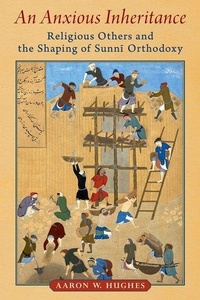
An Anxious Inheritance
Religious Others and the Shaping of Sunni Orthodoxy
Published on 9. June 2022
Book
Hardback
274 pages
978-0-19-761347-4 (ISBN)
Description
An Anxious Inheritance reveals the tensions between the early framers of Islam and the ever-expandable category of non-Muslims. Examining the encounter with these religious others, and showing how the Qur'an functioned as both a script to understand them and a map to classify them, this study traces the key role that these religious others played in what would ultimately emerge as (Sunni) orthodoxy. This orthodoxy would appear to be the natural outgrowth of the Prophet Muhammad's preaching, but it ultimately amounted to little more than a retroactive projection of later ideas onto the earliest period.
Non-Muslims (among them Christians, Jews, Zoroastrians) and the "wrong" kinds of Muslims (e.g., the Shi'a) became integral--by virtue of their perceived stubbornness, infidelity, heresy, or the like--to the understanding of what true religion was not and, just as importantly, what it should be. These non-Muslims were rarely real individuals or groups; rather, they functioned as textual foils that could be conveniently orchestrated, and ultimately controlled, to facilitate Muslim self-definition. Without such religious others proper belief could, quite literally, not be articulated. Shedding new light on the early history of Islam, while also problematizing the binary of orthodoxy/heresy in the study of religion, An Anxious Inheritance makes significant contributions to a number of diverse academic fields.
Non-Muslims (among them Christians, Jews, Zoroastrians) and the "wrong" kinds of Muslims (e.g., the Shi'a) became integral--by virtue of their perceived stubbornness, infidelity, heresy, or the like--to the understanding of what true religion was not and, just as importantly, what it should be. These non-Muslims were rarely real individuals or groups; rather, they functioned as textual foils that could be conveniently orchestrated, and ultimately controlled, to facilitate Muslim self-definition. Without such religious others proper belief could, quite literally, not be articulated. Shedding new light on the early history of Islam, while also problematizing the binary of orthodoxy/heresy in the study of religion, An Anxious Inheritance makes significant contributions to a number of diverse academic fields.
Reviews / Votes
Hughes's thesis that Sunni Islam reduces non-Muslims and "internal others" to literary fictions is compelling and a challenge to Islamic studies' uncritical acceptance of polemical sources * Mark Durie, Melbourne School of Theology, Middle East Quarterly *More details
Language
English
Place of publication
New York
United States
Target group
Professional and scholarly
Product notice
sewn/stitched
Cloth over boards
Dimensions
Height: 221 mm
Width: 150 mm
Thickness: 25 mm
Weight
499 gr
ISBN-13
978-0-19-761347-4 (9780197613474)
Copyright in bibliographic data and cover images is held by Nielsen Book Services Limited or by the publishers or by their respective licensors: all rights reserved.
Schweitzer Classification
Other editions
Additional editions
E-Book
12/2021
OUP eBook
€56.99
Available for download
E-Book
12/2021
OUP eBook
€56.99
Available for download
Person
Aaron W. Hughes is the Dean's Professor of the Humanities and the Philip S. Bernstein Professor in the Department of Religion and Classics at the University of Rochester.
Content
Introduction
Part One: Late Antique Fantasies
Chapter One - Qur'anic Others
Chapter Two - Producing Islam through the Production of Religious Others
Chapter Three - Past Perfect: Opening the Jihiliyya's Complex Present
Part Two: Subsequent Constructions
Chapter Four - Good Jew, Bad Jew
Chapter Five - Making Christians
Chapter Six - Shia: The Other Within
Chapter Seven - The Amorphous Zindiq
Conclusions
Bibliography
Part One: Late Antique Fantasies
Chapter One - Qur'anic Others
Chapter Two - Producing Islam through the Production of Religious Others
Chapter Three - Past Perfect: Opening the Jihiliyya's Complex Present
Part Two: Subsequent Constructions
Chapter Four - Good Jew, Bad Jew
Chapter Five - Making Christians
Chapter Six - Shia: The Other Within
Chapter Seven - The Amorphous Zindiq
Conclusions
Bibliography