

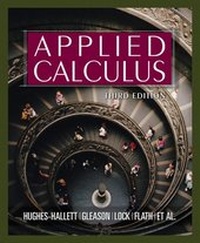
Applied Calculus
3rd Edition
Published on 30. May 2006
Book
Paperback/Softback
528 pages
978-0-471-68121-2 (ISBN)
Description
APPLIED CALCULUS, 3/E brings together the best of both new and traditional curricula to meet the needs of today's students. The author team's extensive teaching experience and proven ability to write innovative and relevant problems has made this text a true bestseller. Exciting new real-world applications make this new edition even more meaningful to students in management, life and social sciences. This book will work well for those departments seeking a middle ground for their instructors.
APPLIED CALCULUS, 3/E exhibits the same strengths from earlier editions including the "Rule of Four", an emphasis on concepts and modeling, exposition that students can read and understand and a flexible approach to technology. The conceptual and modeling problems, praised for their creativity and variety, continue to motivate and challenge students.
APPLIED CALCULUS, 3/E exhibits the same strengths from earlier editions including the "Rule of Four", an emphasis on concepts and modeling, exposition that students can read and understand and a flexible approach to technology. The conceptual and modeling problems, praised for their creativity and variety, continue to motivate and challenge students.
More details
Edition
3., Auflage
Language
English
Place of publication
New York
United States
Publishing group
John Wiley and Sons Ltd
Target group
Professional and scholarly
Edition type
Revised edition
Illustrations
ill
Dimensions
Height: 26.6 cm
Width: 21.8 cm
Thickness: 18 mm
Weight
916 gr
ISBN-13
978-0-471-68121-2 (9780471681212)
Schweitzer Classification
Other editions
Previous edition
Deborah Hughes-Hallett | Andrew M. Gleason | Patti Frazer Lock
Applied Calculus
Book
05/2002
2nd Edition
Wiley
€99.90
Article exhausted; check for reprint
Content
1. Functions and Change.
2. Rate of Change: The Derivative.
3. Short-Cuts to Differentiation.
4. Using the Derivative.
5. Accumulated Change: The Definite Integral.
6. Using the Integral.
7. Antiderivatives.
8. Probability.
9. Functions of Several Variables.
10. Mathematical Modeling using Differential Equations.
11. Geometric Series.
2. Rate of Change: The Derivative.
3. Short-Cuts to Differentiation.
4. Using the Derivative.
5. Accumulated Change: The Definite Integral.
6. Using the Integral.
7. Antiderivatives.
8. Probability.
9. Functions of Several Variables.
10. Mathematical Modeling using Differential Equations.
11. Geometric Series.