

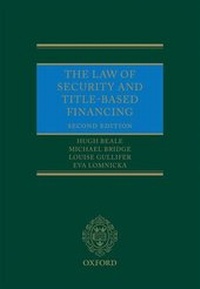
The Law of Security and Title-Based Financing
2nd Edition
Published on 22. March 2012
Book
Hardback
888 pages
978-0-19-960872-0 (ISBN)
Description
Personal property security is an important subject in commercial practice, as it is the key to much of the law of banking and sale. This second edition has been fully updated and expanded to cover all important issues and changes within this highly complex area of law. It explains traditional methods of securing debts (such as mortgages, charges, and pledges) on property other than land, describing how these are created, how they must be registered (or otherwise
'perfected') if they are to be valid, the rights and duties of the parties, and how the security is enforced if the debt is not paid.
The new edition includes an expanded section on priorities in which it explains how 'priority' disputes between competing interests over the same property are resolved. In addition the book covers the law governing other transactions that perform a similar economic function (such as finance leases, retention of title clauses, and sales of a company's book debts). These are not currently treated by the law as security and are therefore subject to different rules on perfection, priority, and
enforcement. There is much expansion of the discussion relating to enforcement including the issue of 'right of use' following Lehman, more analysis on administration and all forms of non-possessory security and quasi-security, and a new chapter on enforcement of security addressing the right of
appropriation under FC/FCAR and the Cukurova case.
The conflict of laws section includes developments under the Rome I Regulation affecting assignment issues, the UNIDROIT Convention 2009 in relation to tiered holdings and the Cape Town Convention's extensions made to coverage of asset-backed security over equipment. It also addresses the changes brought about by the abolition of Slavenburg registration.
This edition contains relevant points from the Banking Act 2009 concerning its impact on security, such as the power to protect certain interests on a transfer of property, and also considers amendments regarding liquidators' expenses under the Insolvency Rules. The authors additionally deal with the role of step-in rights and why they are part of the statutory definition of project finance in the Enterprise Act.
Previously published as The Law of Personal Property Security, this new edition brings together all of the law on this complex area, providing guidance in the context of commercial practice, especially with increased coverage of conflict of laws, priority, insolvency, and enforcement.
'perfected') if they are to be valid, the rights and duties of the parties, and how the security is enforced if the debt is not paid.
The new edition includes an expanded section on priorities in which it explains how 'priority' disputes between competing interests over the same property are resolved. In addition the book covers the law governing other transactions that perform a similar economic function (such as finance leases, retention of title clauses, and sales of a company's book debts). These are not currently treated by the law as security and are therefore subject to different rules on perfection, priority, and
enforcement. There is much expansion of the discussion relating to enforcement including the issue of 'right of use' following Lehman, more analysis on administration and all forms of non-possessory security and quasi-security, and a new chapter on enforcement of security addressing the right of
appropriation under FC/FCAR and the Cukurova case.
The conflict of laws section includes developments under the Rome I Regulation affecting assignment issues, the UNIDROIT Convention 2009 in relation to tiered holdings and the Cape Town Convention's extensions made to coverage of asset-backed security over equipment. It also addresses the changes brought about by the abolition of Slavenburg registration.
This edition contains relevant points from the Banking Act 2009 concerning its impact on security, such as the power to protect certain interests on a transfer of property, and also considers amendments regarding liquidators' expenses under the Insolvency Rules. The authors additionally deal with the role of step-in rights and why they are part of the statutory definition of project finance in the Enterprise Act.
Previously published as The Law of Personal Property Security, this new edition brings together all of the law on this complex area, providing guidance in the context of commercial practice, especially with increased coverage of conflict of laws, priority, insolvency, and enforcement.
Reviews / Votes
This book is as close as one can get to an authoritative and comprehensive text on the law of security and title-based financing in the United Kingdom. Its offers a detailed and critical analysis of the law and it is likely to be valued for its erudition by the publications established readership of practitioners, legal academics, and post-graduate students, who found the first edition such an important source of reference for the law of security and title-basedfinancing. * Tom Burns, Edinburgh Law Review * Building on the successful first edition (bearing the title iThe Law of Personal Property Securityr), the same team of well-known academics have produced another excellent work... Apart from being a useful resource, this work should also serve to stimulate debate in many knotty areas of personal property law. * Look Chan Ho, Journal of International Banking Law and Regulation *
More details
Edition
2nd Revised edition
Language
English
Place of publication
Oxford
United Kingdom
Target group
Professional and scholarly
Practitioners of financial law, members of the bar dealing in general matters of security and enforcement, academics and advanced law students in the area of banking, finance and securities
Edition type
Revised edition
Dimensions
Height: 247 mm
Width: 175 mm
Thickness: 53 mm
Weight
1648 gr
ISBN-13
978-0-19-960872-0 (9780199608720)
Copyright in bibliographic data and cover images is held by Nielsen Book Services Limited or by the publishers or by their respective licensors: all rights reserved.
Schweitzer Classification
Persons
Professor Hugh Beale is Professor of Law at the University of Warwick.
Professor Michael Bridge is Professor of Commercial Law at the London School of Economics. He is also a barrister of the Middle Temple. Before coming to the LSE in 2007, he held chairs in law at McGill University, the University of Nottingham and UCL, and was Dean of the Faculty of Laws at UCL.
Louise Gullifer is a Fellow and tutor in law at Harris Manchester College, Oxford.
Professor Eva Lomnicka is Professor of law at King's College, London, and is also a barrister at 4 New Square Chambers.
Professor Michael Bridge is Professor of Commercial Law at the London School of Economics. He is also a barrister of the Middle Temple. Before coming to the LSE in 2007, he held chairs in law at McGill University, the University of Nottingham and UCL, and was Dean of the Faculty of Laws at UCL.
Louise Gullifer is a Fellow and tutor in law at Harris Manchester College, Oxford.
Professor Eva Lomnicka is Professor of law at King's College, London, and is also a barrister at 4 New Square Chambers.
Content
I: DESCRIPTION OF INTERESTS ; II: REGISTRATION AND OTHER PERFECTION REQUIREMENTS ; III: PRIORITIES ; V: CONFLICT OF LAWS ; VI: CRITICISM AND REFORM PROPOSALS