

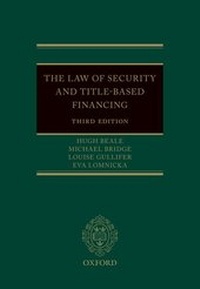
The Law of Security and Title-Based Financing
3rd Edition
Published on 8. March 2018
Book
Hardback
1008 pages
978-0-19-879556-8 (ISBN)
Description
Personal property security is an important subject in commercial practice as it is the key to much of the law of banking and sale. This book examines traditional methods of securing debts (such as mortgages, charges and pledges) on property other than land, describing how these are created, how they must be registered (or otherwise 'perfected') if they are to be valid, the rights and duties of the parties and how the security is enforced if the debt is not paid.
The third edition has been updated to cover a wealth of cases which have been decided since the last edition. These include new cases on: control of financial collateral, and relief against forfeiture under a financial collateral arrangement; retention of title (including the effect of "extended" clauses); estoppel and the HPI register; availability of set-off against assignee; a number of cases on enforcement of security; equitable liens; solicitor's liens and databases; on priority or purchase money security interests; and the Irish Supreme Court decision on floating charge and crystallisation.
The effect of key legislative changes have also been analysed and these include the 2013 amendments to the Companies Act 2006 Part 25, and issues post-ratification relating to the Cape Town Convention.
The only full-length treatment covering both traditional security over personal property and also devices that fulfil a similar economic function, such as retention of title and sales of receivables, The Law of Security and Title-Based Financing is a frequently-cited and indispensable reference work both for practitioners and academics.
The third edition has been updated to cover a wealth of cases which have been decided since the last edition. These include new cases on: control of financial collateral, and relief against forfeiture under a financial collateral arrangement; retention of title (including the effect of "extended" clauses); estoppel and the HPI register; availability of set-off against assignee; a number of cases on enforcement of security; equitable liens; solicitor's liens and databases; on priority or purchase money security interests; and the Irish Supreme Court decision on floating charge and crystallisation.
The effect of key legislative changes have also been analysed and these include the 2013 amendments to the Companies Act 2006 Part 25, and issues post-ratification relating to the Cape Town Convention.
The only full-length treatment covering both traditional security over personal property and also devices that fulfil a similar economic function, such as retention of title and sales of receivables, The Law of Security and Title-Based Financing is a frequently-cited and indispensable reference work both for practitioners and academics.
Reviews / Votes
This book offers an authoritative and essential systemisation of the law and a convincing demonstration that whilst the English doctrine on personal property security can broadly work; it is complicated and susceptible to substantial critique. * Dr Sean Thomas, Journal of International Banking Law and Regulation * Corporate lawyers dealing with the myriad forms and ramifications of secured lending - on personal property specifically - will welcome this brand-new edition of this long-established, highly readable and famously authoritative legal text ... For practitioners grappling with the intricacies of this area of law, it is an indispensable resource. * Phillip Taylor MBE, Head of Chambers, and Elizabeth Taylor, Richmond Green Chamber * Review from previous edition This book is as close as one can get to an authoritative and comprehensive text on the law of security and title-based financing in the United Kingdom. Its offers a detailed and critical analysis of the law and it is likely to be valued for its erudition by the publications established readership of practitioners, legal academics, and post-graduate students, who found the first edition such an important source of reference for the law of security and title-based financing. * Tom Burns, Edinburgh Law Review * Building on the successful first edition (bearing the title The Law of Personal Property Security), the same team of well-known academics have produced another excellent work... Apart from being a useful resource, this work should also serve to stimulate debate in many knotty areas of personal property law. * Look Chan Ho, Journal of International Banking Law and Regulation *More details
Edition
3rd Revised edition
Language
English
Place of publication
Oxford
United Kingdom
Target group
College/higher education
Professional and scholarly
Edition type
Revised edition
Dimensions
Height: 247 mm
Width: 177 mm
Thickness: 58 mm
Weight
1856 gr
ISBN-13
978-0-19-879556-8 (9780198795568)
Copyright in bibliographic data and cover images is held by Nielsen Book Services Limited or by the publishers or by their respective licensors: all rights reserved.
Schweitzer Classification
Other editions
Additional editions
Hugh Beale | Michael Bridge | Louise Gullifer
Law of Security and Title-Based Financing
E-Book
02/2018
1st Edition
OUP Oxford
€357.50
Available for download
Hugh Beale | Michael Bridge | Louise Gullifer
The Law of Security and Title-Based Financing
E-Book
02/2018
3rd Edition
OUP eBook
€288.99
Available for download
Persons
Professor Hugh Beale is Professor of Law at the University of Warwick.
Professor Michael Bridge is Cassel Professor of Commercial Law, London School of Economics and Professor of Law, National University of Singapore.
Professor Louise Gullifer is Professor of Commercial Law at the University of Oxford.
Professor Eva Lomnicka is Professor of Law at King's College London School of Law and a barrister at 4 New Square chambers.
Professor Michael Bridge is Cassel Professor of Commercial Law, London School of Economics and Professor of Law, National University of Singapore.
Professor Louise Gullifer is Professor of Commercial Law at the University of Oxford.
Professor Eva Lomnicka is Professor of Law at King's College London School of Law and a barrister at 4 New Square chambers.
Content
1 : Introduction 2 : Use of Security Interests and Quasi-security Interests in Debt Financing 3 : Financial Collateral I: Description of Interests 4 : Types of Interest 5 : Possessory Security 6 : Non-possessory Security 7 : Financing Devices Involving the Transfer or Retention of Title 8 : Rights not Including the Transfer or Retention of Title II: Registration and Other Perfection Requirements 9 : Perfection Requirement 10 : Interests Created by Companies 11 : Interests Created by Debtors who are not Companies III: Priorities 12 : Introduction to Priorities 13 : General Priority Rule: Nemo Dat (first in time to be created wins) 14 : Exceptions to the Nemo Dat Rule 15 : Authorized Dispositions 16 : Priority between Consensual and Non-consensual Security Interests 17 : Other Priority Issues 18 : Enforcement of True Security interests 19 : Enforcement of Financial Devices Involving the Transfer or 20 : Enforcement of Security in Insolvency 21 : Enforcement of Rights not Including the Transfer of Title V: Conflict of laws 22 : Conflict of Laws VI: Criticism and reform proposals 23 : Criticism and Reform Proposals