

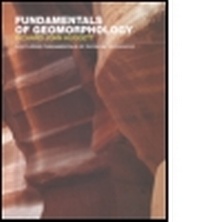
Fundamentals of Geomorphology
Published on 7. November 2002
Book
Paperback/Softback
400 pages
978-0-415-24146-5 (ISBN)
Description
This extensively revised and updated edition continues to present an engaging and comprehensive introduction to the subject, exploring the world's landforms from a broad systems perspective. It reflects on the latest developments in the field and includes new chapters on geomorphic materials and processes, hillslopes and changing landscapes.
Fundamentals of Geomorphology is an engaging and comprehensive introduction. Starting with a consideration of the nature of geomorphology and the geomorphic system, geomorphic materials and processes, and the quest of process and historical geomorphologists, it moves on to discuss:
structure: landforms resulting from, or influenced by, the endogenic agencies of tectonic and volcanic processes, geological structures and rock types
process and form: landforms resulting from, or influenced by, the exogenic agencies of weathering, running water, flowing ice and meltwater, ground ice and frost, the wind and the sea
history: earth surface history, giving a discussion of Quaternary landforms and ancient landforms, including the origin of old plains, relict, exhumed, and stagnant landscape features and evolutionary aspects of landscape change.
Fundamentals of Geomorphology provides a stimulating and innovative perspective on the key topics and debates within the field of geomorphology. Written in an accessible and lively manner, it includes guides to further reading, chapter summaries and an extensive glossary of key terms. The book is also illustrated throughout with over 200 informative diagrams and attractive photographs, including a colour plate section.
Fundamentals of Geomorphology is an engaging and comprehensive introduction. Starting with a consideration of the nature of geomorphology and the geomorphic system, geomorphic materials and processes, and the quest of process and historical geomorphologists, it moves on to discuss:
structure: landforms resulting from, or influenced by, the endogenic agencies of tectonic and volcanic processes, geological structures and rock types
process and form: landforms resulting from, or influenced by, the exogenic agencies of weathering, running water, flowing ice and meltwater, ground ice and frost, the wind and the sea
history: earth surface history, giving a discussion of Quaternary landforms and ancient landforms, including the origin of old plains, relict, exhumed, and stagnant landscape features and evolutionary aspects of landscape change.
Fundamentals of Geomorphology provides a stimulating and innovative perspective on the key topics and debates within the field of geomorphology. Written in an accessible and lively manner, it includes guides to further reading, chapter summaries and an extensive glossary of key terms. The book is also illustrated throughout with over 200 informative diagrams and attractive photographs, including a colour plate section.
More details
Series
Language
English
Place of publication
London
United Kingdom
Publishing group
Taylor & Francis Ltd
Target group
College/higher education
Dimensions
Height: 248 mm
Width: 189 mm
Weight
885 gr
ISBN-13
978-0-415-24146-5 (9780415241465)
Copyright in bibliographic data and cover images is held by Nielsen Book Services Limited or by the publishers or by their respective licensors: all rights reserved.
Schweitzer Classification
Other editions
New editions
Richard John Huggett
Fundamentals of Geomorphology
Book
07/2007
2nd Edition
Routledge
€60.84
Article exhausted; check for reprint
Additional editions

Richard John Huggett
Fundamentals of Geomorphology
Book
11/2002
Routledge
€178.27
Article exhausted; check for reprint
Person
Richard John Huggett is a Reader in Physical Geography at the University of Manchester.
Content
Part 1: Introducing Landforms and Landscapes 1. What is Geomorphology? 2. The Geomorphic System 3. Geomorphic Materials and Processes Part 2: Structure 4. Large-Scale Tectonic and Structural Landforms 5. Small-Scale Tectonic and Structural Landforms Part 3: Process and Form 6. Weathering and Related Landforms 7. Hillslopes 8. Karst Landscapes 9. Fluvial Landscapes 10. Glacial and Glaciofluvial Landscapes 11. Periglacial Landscapes 12. Aeolian Landscapes 13. Coastal Landscapes Part 4: History 14. Quaternary Landscapes 15. Ancient Landscapes