

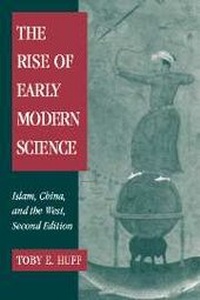
The Rise of Early Modern Science
Islam, China and the West
2nd Edition
Published on 18. August 2003
Book
Hardback
448 pages
978-0-521-82302-9 (ISBN)
Description
This 2003 study examines the long-standing question of why modern science arose only in the West and not in the civilizations of Islam and China, despite the fact that medieval Islam and China were more scientifically advanced. To explain this outcome, Tony E. Huff explores the cultural - religious, legal, philosophical, and institutional - contexts within which science was practised in Islam, China, and the West. He finds in the history of law and the European cultural revolution of the twelfth and thirteenth centuries major clues as to why the ethos of science arose in the West, permitting the breakthrough to modern science that did not occur elsewhere. This line of inquiry leads to novel ideas about the centrality of the legal concept of corporation, which is unique to the West and gave rise to the concepts of neutral space and free inquiry.
Reviews / Votes
'Huff cogently substantiates how the underlying cultural values of a society and civilization assist or check scientific inquiry, and thus discloses modern science as an intercivilizational phenomenon.' Choice '... Huff provides a thorough, coherent hypothesis and thus helps sharpen the debates on the rise of modern science.' MESA Bulletin '... Huff's comparison of Catholic Europe, Islamic Asia, and Confucian China in terms of natural philosophy and educational institutions is timely and rewarding ...'. Benjamin Elman, American Journal of Sociology '... Huff's excellent book is a comparative study of the development of these exclusive commitments within the thoughts, institutions, and beliefs about the nature of existence and of man in the West, and of the contrasting consequences of the different commitments and beliefs of Islam and China. His scope is impressive.' A. C. Crombie, Journal of Asian Studies '... provides a definitive, albeit implicit, commentary on the thesis much beloved by some theologians that the Christian doctrine of creation was responsible for the rise of modern science...casts light on the general theme of the origins of modernity ... of sustained interest and full of copious reference to primary and secondary literature ...' Religious Studies '... essential reading ...'. Scientific and Medical Network ReviewMore details
Edition
2nd Revised edition
Language
English
Place of publication
Cambridge
United Kingdom
Target group
Professional and scholarly
College/higher education
Edition type
Revised edition
Illustrations
1 Maps; 7 Halftones, unspecified; 11 Line drawings, unspecified
Dimensions
Height: 234 mm
Width: 157 mm
Thickness: 31 mm
Weight
734 gr
ISBN-13
978-0-521-82302-9 (9780521823029)
Copyright in bibliographic data and cover images is held by Nielsen Book Services Limited or by the publishers or by their respective licensors: all rights reserved.
Schweitzer Classification
Other editions
New editions
Book
06/2017
3rd Edition
Cambridge University Press
€119.50
Shipment within 15-20 days
Previous edition
Book
09/1993
Cambridge University Press
€46.43
Article exhausted; check for reprint
Person
Content
List of illustrations; New preface; Preface - 1993; Acknowledgments; Introduction; 1. The comparative study of science; 2. Arabic science and the Islamic world; 3. Reason and rationality in Islam and the West; 4. The European legal revolution; 5. Madrasas, universities, and sciences; 6. Cultural climates and the ethos of science; 7. Science and civilization in China; 8. Science and social organization in China; 9. The rise of early modern science; Epilogue: educational reform and attitudes towards science since the eighteenth century; Selected bibliography; Index.