

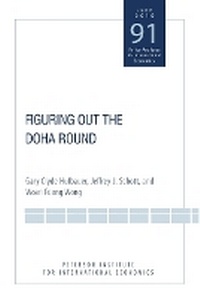
Figuring Out the Doha Round
Published on 15. June 2010
Book
Paperback/Softback
128 pages
978-0-88132-503-4 (ISBN)
Description
The global economic and financial crisis has awakened protectionist sentiments around the world, and policymakers have failed to actively seek trade liberalization. In light of this, some have proposed abandoning the Doha Round and starting over with a new agenda. Figuring Out the Doha Round argues that this is far from the time to drop the Doha Round and that it is now more important than ever to sustain political support for the rules-based multilateral trade system.
This important new study recommends modest increments in market access commitments by G-20 countries beyond tariff and subsidy cuts in agriculture and nonagricultural market access (NAMA), and policy reforms in customs procedures and related areas that slash red tape and cut transactions costs for exporting and importing goods and services. With additional effort by the G-20 countries, WTO countries can put together a Doha package that is both ambitious and balanced between the interests of developed and developing countries. The study finds that following these recommendations can lead to a world GDP gain of almost $300 billion a year.
This important new study recommends modest increments in market access commitments by G-20 countries beyond tariff and subsidy cuts in agriculture and nonagricultural market access (NAMA), and policy reforms in customs procedures and related areas that slash red tape and cut transactions costs for exporting and importing goods and services. With additional effort by the G-20 countries, WTO countries can put together a Doha package that is both ambitious and balanced between the interests of developed and developing countries. The study finds that following these recommendations can lead to a world GDP gain of almost $300 billion a year.
More details
Language
English
Place of publication
Washington
United States
Target group
Professional and scholarly
Product notice
Paperback (trade)
Dimensions
Height: 229 mm
Width: 152 mm
Thickness: 14 mm
Weight
354 gr
ISBN-13
978-0-88132-503-4 (9780881325034)
Copyright in bibliographic data and cover images is held by Nielsen Book Services Limited or by the publishers or by their respective licensors: all rights reserved.
Schweitzer Classification
Other editions
Additional editions
Gary Clyde Hufbauer | Jeffrey Schott | Woan Foong Wong
Figuring Out the Doha Round
E-Book
06/2010
Peterson Institute for International Economics
€9.49
Available for download
Persons
Gary Clyde Hufbauer, Reginald Jones Senior Fellow since 1992, was formerly the Maurice Greenberg Chair and Director of Studies at the Council on Foreign Relations (1996-98), the Marcus Wallenberg Professor of International Finance Diplomacy at Georgetown University (1985-92), senior fellow at the Institute (1981-85), deputy director of the International Law Institute at Georgetown University (1979-81); deputy assistant secretary for international trade and investment policy of the US Treasury (1977-79); and director of the international tax staff at the Treasury (1974-76).
Jeffrey J. Schott joined the Peterson Institute for International Economics in 1983 and is a senior fellow working on international trade policy and economic sanctions. During his tenure at the Institute, Schott was also a visiting lecturer at Princeton University (1994) and an adjunct professor at Georgetown University (1986-88). He was a senior associate at the Carnegie Endowment for International Peace (1982-83) and an official of the US Treasury Department (1974-82) in international trade and energy policy. During the Tokyo Round of multilateral trade negotiations, he was a member of the US delegation that negotiated the GATT Subsidies Code. Since January 2003, he has been a member of the Trade and Environment Policy Advisory Committee of the US government. He is also a member of the State Department's Advisory Committee on International Economic Policy.
A Malaysian native, Woan Foong Wong was a research analyst from July 2009 to July 2011 who worked with Senior Fellows Gary Clyde Hufbauer and Jeffrey J. Schott. Her research areas included international trade policy, foreign investments, economic growth, and development. Prior to this position, she held research assistantships at Williams College and Oberlin College with Professors Kenneth N. Kuttner and Alberto Ortiz, respectively. She also worked on policy research and advocacy at the Center for Public Policy Studies, a think tank in Malaysia.
Jeffrey J. Schott joined the Peterson Institute for International Economics in 1983 and is a senior fellow working on international trade policy and economic sanctions. During his tenure at the Institute, Schott was also a visiting lecturer at Princeton University (1994) and an adjunct professor at Georgetown University (1986-88). He was a senior associate at the Carnegie Endowment for International Peace (1982-83) and an official of the US Treasury Department (1974-82) in international trade and energy policy. During the Tokyo Round of multilateral trade negotiations, he was a member of the US delegation that negotiated the GATT Subsidies Code. Since January 2003, he has been a member of the Trade and Environment Policy Advisory Committee of the US government. He is also a member of the State Department's Advisory Committee on International Economic Policy.
A Malaysian native, Woan Foong Wong was a research analyst from July 2009 to July 2011 who worked with Senior Fellows Gary Clyde Hufbauer and Jeffrey J. Schott. Her research areas included international trade policy, foreign investments, economic growth, and development. Prior to this position, she held research assistantships at Williams College and Oberlin College with Professors Kenneth N. Kuttner and Alberto Ortiz, respectively. She also worked on policy research and advocacy at the Center for Public Policy Studies, a think tank in Malaysia.