

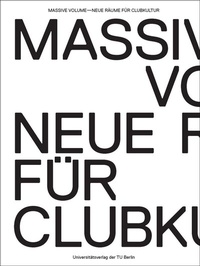
Massive Volume - Neue Räume für Clubkultur
Published on 9. May 2022
Book
155 pages
978-3-7983-3198-3 (ISBN)
Description
Die Musikszene Berlins ist eng mit der gebauten Geschichte der ehemals geteilten Stadt verbunden. Die Herausforderungen in der wachsenden Stadt - anhaltende Verdichtung, wachsendes Verwertungsinteresse, strenge Auflagen der Bauaufsicht und Konflikte mit Anwohner*innen - sind für eine Kultur, die vornehmlich in urbanen Resträumen gedeiht, immens groß. Wie kann sichergestellt werden, dass urbane Nischen für Clubkultur zukünftig bei Neubau- und Sanierungsprojekten mitgedacht werden? Welche hybriden Nutzungsformen können erarbeitet und welche architektonischen Antworten gefunden werden, um neue Veranstaltungsorte in das sozio-politische Gefüge eines Stadtteils zu integrieren? Welche Möglichkeiten stehen Architekt*innen zur Verfügung, das Spannungsverhältnis von Raum und Musik so zu beeinflussen, dass Orte eine Persönlichkeit bzw. eine Identität erhalten?Der vorliegende Band beschäftigt sich damit, wie sich Clubkultur architektonisch und städtebaulich manifestiert hat und zukünftig manifestieren kann. Neben dem historischen Überblick der Clubmigration in der Stadt Berlin werden, basierend auf städtebaulichen Analysen, urbane Prototypen definiert, die neue Fläche für Clubnutzung in der Stadt erschließen könnten. Zukünftige Themen und Szenarien einer sozial-nachhaltigen Neubauplanung werden am Beispiel architektonischer Entwürfe von Bachelor- und Master-Studierenden der TU Berlin erläutert.
The music scene in Berlin is closely linked to the built environment of this formerly divided city. The challenges of increasing densification - a burgeoning property market leading to speculation and development, strict local planning requirements, and conflicts with residents - are immense challenges for a culture that primarily thrives in residual urban spaces. How can it be ensured that urban niches for club culture are also taken into account in future construction and renovation projects? Which hybrid forms of use can be developed and what architectural answers can be found in order to integrate new clubbing locations into the socio-political structure of a neighborhood? What options are available to architects to influence the dynamic between space and music in a way that enables them to form a personality or an identity?This publication investigates how club culture has manifested itself in Berlin and how it will be able to potentially do so in the future in terms of urban planning and architecture. In addition to a historical overview of club migration in the city, an urban analysis defines spatial prototypes that allow for new areas in the city to become attractive to the music scene. Future topics and scenarios for socio-sustainable building design are investigated through architectural proposals from Bachelor and Master students of the TU Berlin.
The music scene in Berlin is closely linked to the built environment of this formerly divided city. The challenges of increasing densification - a burgeoning property market leading to speculation and development, strict local planning requirements, and conflicts with residents - are immense challenges for a culture that primarily thrives in residual urban spaces. How can it be ensured that urban niches for club culture are also taken into account in future construction and renovation projects? Which hybrid forms of use can be developed and what architectural answers can be found in order to integrate new clubbing locations into the socio-political structure of a neighborhood? What options are available to architects to influence the dynamic between space and music in a way that enables them to form a personality or an identity?This publication investigates how club culture has manifested itself in Berlin and how it will be able to potentially do so in the future in terms of urban planning and architecture. In addition to a historical overview of club migration in the city, an urban analysis defines spatial prototypes that allow for new areas in the city to become attractive to the music scene. Future topics and scenarios for socio-sustainable building design are investigated through architectural proposals from Bachelor and Master students of the TU Berlin.