

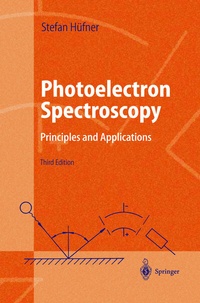
Photoelectron Spectroscopy
Principles and Applications
3rd Edition
Published on 8. April 2003
Book
Hardback
XV, 662 pages
978-3-540-41802-3 (ISBN)
Description
Photoemission spectroscopy is one of the best methods for studying the electronic structure of atoms, molecules, solids, and surfaces (interfaces). This volume gives an up-to-date introduction to this field with the emphasis on solids and surfaces. The reader will learn about the basic technique of photoemission spectroscopy and obtain the necessary background for work based on this book.
More details
Series
Edition
Third Edition 2003
Language
English
Place of publication
Berlin
Germany
Publishing group
Springer Berlin
Target group
Primary & secondary/elementary & high school
Graduate
Edition type
New edition
Illustrations
XV, 662 p.
Dimensions
Height: 241 mm
Width: 160 mm
Thickness: 42 mm
Weight
1180 gr
ISBN-13
978-3-540-41802-3 (9783540418023)
DOI
10.1007/978-3-662-09280-4
Schweitzer Classification
Other editions
Additional editions
E-Book
03/2013
3rd Edition
Springer
€106.99
Available for download
Book
12/2010
3rd Edition
Springer
€117.69
Shipment within 7-9 days
Previous edition
Book
05/1996
2nd Edition
Springer
€85.59
Article exhausted; check for reprint
Content
1. Introduction and Basic Principles.- 2. Core Levels and Final States.- 3. Charge-Excitation Final States: Satellites.- 4. Continuous Satellites and Plasmon Satellites: XPS Photoemission in Nearly Free Electron Systems.- 5. Valence Orbitals in Simple Molecules and Insulating Solids.- 6. Photoemission of Valence Electrons from Metallic Solids in the One-Electron Approximation.- 7. Band Structure and Angular-Resolved Photoelectron Spectra.- 8. Surface States, Surface Effects.- 9. Inverse Photoelectron Spectroscopy.- 10. Spin-Polarized Photoelectron Spectroscopy.- 11. Photoelectron Diffraction.- A.1 Table of Binding Energies.- A.2 Surface and Bulk Brillouin Zones of the Three Low-Index Faces of a Face-Centered Cubic (fcc) Crystal Face.- A.3 Compilation of Work Functions.- References.