

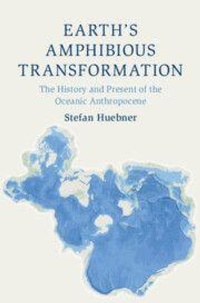
Earth's Amphibious Transformation
The History and Present of the Oceanic Anthropocene
Will be published approx. on 16. July 2026
Book
Paperback/Softback
494 pages
978-1-009-73481-3 (ISBN)
Description
In the first history of the oceanic Anthropocene, Stefan Huebner explores the twentieth-century extension of human habitats into oceanic spaces. He shows how the effects of this amphibious transformation have followed a very different trajectory from human-driven change on land, in terms of both socioeconomic development and environmental degradation. The extension of the human habitat through artificial islands such as seabed-fixed and floating structures has granted vertical access to Earth's different spatial layers, from the fossil fuels beneath the seabed to outer space. Huebner asks why this transformation occurred; how it has been shaped by political, economic, and environmental factors; and how it has altered marine environments. A deeper understanding of Earth's amphibious transformation compels us to reconsider the history and future of climate change, sea level rise, energy transitions, human-marine species interactions, globalization, and even urbanization, including floating cities. This title is also available as open access on Cambridge Core.
Reviews / Votes
'Prepare to be disoriented: this innovative, ambitious book takes us below the waves to understand the world's oceans in their full vertical complexity. Revealing the startling range and environmental impact of 'artificial islands' - from offshore oil rigs to futuristic floating homes - Stefan Huebner fundamentally shifts our perspective on the accelerating human transformation of marine space.' William M. Tsutsui, Chancellor and Professor of History, Ottawa University 'How do we think through the Anthropocene via a world ocean? We can all conjure, if not solve, the great problems of oceanic plastics and sea-level rise. Yet Huebner explains a recent history, and perhaps a near future, defined by momentous amphibious transformation. Via Southeast and East Asian waterscapes and landscapes, this compelling book sets out an earthly history in which terra and aqua become one.' Alison Bashford, Scientia Professor of History, University of New South Wales 'The ocean has long been imagined as a vast and mysterious expanse, peripheral to the terrestrial stage of human history. However, in Earth's Amphibious Transformation: History and Present of the Oceanic Anthropocene, that perception is profoundly challenged. This book invites us to reconsider the ocean not as a backdrop, but as a central actor in the unfolding drama of the Anthropocene-a period increasingly defined by the deep entanglement of human activity and Earth's ecosystem and climate. From floating airports to offshore oil platforms, from mariculture farms to floating islands, this volume traces a sweeping history of how human infrastructure has extended into, onto, and above the ocean since the mid-20th century. Through the analytical lens of Earth's amphibious transformation, the book offers both a vertical and horizontal cartography of how marine regions have become arenas of energy extraction, technological experimentation, multispecies interactions, and geopolitical ambition. Across its chapters, the book reveals how artificial islands-whether tethered to the seabed, floating freely, or extending skyward-have reshaped the dynamics of global development, environmental politics, and climate resilience. It also tells a lesser-known but crucial story of energy transitions, of the techno-utopian visions of cyberneticists and architects, and of the ecological consequences of building new human habitats across watery frontiers. More than an account of technological change, Earth's Amphibious Transformation is a call for a paradigm shift: to dislodge the land in our environmental thinking and to 'think through water.' In doing so, it opens a new frontier of understanding the Anthropocene-one that is as fluid, layered, and dynamic as the ocean itself.' C. M. Wang, School of Civil Engineering, The University of Queensland, Australia 'This strikingly original book rewrites the history of the Anthropocene from the waterline up. In the Earth's Amphibious Transformation, Stefan Huebner opens new frontiers in the history of the world's oceans, showing how offshore rigs, floating cities, mariculture, and satellite infrastructure gave form to one of the grand transformations of modern history: the extension of human life, culture, and economies into, onto, and under the sea.' Ian J. Miller, Reischauer Institute Professor of Environmental History, Harvard UniversityMore details
Series
Language
English
Place of publication
Cambridge
United Kingdom
Product notice
Paperback (trade)
Illustrations
Worked examples or Exercises
ISBN-13
978-1-009-73481-3 (9781009734813)
Copyright in bibliographic data and cover images is held by Nielsen Book Services Limited or by the publishers or by their respective licensors: all rights reserved.
Schweitzer Classification
Other editions
Additional editions
Book
approx. 07/2026
Cambridge University Press
€154.50
Not yet published
Person
Stefan Huebner is Senior Research Fellow at the National University of Singapore, President of the Society of Floating Solutions (Singapore) and Deputy Chair of the International Scientific Committee of the World Conference on Floating Solutions.
Content
1. Earth's amphibious transformation; 2. Asia's oceanic Anthropocene: how political elites and global offshore oil exploitation moved Asian marine regions into the new epoch; 3. Oceans and orbits: verticality at sea from seadromes to rocket launches and light islands; 4. Terrestrial mindsets and the origins of sea surface urbanization in Tokyo Bay; 5. Ocean-to-land globalization: communication, navigation, and Earth's production centers; 6. Environmentalisms clashing: Buckminster Fuller, floating structures, and US urban waterfronts since the late 1960s; 7. Economies and ecologies of energy generation on islands: Hawaiian metabolism's alternatives to fossil fuels; 8. Dual habitats above and below the surface: Japanese mariculture research, plastics, and the global concentration of marine biomass and nutrients; 9. The invasive threat of slowly traveling ecosystems: artificial islands and biosphere integrity in the oceanic Anthropocene; 10. A paradigm shift: Earth's amphibious transformation and the oceanic Anthropocene.