

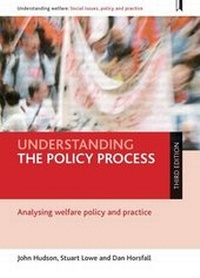
Understanding the Policy Process
Analysing Welfare Policy and Practice
Book
Hardback
304 pages
978-1-4473-2376-1 (ISBN)
Description
Fully updated to take account of the 2008 financial crisis and its aftermath, Understanding the policy process (3e) draws on the latest and best social science to explain how and why policy change occurs. Using core concepts of policy analysis in each chapter, it builds up a fully worked explanation of policy change that can be applied to any aspect of welfare policy, public and social policy.
Reviews / Votes
"I think it is the best book of its kind available for students, and I would not hesitate to recommend it." Ian Greener in Journal of Social Policy "An excellent overview - clear and well-written" Sevasti-Melissa Nolas, University of SussexMore details
Series
Edition
New edition
Language
English
Place of publication
Bristol
United Kingdom
Target group
College/higher education
Edition type
New edition
Dimensions
Height: 240 mm
Width: 172 mm
ISBN-13
978-1-4473-2376-1 (9781447323761)
Copyright in bibliographic data and cover images is held by Nielsen Book Services Limited or by the publishers or by their respective licensors: all rights reserved.
Schweitzer Classification
Other editions
Additional editions
Book
03/2009
2nd Edition
Policy Press
€40.00
Shipment within 15-20 days
E-Book
03/2009
2nd Edition
Policy Press
€47.99
Available for download
Persons
John Hudson is Professor of Social Policy at the University of York, where Stuart Lowe is Senior Lecturer in Social Policy and Dan Horsfall is Lecturer in Comparative Social Policy. Together the authors have extensive experience of teaching and researching across a wide range of social policy fields.
Content
Introduction: what is policy analysis?; Part I: Macro-Level Analysis; Globalisation; The Informational Network Society; Political Economy; New Social Risks; Part II: Meso-Level Analysis; Governance; Structures of Power & Policy Networks; Path Dependency: The Often Longue Duree of Policy; The Institutions of Government; Policy Transfer Networks; Part III: Micro-Level Analysis; Street Level Bureaucrats; Decision Making, Leadership & Personality; Policy Makers and Policy Learning; Conclusions.