

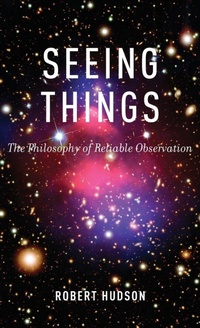
Seeing Things
The Philosophy of Reliable Observation
Published on 17. October 2013
Book
Hardback
298 pages
978-0-19-930328-1 (ISBN)
Description
In Seeing Things, Robert Hudson assesses a common way of arguing about observation reports called "robustness reasoning." Robustness reasoning claims that an observation report is more likely to be true if the report is produced by multiple, independent sources. Seeing Things argues that robustness reasoning lacks the special value it is often claimed to have. Hudson exposes key flaws in various popular philosophical defenses of robustness reasoning. This philosophical critique of robustness is extended by recounting five episodes in the history of science (from experimental microbiology, atomic theory, astrophysics and astronomy) where robustness reasoning is -- or could be claimed to have been -- used. Hudson goes on to show that none of these episodes do in fact exhibit robustness reasoning. In this way, the significance of robustness reasoning is rebutted on both philosophical and historical grounds.
But the book does more than critique robustness reasoning. It also develops a better defense of the informative value of observation reports. The book concludes by relating insights into the failure of robustness reasoning to a popular approach to scientific realism called "(theoretical) preservationism." Hudson argues that those who defend this approach to realism commit similar errors to those who advocate robustness reasoning. In turn, a new form of realism is formulated and defended. Called "methodological preservationism," it recognizes the fundamental value of naked eye observation to scientists -- and the rest of us.
But the book does more than critique robustness reasoning. It also develops a better defense of the informative value of observation reports. The book concludes by relating insights into the failure of robustness reasoning to a popular approach to scientific realism called "(theoretical) preservationism." Hudson argues that those who defend this approach to realism commit similar errors to those who advocate robustness reasoning. In turn, a new form of realism is formulated and defended. Called "methodological preservationism," it recognizes the fundamental value of naked eye observation to scientists -- and the rest of us.
Reviews / Votes
Seeing Things is the first of its kind, and for that reason alone it is a valuable contribution. More than this, however, it challenges the mainstream view of robustness. It is, therefore, an ambitious project. * Jacob Stegenga, Notre Dame Philosophical Reviews Online * This is one of the first monographs to present different accounts of robustness analysis in a unified picture. It is particularly welcome in an area of research which is dispersed over various subfields * Chiara Lisciandra, Metascience *More details
Language
English
Place of publication
New York
United States
Target group
College/higher education
Dimensions
Height: 222 mm
Width: 145 mm
Thickness: 20 mm
Weight
511 gr
ISBN-13
978-0-19-930328-1 (9780199303281)
Copyright in bibliographic data and cover images is held by Nielsen Book Services Limited or by the publishers or by their respective licensors: all rights reserved.
Schweitzer Classification
Other editions
Additional editions
E-Book
09/2013
1st Edition
OUP eBook
€46.99
Available for download
Person
Robert Hudson received his Ph.D. in the Philosophy of Science from the University of Western Ontario in 1992. He has taught at a number of universities throughout North America, and has been at the University of Saskatchewan since 2001. He works mainly in the areas of epistemology and the history and philosophy of science.
Content
Preface ; Introduction ; Chapter 1: For and Against Robustness ; The 'No-Miracle' Argument for Robustness ; Probabilistic Approaches to Robustness ; Pragmatic Approaches to Robustness ; Epistemic Independence Approaches to Robustness ; Summary ; Chapter 2: The Mesosome: a Case of Mistaken Observation ; Introducing the Mesosome: Rasmussen and Culp ; The Mesosome Experiments ; Reliable Process Reasoning ; Rasmussen's Indeterminism ; Chapter 3: The WIMP: the Value of Model-Independence ; Dark Matter and WIMPs ; DAMA's Model-Independent Approach ; Model-Dependent Approaches ; An Historical Argument Against Robustness ; Reliable Process Reasoning ; Chapter 4: Perrin's Atoms and Molecules ; Perrin's Table ; The Viscosity of Gases ; Brownian Movement: Vertical Distributions in Emulsions ; Brownian Movement: Displacement, Rotation and Diffusion of Brownian Particles Taking Stock ; Perrin's Realism about Molecules ; Chapter 5: Dark Matter and Dark Energy ; Dark Matter and the Bullet Cluster ; Type Ia Supernovae and Dark Energy ; Defeating Systematic Errors: the Smoking Gun ; Robustness in the Dark Energy Case? ; Chapter 6: Final Considerations Against Robustness ; Independence and the Core Argument ; The Need for Independence Does Not Equal the Need for Robustness The Converse to Robustness is Normally Resisted ; The Corroborating Witness: Not a Case of Robustness ; No Robustness Found in Mathematics and Logic ; Robustness Fails to Ground Representational Accuracy ; The Sociological Dimension of Robustness ; Chapter 7: Robustness and Scientific Realism ; The No-Miracle Argument for Scientific Realism ; In Support of Theoretical Preservationism ; Objections to Theoretical Preservationism ; Realism, the Pessimistic Induction and Preservationism ; The Improved Standards Response: 'Methodological Preservationism' ; Conclusion ; Appendix 1 ; Appendix 2 ; Appendix 3 ; Appendix 4 ; Bibliography ; Index