

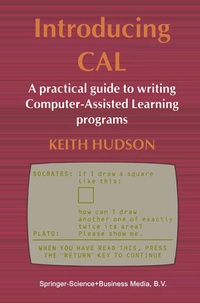
Introducing CAL
A practical guide to writing Computer-Assisted Learning programs
Published on 1. January 1984
Book
Paperback/Softback
X, 171 pages
978-0-412-26230-2 (ISBN)
Description
It is often the case - perhaps more often than not - that new ideas arrive long before there is the me ans to clothe and deli ver them. We can think ofLeonardo da Vinci's drawings of helicopters and submarines among many other examples. Computer-Assisted Learning (CAL) is an example of an idea which has had a particularly long gestation. As I will illustrate early in the book, the principles of CAL were really first discovered by Socrates. As a formal method of teaching, the Socratic method disappeared for over two millennia until the 1950s. It was then revived in the form ofProgrammed Learning (PL) which resulted from the researches ofB. F. Skinner at Harvard University. Even then, PL was premature. In the 1950s and 60s, methods were devised, such as teaching machines and various sorts ofPL text books, and there was a mushrooming of PL publishing at that time. For a complex of reason- economic, logistical and technical-PL also largely disappeared from the mid- 60s, although it continued in a few specialized areas ofteaching and industrial training. However, during the same period, PL quietly transformed itselfinto CAL. But the computerized form was not capable of mass dissemination until recently hecause personal microcomputers did not have sufficient internal memory sizes. That situation has now changed very dramatically and 128K microcomputers are becoming cheap and widely available. Cheap memory chips of256K and 1024K cannot be far away, either.
More details
Edition
Softcover reprint of the original 1st ed. 1984
Language
English
Place of publication
New York
United States
Target group
Professional and scholarly
Research
Product notice
Paperback (trade)
Unsewn / adhesive bound
Illustrations
23 s/w Abbildungen
X, 171 p. 23 illus.
Dimensions
Height: 235 mm
Width: 155 mm
Thickness: 11 mm
Weight
289 gr
ISBN-13
978-0-412-26230-2 (9780412262302)
DOI
10.1007/978-1-4899-3190-0
Schweitzer Classification
Other editions
Additional editions
E-Book
11/2013
Springer
€53.49
Available for download
Content
1 Introduction.- 2 Introductory techniques.- 3 Reinforcement.- 4 Principles of structured learning.- 5 Brain processes of learning and memory.- 6 The structure of the CAL Unit.- 7 Frame formats.- 8 Preparation, writing and testing.- 9 Publishing CAL.- Appendix 1.- An exemplary CAL Unit (Biology).- Appendix 2.- Various CAL and CBT authoring languages.- Appendix 3.- Centres of CAL activity.- References.- Recommended bibliography.- CAL section.- Brain systems section.- Tomorrow's world section.