

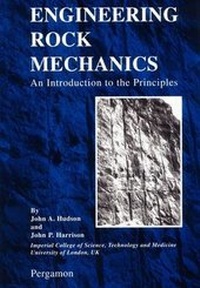
Engineering Rock Mechanics
An Introduction to the Principles
Published on 12. June 2000
Book
Paperback/Softback
456 pages
978-0-08-043864-1 (ISBN)
Description
Engineering rock mechanics is the discipline used to design structures built in rock. These structures encompass building foundations, dams, slopes, shafts, tunnels, caverns, hydroelectric schemes, mines, radioactive waste repositories and geothermal energy projects: in short, any structure built on or in a rock mass. Despite the variety of projects that use rock engineering, the principles remain the same. Engineering Rock Mechanics clearly and systematically explains the key principles behind rock engineering. The book covers the basic rock mechanics principles; how to study the interactions between these principles and a discussion on the fundamentals of excavation and support and the application of these in the design of surface and underground structures. Engineering Rock Mechanics is recommended as an across-the-board source of information for the benefit of anyone involved in rock mechanics and rock engineering.
Reviews / Votes
"...this book is very good work tool in the understanding of the Engineering Rock Mechanics from the undergraduate and graduate points of view, because the easy on going terminology makes fruitful the reading for any public." --FABIO ANTONIO GIL ESCOBAR SPECIAL GRADUATE COURSE DEPARTMENT OF GEOSCIENCE FACULTY OF SCIENCE AND ENGINEERING SHIMANE UNIVERSITY JAPANMore details
Language
English
Place of publication
Oxford
United Kingdom
Publishing group
Elsevier Science & Technology
Target group
College/higher education
Professional and scholarly
Geologists, civil and geotechnical engineers
Dimensions
Height: 240 mm
Width: 165 mm
Weight
820 gr
ISBN-13
978-0-08-043864-1 (9780080438641)
Copyright in bibliographic data and cover images is held by Nielsen Book Services Limited or by the publishers or by their respective licensors: all rights reserved.
Schweitzer Classification
Other editions
Additional editions
E-Book
06/2000
3rd Edition
Elsevier
€58.95
Available for download
Content
Preface
Introduction
Geological Setting
Stress
In situ Stress
Strain
Intact Rock
Discontinuities
Rock Masses
Permeability
Anisotropy and Inhomogeneity
Testing Techniques
Rock Mass Classification
Rock Dynamics and Time Dependent Aspects
Rock Mechanics Interactions and Rock Engineering Systems (RES)
Excavation Principles
Stabilization Principles
Surface Excavation Instability Mechanisms
Design and Snalysis of Surface Excavations Underground Excavation Instability Mechanisms Design and Analysis of Underground Excavations References
Appendices
Index
Introduction
Geological Setting
Stress
In situ Stress
Strain
Intact Rock
Discontinuities
Rock Masses
Permeability
Anisotropy and Inhomogeneity
Testing Techniques
Rock Mass Classification
Rock Dynamics and Time Dependent Aspects
Rock Mechanics Interactions and Rock Engineering Systems (RES)
Excavation Principles
Stabilization Principles
Surface Excavation Instability Mechanisms
Design and Snalysis of Surface Excavations Underground Excavation Instability Mechanisms Design and Analysis of Underground Excavations References
Appendices
Index