

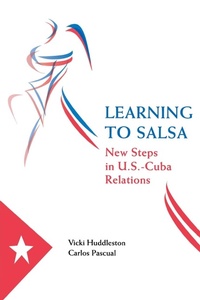
Learning to Salsa
New Steps in U.S.-Cuba Relations
Published on 23. February 2010
Book
Paperback/Softback
264 pages
978-0-8157-0389-1 (ISBN)
Description
Today the United States has little leverage to promote change in Cuba. Indeed, Cuba enjoys normal relations with virtually every country in the world, and American attempts to isolate the Cuban government have served only to elevate its symbolic predicament as an ""underdog"" in the international arena. A new policy of engagement toward Cuba is long overdue. ?From the Introduction
As longtime U.S. diplomats Vicki Huddleston and Carlos Pascual make painfully clear in their introduction, the United States is long overdue in rethinking its policy toward Cuba. This is a propitious time for such an undertaking?the combination of change within Cuba and in the Cuban American community creates the most significant opening for a reassessment of U.S. policy since Fidel Castro took control in 1959. To that end, Huddleston and Pascual convened opinion leaders in the Cuban American community, leading scholars, and international diplomats from diverse backgrounds and political orientations to seek common ground on U.S. policy toward Cuba. This pithy yet authoritative analysis is the result.
In the quest for ideas that would support the emergence of a peaceful, prosperous, and democratic Cuba?one in which the Cuban people shape their political and economic future?the authors conducted a series of simulations to identify the critical factors that the U.S. government should consider as it reformulates its Cuba policies. The advisers' wide-ranging expertise was applied to a series of hypothetical scenarios in which participants tested how different U.S. policy responses would affect a political transition in Cuba.
By modeling and analyzing the decisionmaking processes of the various strategic actors and stakeholders, the simulations identified factors that might influence the success or failure of specific policy options. They then projected how key actors such as the Cuban hierarchy, civil society, and the international and Cuban American communities might act and react to internal and external events that would logically be expected to occur in the near future.
The lessons drawn from these simulations led to the unanimous conclusion that the United States should adopt a proactive policy of critical and constructive engagement toward Cuba.
As longtime U.S. diplomats Vicki Huddleston and Carlos Pascual make painfully clear in their introduction, the United States is long overdue in rethinking its policy toward Cuba. This is a propitious time for such an undertaking?the combination of change within Cuba and in the Cuban American community creates the most significant opening for a reassessment of U.S. policy since Fidel Castro took control in 1959. To that end, Huddleston and Pascual convened opinion leaders in the Cuban American community, leading scholars, and international diplomats from diverse backgrounds and political orientations to seek common ground on U.S. policy toward Cuba. This pithy yet authoritative analysis is the result.
In the quest for ideas that would support the emergence of a peaceful, prosperous, and democratic Cuba?one in which the Cuban people shape their political and economic future?the authors conducted a series of simulations to identify the critical factors that the U.S. government should consider as it reformulates its Cuba policies. The advisers' wide-ranging expertise was applied to a series of hypothetical scenarios in which participants tested how different U.S. policy responses would affect a political transition in Cuba.
By modeling and analyzing the decisionmaking processes of the various strategic actors and stakeholders, the simulations identified factors that might influence the success or failure of specific policy options. They then projected how key actors such as the Cuban hierarchy, civil society, and the international and Cuban American communities might act and react to internal and external events that would logically be expected to occur in the near future.
The lessons drawn from these simulations led to the unanimous conclusion that the United States should adopt a proactive policy of critical and constructive engagement toward Cuba.
Reviews / Votes
"Through this project, Huddleston and Pascual present a pragmatic policy strategyfor U.S. relations with Cuba. They put forth a well-grounded road map for effective
engagement that would improve our ability to broadly advance U.S. interests, from
human rights to security and commercial opportunities. This book is excellent
reading for policymakers, analysts, practitioners, and students of U.S.-Cuba affairs." -Sen. Richard G. Lugar of Indiana, Ranking Member of the U.S. Senate Committee on Foreign Relations
|"A thought-provoking, timely, and original contribution from two of America's
most impressive public servants and foreign policy practitioners. Our nation has
an opportunity to reassess and reshape our policy toward Cuba. In this engaging,
forward-looking book, Vicki Huddleston and Carlos Pascual show us how." -Thomas "Mack" McLarty, White House Special Envoy for the Americas, 1996-98
|"Stemming from a highly creative, original -and yet rigorous -methodology, this
book provides a practical blueprint for a new U.S. policy of engagement toward
Cuba. If adopted on the terms suggested by Pascual and Huddleston, that policy
would serve both the interests of the Cuban people and American diplomacy; as
a bonus it would also remove a traditional cause of uneasiness in the relationship
between the U.S. and many of the other Latin American republics." -Ernesto Zedillo, Director, Yale Center for the Study of Globalization,
and President of Mexico, 1994-2000
|"Somehow, to the amazement of all involved, the Right, the Left, and the Center
came to the Brookings table to forge a road map out of the fifty-year quicksand
bog of U.S.-Cuba relations. Just how Carlos Pascual and Vicki Huddleston
assembled us all remains a mystery, but the result is an undeniable breakthrough:
a concrete, pragmatic blueprint for a future with Cuba in which the United States
recuses itself from its role as the Castros' Goliath, while averting an even worse
outcome: irrelevancy. Hallelulah.... Adelante!" -Annie Bardach, University of California-Berkeley and author of Without Fidel:
A Death Foretold in Miami, Havana, and Washington
More details
Language
English
Place of publication
United States
Publishing group
Bloomsbury Publishing Plc
Target group
Professional and scholarly
Dimensions
Height: 229 mm
Width: 152 mm
Thickness: 16 mm
Weight
434 gr
ISBN-13
978-0-8157-0389-1 (9780815703891)
Copyright in bibliographic data and cover images is held by Nielsen Book Services Limited or by the publishers or by their respective licensors: all rights reserved.
Schweitzer Classification
Other editions
Additional editions
E-Book
08/2010
1st Edition
Brookings Institution
€26.99
Available for download
Persons
Vicki Huddleston is U.S. deputy assistant secretary of defense for Africa. Before taking this post, she was codirector of the Brookings Project on U.S. Policy toward Cuba in Transition, 2007?09. A veteran diplomat, she was head of the U.S. mission in Cuba from 1999 to 2002.Carlos Pascual, now U.S. ambassador to Mexico, was vice president and director of foreign policy at Brookings Institution, 2006?09. He also has served as U.S. ambassador to Ukraine and is coauthor of Power and Responsibility: Building International Order in an Era of Transnational Threat (Brookings, 2009).