

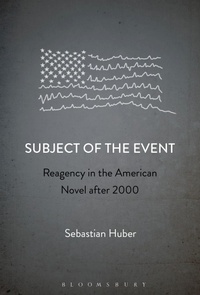
Subject of the Event
Reagency in the American Novel after 2000
Published on 5. May 2016
Book
Hardback
328 pages
978-1-5013-1712-5 (ISBN)
Description
What does falling in love have in common with the fall of the Berlin Wall? Or the fall of the Twin Towers?
In the light of postmodernism's programmatic critique of a humanist notion of the subject and an emphatic understanding of events, Subject of the Event shows that selected American novels after 2000 offer an alternative to the "death of the subject."
As the first book to comprehensively engage with Alain Badiou's writings outside of a philosophical context, Subject of the Event analyzes five critically acclaimed novels of the new millennium-Cormac McCarthy's The Road (2006), Jess Walter's The Zero (2006), Mark Z. Danielewski's Only Revolutions (2006), Paul Beatty's Slumberland (2008) and Thomas Pynchon's Against the Day (2006)-and argues that they create different 'subjects of the event' that are empowered with "reagency." The "subject of the event" and its empowerment, what this book calls "reagency," implies that subjects only evolve out of their confrontation with the revolutionary impetus that events propel. Unlike a humanist capability of having agency, reagency is defined as a repetitive subjective praxis that is contingent upon events, which is given a concrete literary form in the novels under investigation. Sebastian Huber explores how the American penchant for events ("new beginnings," "clean slates," "apocalypse") is being critically dealt with in the novels at hand, while still offering an emphatic idea of singular disruptions that open up ways for subjects to affirm and become empowered by the new propositions of these happenings.
In the light of postmodernism's programmatic critique of a humanist notion of the subject and an emphatic understanding of events, Subject of the Event shows that selected American novels after 2000 offer an alternative to the "death of the subject."
As the first book to comprehensively engage with Alain Badiou's writings outside of a philosophical context, Subject of the Event analyzes five critically acclaimed novels of the new millennium-Cormac McCarthy's The Road (2006), Jess Walter's The Zero (2006), Mark Z. Danielewski's Only Revolutions (2006), Paul Beatty's Slumberland (2008) and Thomas Pynchon's Against the Day (2006)-and argues that they create different 'subjects of the event' that are empowered with "reagency." The "subject of the event" and its empowerment, what this book calls "reagency," implies that subjects only evolve out of their confrontation with the revolutionary impetus that events propel. Unlike a humanist capability of having agency, reagency is defined as a repetitive subjective praxis that is contingent upon events, which is given a concrete literary form in the novels under investigation. Sebastian Huber explores how the American penchant for events ("new beginnings," "clean slates," "apocalypse") is being critically dealt with in the novels at hand, while still offering an emphatic idea of singular disruptions that open up ways for subjects to affirm and become empowered by the new propositions of these happenings.
Reviews / Votes
Drawing on Alain Badiou's notion of 'the subject of the event,' Huber leads the way out of a conceptual deadlock that has informed much of contemporary literary studies. Having less agency than the premodern 'subject-supposed-to-be-autonomous,' but more agency than the postmodern subject 'supposed-to-be-a-victim-of-discursive-circumstance,' the 'subject of the event' allows to think a precarious, invariably site- and time-specific subjectivity that is not either active or passive, but active and passive simultaneously. In a number of brilliantly provocative readings of contemporary American fiction, Huber asks what it means for this new subject - or should I simply say 'us'? - to be 'faithful' or also 'unfaithful' to the event. What ultimately drives the book's argument is Badiou's equally pressing and acute question of 'how are we to be faithful to changing the world within the world itself?' On this background, Huber's book promises to become itself somewhat of an event. * Hanjo Berressem, Professor of American Studies, University of Cologne, Germany * Philosophically rich and packed with ingenious readings, Sebastian Huber's Subject of the Event: Reagency in the American Novel after 2000 is a fresh and exciting intervention in philosophical literary criticism. Indeed, while we may have been told that 'the era of Theory is over,' rumours of its death remain greatly exaggerated. Focusing on Badiou's notion of the 'event' and its complicated interactions with contemporary American fiction, Huber's book demonstrates that there is still gold to be mined at the intersection of philosophy and literature. * Martin Paul Eve, Senior Lecturer in Literature, Technology and Publishing at Birkbeck, University of London, UK * Using Alain Badiou's philosophy, Huber defines events as nonontological, contingent, and singular ruptures. By analyzing Cormac McCarthy's The Road (2006), JessWalter's The Zero (2006), Mark Z. Danielewski's Only Revolutions (2006), Paul Beatty's Slumberland (2008), and Thomas Pynchon's Against the Day (2006), he argues that events and subjects are two phenomena that are "inherently reciprocal." America as a concept is fundamentally associated with emphatic events, according to Huber. His goal is to employ a theoretical approach that opposes poststructuralism and postmodernism, while also avoiding the traditional humanist conception of the subject. * American Literature *More details
Language
English
Place of publication
New York
United States
Publishing group
Bloomsbury Publishing Plc
Target group
College/higher education
Dimensions
Height: 235 mm
Width: 157 mm
Thickness: 22 mm
Weight
627 gr
ISBN-13
978-1-5013-1712-5 (9781501317125)
Copyright in bibliographic data and cover images is held by Nielsen Book Services Limited or by the publishers or by their respective licensors: all rights reserved.
Schweitzer Classification
Other editions
Additional editions
E-Book
05/2016
1st Edition
Bloomsbury Academic USA
€40.49
Available for download
Person
Sebastian Huber is Lecturer for English at the Fresenius University, Munich, Germany.
Content
Acknowledgements
List of Abbreviations
Introduction: America's Subjects of Events
Chapter 1. The Question of the Event and the Question(s) of the Subject
Chapter 2. 'You have to carry the fire': The Reactive Subject in Cormac McCarthy's The Road (2006)
Chapter 3. 'With Us or Against Us': The Obscure Subject in Jess Walter's The Zero (2006)
Chapter 4. 'Let us go then you and I': The Amorous Subject in Mark Z. Danielewski's Only Revolutions (2006)
Chapter 5. 'You'll never be passe': The Aesthetico-Political Subject in Paul Beatty's Slumberland (2008)
Chapter 6. 'There is nothing to compare it to now': The Scientific-Political Subjects in Thomas Pynchon's Against the Day (2006)
Conclusion: The End as Enjambment
Notes
Bibliography
Index
List of Abbreviations
Introduction: America's Subjects of Events
Chapter 1. The Question of the Event and the Question(s) of the Subject
Chapter 2. 'You have to carry the fire': The Reactive Subject in Cormac McCarthy's The Road (2006)
Chapter 3. 'With Us or Against Us': The Obscure Subject in Jess Walter's The Zero (2006)
Chapter 4. 'Let us go then you and I': The Amorous Subject in Mark Z. Danielewski's Only Revolutions (2006)
Chapter 5. 'You'll never be passe': The Aesthetico-Political Subject in Paul Beatty's Slumberland (2008)
Chapter 6. 'There is nothing to compare it to now': The Scientific-Political Subjects in Thomas Pynchon's Against the Day (2006)
Conclusion: The End as Enjambment
Notes
Bibliography
Index