

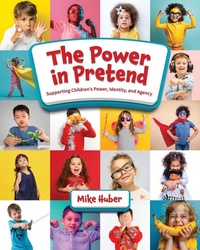
The Power in Pretend
Description
Ranging from princess play to gun play, The Power in Pretend questions and sheds light on the ways children play with ideas of power. Children’s play often tells a story of power through the roles they choose to play: exercising power over, power with, or power for peers, adults, or phenomena from the wider world. Allowing and supporting these types of play, even when they may make adults uncomfortable, is key to fostering children’s identity and agency.
Find practical strategies for adults in early childhood settings to support this sense of power in pretend play and in real ways. The book draws on an updated understanding of gender expression, as well as a nuanced approach to consent, and includes a contemporary understanding of the development of executive function skills and their impact on young children’s behaviors. It also considers cultural influences on children’s play and adults’ reactions, as well as how peer interactions and play may be affected by differences among children.
More details
Person
Content
Introduction
Understanding from the Outside
Othering Gun Play
Exploring Power
Power Play
Chapter One: Power
Agency
Self-Efficacy
Self-Regulation
Connection
Chapter Two: Imagination
Mental Imagery
Perspective Taking
Flow State
Imagination and Power
Chapter Three: Identity
Cultural Identity and Power
The Case Study of Q and A
Gender Schema and Gender Norms
Own-Gender Schema and Gender Expression
Chapter Four: Peers Sharing Power
We Listen to Our Bodies
We Check In with Each Other
We Get Permission
We Accept No
We Can Say No
We Are in Charge of Our Bodies
We Share Space
Chapter Five: Adults and Children
Participating in Decision-Making
Participating in Caring for the Community
Sense of Ownership and Power
Chapter Six: Your Own Power
Your Agency
Your Self-Effi cacy
Your Self-Regulation
Your Connection to Others
References