

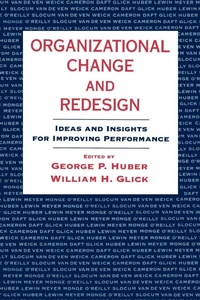
Organizational Change and Redesign
Ideas and Insights for Improving Performance
Published on 28. March 1996
Book
Paperback/Softback
464 pages
978-0-19-510115-7 (ISBN)
Description
This book is the culmination of four years of the coordinated research of twelve business professors in management and organizational science. Their studies were directed at increasing an understanding of the relationships among organizational change, redesign, and performance. The book deals with the way in which organizational performance is affected by changes in the organization's environment, strategy, structure, and leadership, and how managerial effectiveness is influenced by managerial demographics, team structure, and communication processes. This book represents some of the finest authors currently working in the area of organizational change and performance.
Reviews / Votes
"This book takes the topic of organizational change to a new plateau; and, with the wealth of empirical data and conceptual insights offered, the new view is expansive and enlightening. With cutting-edge contributions by some of the leading thinkers on strategic change, the Huber and Glick volume will be exceedingly valuable for executives and management scholars alike."--Donald Hambrick, Columbia University "Simultaneously intellectually challengingand practically relevant."--Mary Ann Von Glinow, Florida International University
"This book on organizational change and redesign is very timely for today's successful manager...The material in the book is quite comprehensive, and contributes extensively to research in the area of organizational redesign. It is definitely a book not to be missed by academics."--Journal of Product Innovation Management
"All the chapters are solid contributions, while several are outstanding. There is much to praise in this anthology."--Choice
"This book focuses on an extremely important topic. The contents emphasize cutting edge issues regarding organizational change and redesign. The articles are largely based on empirical research and are authored by an excellent set of scholars. It should make major contributions to management theory and practice in the design and implementation of major organizational change."--Michael A. Hitt, Texas A&M University
"This book takes the topic of organizational change to a new plateau; and, with the wealth of empirical data and conceptual insights offered, the new view is expansive and enlightening. With cutting-edge contributions by some of the leading thinkers on strategic change, the Huber and Glick volume will be exceedingly valuable for executives and management scholars alike."--Donald C. Hambrick, Columbia University
"This is a major work. I would encourage scholars and mindful executives to thoughtfully read this book. Professors Huber and Glick have offered us a current; more importantly a stimulating and insightful, program of research through the eyes and works of influential scholars."--L.L. Cummings, University of Minnesota
"An outstanding compilation of research on change and a sterling contribution to the organizational change literature. In depth and comprehensive analyses of change in many organizations. A must read for scholars and managers."--Karlene Roberts, University of California, Berkeley
"Huber and Glick assembled a group of distinguished organizational scholars to ponder the future of post-industrial organizations and in this light, rethink our theories of organizational design and change. The result is impresive testimony of the power of theory to inform practice. Students and stewarts of organizations alike are well-served by this timely and important book."--James P. Walsh, University of Michigan
"The taproot of our discipline is organizational design. Weber developed the theory of bureaucracy to describe the structure of emerging "modern" organizations. Today we are witnessing an equally dramatic change in the shape and form of our organizational landscape. Ironically, as our opportunity as organizational scientists to influence the shape of this transformation is peaking our collective interest in the subject of organizational design is waning. The
intellectual tools required to understand emerging post-bureaucracy organizational forms have grown rust from neglect. This book represents an important effort to redress that neglect by prodding us to
rediscover our roots."--David Whetten, University of Illinois at Urbana-Champaign
"For several years, I've watched this group of organizational scientists huddle at various professional association meetings--ostensibly to produce a product on organizational change. The wait has been worth it. George Huber and Bill Glick's group has produced a book simultaneously intellectually challenging and practically relevant. This book will direct the efforts of scholars and practitioners as they wrestle with the overwhelming speed of change, as we move
toward a globalized, boundaryless future."--Mary Ann Von Glinow, University of Southern California
"This book contains the best information available for designing postindustrial organizations."--National Productivity Review
More details
Language
English
Place of publication
New York
United States
Target group
Professional and scholarly
Illustrations
line figures, tables
Dimensions
Height: 234 mm
Width: 156 mm
Thickness: 25 mm
Weight
705 gr
ISBN-13
978-0-19-510115-7 (9780195101157)
Copyright in bibliographic data and cover images is held by Nielsen Book Services Limited or by the publishers or by their respective licensors: all rights reserved.
Schweitzer Classification
Other editions
Additional editions
George P. Huber | William H. Glick
Organizational Change and Redesign
Ideas and Insights for Improving Performance
Book
11/1993
Oxford University Press
€62.50
Shipment within 15-20 days
Persons
Editor
Charles and Elizabeth Prothro Regents Chair in Business Administration, and Professor of Management, Graduate School of Business AdministrationCharles and Elizabeth Prothro Regents Chair in Business Administration, and Professor of Management, Graduate School of Business Administration
Associate Professor of ManagementAssociate Professor of Management, both at University of Texas, Austin
Content
Contributors
1: Sources and Forms of Organizational Change
Part I: The Challenge of Change
2: Kim S. Cameron, Sarah J. Freeman, and Aneil K. Mishra: Downsizing and Redesigning Organizations
3: Alan D. Meyer, James B. Goes, and Geoffrey R. Brooks: Organizations Reacting to Hyperturbulence
4: Richard L. Daft, Kenneth R. Bettenhausen, and Beverly B. Tyler: Implications of Top Managers' Communication Choices for Strategic Decisions
5: Charles A. O'Reilly III, et al.: Effects of Executive Team Demography on Organizational Change
6: William H. Glick, C. Chet Miller, and George P. Huber: The Impact of Upper-Echelon Diversity on Organizational Performance
7: George P. Huber, et al.: Understanding and Predicting Organizational Change
Part II: Redesigning Organizations
8: Andrew H. Van de Ven: Managing the Process of Organizational Innovation
9: John W. Slocum, Jr. and David Lei: Designing Global Strategic Alliances: Integrating Cultural and Economic Factors
10: Peter R. Monge: (Re)Designing Dynamic Organizations
11: Karl E. Weick: Organizational Redesign As Improvisation
Part III: Conclusion
12: What Was Learned About Organizational Change and Redesign
Arie Y. Levin and Carroll U. Stephens: Epilogue Designing Postindustrial Organizations: Combining Theory and Practice
William H. Glick, et al.: Appendix Studying Changes in Organizational Design and Effectiveness: Retrospective Even Histories and Periodic Assessments
Name Index
Subject Index
1: Sources and Forms of Organizational Change
Part I: The Challenge of Change
2: Kim S. Cameron, Sarah J. Freeman, and Aneil K. Mishra: Downsizing and Redesigning Organizations
3: Alan D. Meyer, James B. Goes, and Geoffrey R. Brooks: Organizations Reacting to Hyperturbulence
4: Richard L. Daft, Kenneth R. Bettenhausen, and Beverly B. Tyler: Implications of Top Managers' Communication Choices for Strategic Decisions
5: Charles A. O'Reilly III, et al.: Effects of Executive Team Demography on Organizational Change
6: William H. Glick, C. Chet Miller, and George P. Huber: The Impact of Upper-Echelon Diversity on Organizational Performance
7: George P. Huber, et al.: Understanding and Predicting Organizational Change
Part II: Redesigning Organizations
8: Andrew H. Van de Ven: Managing the Process of Organizational Innovation
9: John W. Slocum, Jr. and David Lei: Designing Global Strategic Alliances: Integrating Cultural and Economic Factors
10: Peter R. Monge: (Re)Designing Dynamic Organizations
11: Karl E. Weick: Organizational Redesign As Improvisation
Part III: Conclusion
12: What Was Learned About Organizational Change and Redesign
Arie Y. Levin and Carroll U. Stephens: Epilogue Designing Postindustrial Organizations: Combining Theory and Practice
William H. Glick, et al.: Appendix Studying Changes in Organizational Design and Effectiveness: Retrospective Even Histories and Periodic Assessments
Name Index
Subject Index