

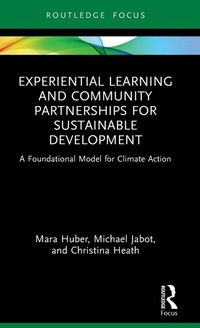
Experiential Learning and Community Partnerships for Sustainable Development
A Foundational Model for Climate Action
1st Edition
Published on 19. August 2024
Book
Hardback
142 pages
978-1-032-74171-0 (ISBN)
Description
This book addresses the growing demand for applied experiences that move students beyond learning into the realm of doing by supporting the development of skills and competencies that align with emerging areas of innovation and work. It considers the urgent need to promote and invest in skills that support sustainable development, such as those needed to analyze and mitigate climate change. The authors argue that this challenge provides an opportunity to reimagine the use of Experiential Learning, connecting students with community-based partners doing the work of sustainable development around the world. Featuring compelling case studies of project partners in Nigeria, Uganda, and Tanzania working to address the complexities of climate change, they offer a practical model for implementing Experiential Learning that can be translated and scaled across sectors and resource environments. It is aimed at scholars and educators working across higher education and international education with interests in digital and experiential education.
Reviews / Votes
"The tremendous value of the approach laid out in Experiential Learning and Community Partnerships for Sustainable Development is that it gives students the opportunity to experience their own power and agency to impact the world in a positive way."Sally Crimmins Villela, Associate Vice Chancellor for Global Affairs and Senior International Officer, The State University of New York
"Experiential Learning and Community Partnerships for Sustainable Development is a treasure. It's like a handbook for lost students like me. If only I had this in my freshman year."
Muhammed Moinuddin, Mechanical Engineering student, University at Buffalo
More details
Series
Language
English
Place of publication
London
United Kingdom
Publishing group
Taylor & Francis Ltd
Target group
College/higher education
Professional and scholarly
Academic and Postgraduate
Illustrations
3 s/w Zeichnungen, 3 s/w Abbildungen
3 Line drawings, black and white; 3 Illustrations, black and white
Dimensions
Height: 222 mm
Width: 145 mm
Thickness: 12 mm
Weight
339 gr
ISBN-13
978-1-032-74171-0 (9781032741710)
Copyright in bibliographic data and cover images is held by Nielsen Book Services Limited or by the publishers or by their respective licensors: all rights reserved.
Schweitzer Classification
Other editions
Additional editions
Mara Huber | Michael Jabot | Christina Heath
Experiential Learning and Community Partnerships for Sustainable Development
A Foundational Model for Climate Action
Book
12/2025
1st Edition
Routledge
€33.70
Shipment within 10-20 days
Mara Huber | Michael Jabot | Christina Heath
Experiential Learning and Community Partnerships for Sustainable Development
A Foundational Model for Climate Action
E-Book
08/2024
1st Edition
Routledge
€27.49
Available for download
Mara Huber | Michael Jabot | Christina Heath
Experiential Learning and Community Partnerships for Sustainable Development
A Foundational Model for Climate Action
E-Book
08/2024
1st Edition
Routledge
€27.49
Available for download
Persons
Mara Huber is Senior Director of Instructional Innovation and Transformation at the University at Buffalo Office of Curriculum, Assessment and Teaching Transformation (CATT).
Michael Jabot is SUNY Distinguished Professor of Science Education at the State University of New York at Fredonia, USA.
Christina Heath is Administrative Director of the Experiential Learning Network, University at Buffalo, USA.
Michael Jabot is SUNY Distinguished Professor of Science Education at the State University of New York at Fredonia, USA.
Christina Heath is Administrative Director of the Experiential Learning Network, University at Buffalo, USA.
Content
Part I: Expecting More from Experiential Learning
1. A Case for Project Challenges
2. Activating the Sustainable Development Goals (SDGs)
3. Community-Based Partners 4. Mentors, Teachers, and Content Experts
Part II: A Scalable Model
5. Creating a Project Portal
6. PEARL Engagement Framework
7. Leveraging Digital Badges
8. Curricular Versatility
Part III: Partners, Projects, and Students
9. Empowering Women Farmers in Uganda
10. Addressing Vulnerability with Community Technologies in Tanzania
11. Youth Engagement in Nakivale Refugee Settlement, Uganda
12. Transforming Basic Education in Enugu Nigeria
13. Featured Partners and their Engagement with the SDGs
Part IV: Synergies and Broader Impacts
14. STEM Education and Global Climate Change
15. Geospatial Technologies and Open Science
16. NASA Globe and the Sustainable Development Goals
17. Ecorestoration and Regenerative Agriculture
Epilogue: Putting our Partners on the Map
Appendix: Featured Technology-Supported Tools and Resources
1. A Case for Project Challenges
2. Activating the Sustainable Development Goals (SDGs)
3. Community-Based Partners 4. Mentors, Teachers, and Content Experts
Part II: A Scalable Model
5. Creating a Project Portal
6. PEARL Engagement Framework
7. Leveraging Digital Badges
8. Curricular Versatility
Part III: Partners, Projects, and Students
9. Empowering Women Farmers in Uganda
10. Addressing Vulnerability with Community Technologies in Tanzania
11. Youth Engagement in Nakivale Refugee Settlement, Uganda
12. Transforming Basic Education in Enugu Nigeria
13. Featured Partners and their Engagement with the SDGs
Part IV: Synergies and Broader Impacts
14. STEM Education and Global Climate Change
15. Geospatial Technologies and Open Science
16. NASA Globe and the Sustainable Development Goals
17. Ecorestoration and Regenerative Agriculture
Epilogue: Putting our Partners on the Map
Appendix: Featured Technology-Supported Tools and Resources