

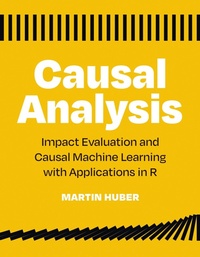
Causal Analysis
Impact Evaluation and Causal Machine Learning with Applications in R
Published on 1. August 2023
Book
Paperback/Softback
336 pages
978-0-262-54591-4 (ISBN)
Description
A comprehensive and cutting-edge introduction to quantitative methods of causal analysis, including new trends in machine learning.
Reasoning about cause and effect—the consequence of doing one thing versus another—is an integral part of our lives as human beings. In an increasingly digital and data-driven economy, the importance of sophisticated causal analysis only deepens. Presenting the most important quantitative methods for evaluating causal effects, this textbook provides graduate students and researchers with a clear and comprehensive introduction to the causal analysis of empirical data. Martin Huber’s accessible approach highlights the intuition and motivation behind various methods while also providing formal discussions of key concepts using statistical notation. Causal Analysis covers several methodological developments not covered in other texts, including new trends in machine learning, the evaluation of interaction or interference effects, and recent research designs such as bunching or kink designs.
Reasoning about cause and effect—the consequence of doing one thing versus another—is an integral part of our lives as human beings. In an increasingly digital and data-driven economy, the importance of sophisticated causal analysis only deepens. Presenting the most important quantitative methods for evaluating causal effects, this textbook provides graduate students and researchers with a clear and comprehensive introduction to the causal analysis of empirical data. Martin Huber’s accessible approach highlights the intuition and motivation behind various methods while also providing formal discussions of key concepts using statistical notation. Causal Analysis covers several methodological developments not covered in other texts, including new trends in machine learning, the evaluation of interaction or interference effects, and recent research designs such as bunching or kink designs.
- Most complete and cutting-edge introduction to causal analysis, including causal machine learning
- Clean presentation of rigorous material avoids extraneous detail and emphasizes conceptual analogies over statistical notation
- Supplies a range of applications and practical examples using R
More details
Language
English
Place of publication
Cambridge (Massachusetts)
United States
Publishing group
MIT Press Ltd
Illustrations
40 BLACK AND WHITE ILLUS.
Dimensions
Height: 224 mm
Width: 175 mm
Thickness: 19 mm
Weight
620 gr
ISBN-13
978-0-262-54591-4 (9780262545914)
Copyright in bibliographic data and cover images is held by Nielsen Book Services Limited or by the publishers or by their respective licensors: all rights reserved.
Schweitzer Classification
Other editions
Additional editions
E-Book
08/2023
MIT Press
€58.99
Available for download
Person
Martin Huber is Professor of Applied Econometrics at the University of Fribourg, Switzerland, where his research comprises both methodological and applied contributions in the fields of causal analysis and policy evaluation, machine learning, statistics, econometrics, and empirical economics.
Content
1 Introduction 1
2 Causality and No Causality 11
3 Social Experiments and Linear Regression 19
4 Selection on Observables 65
5 Casual Machine Learning 137
6 Instrumental Variables 169
7 Difference-in-Differences 195
8 Synthetic Controls 219
9 Regression Discontinuity, Kink, and Bunching Designs 231
10 Partial Identification and Sensitivity Analysis 255
11 Treatment Evaluation under Interference Effects 271
12 Conclusion 285
References 287
Index 311
2 Causality and No Causality 11
3 Social Experiments and Linear Regression 19
4 Selection on Observables 65
5 Casual Machine Learning 137
6 Instrumental Variables 169
7 Difference-in-Differences 195
8 Synthetic Controls 219
9 Regression Discontinuity, Kink, and Bunching Designs 231
10 Partial Identification and Sensitivity Analysis 255
11 Treatment Evaluation under Interference Effects 271
12 Conclusion 285
References 287
Index 311