

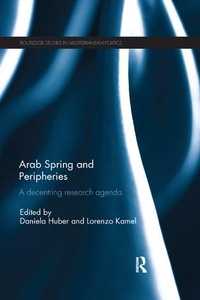
Arab Spring and Peripheries
A Decentring Research Agenda
1st Edition
Published on 18. October 2018
Book
Paperback/Softback
160 pages
978-1-138-39322-6 (ISBN)
Description
The emerging literature on the so-called 'Arab Spring' has largely focused on the evolution of the uprisings in cities and power centres. In order to reach a more diversified and inner understanding of the 'Arab Spring', this edited book examines how peripheries have reacted and contributed to the historical dynamics at work in the Middle East and North Africa. It rejects the idea that the 'Arab Spring' is a unitary process and shows that it consists of diverse Springs which differed in terms of opportunity structure, strategies of a variance of actors, and outcomes. This book looks at geographical, religious, gender and ethnical peripheries, conceptualizing periphery as a dynamic structure which can expand and contract. It shows that the seeds for changing the face of politics and polities are within peripheries themselves. Focusing on the voices of peripheries can therefore be a powerful tool to 'de-simplify' the reading of the Arab Spring and to reshape the paradigmatic schemes through which to look at this part of the world.
This book was published as a special issue of Mediterranean Politics.
This book was published as a special issue of Mediterranean Politics.
More details
Series
Language
English
Place of publication
London
United Kingdom
Publishing group
Taylor & Francis Ltd
Target group
College/higher education
Professional and scholarly
Dimensions
Height: 234 mm
Width: 156 mm
Weight
320 gr
ISBN-13
978-1-138-39322-6 (9781138393226)
Copyright in bibliographic data and cover images is held by Nielsen Book Services Limited or by the publishers or by their respective licensors: all rights reserved.
Schweitzer Classification
Other editions
Additional editions
E-Book
10/2018
Routledge
€16.99
Available for download
E-Book
10/2018
1st Edition
Routledge
€16.99
Available for download
Book
05/2016
1st Edition
Routledge
€65.79
Shipment within 10-20 days
Persons
Daniela Huber is Senior Fellow at IAI. She holds a Ph.D. from the Hebrew University of Jerusalem and an M.A. degree in International Relations from the Free University of Berlin. She has worked for the Friedrich Ebert Foundation in Tel Aviv and Berlin and as a Carlo Schmid Fellow at the United Nations in Copenhagen. Her research interests include EU and US foreign policies in the Middle East and North Africa, democracy promotion and democratization, the European neighbourhood, and Israel/Palestine.
Lorenzo Kamel is a Middle East Historian at Bologna University and a Research Fellow (2013/14 and 2014/15) at Harvard University's Center for Middle Eastern Studies. He authored four books on Middle Eastern affairs, including 'Imperial Perceptions of Palestine: British Influence and Power in Late Ottoman Times' (I.B. Tauris 2015).
Lorenzo Kamel is a Middle East Historian at Bologna University and a Research Fellow (2013/14 and 2014/15) at Harvard University's Center for Middle Eastern Studies. He authored four books on Middle Eastern affairs, including 'Imperial Perceptions of Palestine: British Influence and Power in Late Ottoman Times' (I.B. Tauris 2015).
Content
1. Arab Spring: The Role of the Peripheries. 2. Transition and Marginalisation: Locating Spaces for Discursive Contestation in Post-Revolution Tunisia. 3. The Peripheries of Gender and Sexuality in the 'Arab Spring'. 4. Plus ca change? Observing the dynamics of Morocco's 'Arab Spring' in the High Atlas. 5. Secular Autocracy vs. Sectarian Democracy? Weighing Reasons for Christian Support for Regime Transition in Syria and Egypt. 6. Territorial Stress in Morocco: From Democratic to Autonomist Demands in Popular Protests in the Rif. 7. Protests Under Occupation: The Spring Inside Western Sahara. 8. Periphery Discourse: An Alternative Media Eye on the Geographical, Social and Media Peripheries in Egypt's Spring. 9. Arab Spring: A Decentring Research Agenda.