

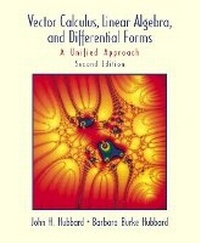
Vector Calculus, Linear Algebra, and Differential Forms
A Unified Approach
2nd Edition
Published on 6. March 2002
Book
Hardback
668 pages
978-0-13-041408-3 (ISBN)
Description
For an undergraduate course in Vector or Multivariable Calculus for math, engineering, and science majors.
Using a dual presentation that is rigorous and comprehensive-yet exceptionally student-friendly in approach-this text covers most of the standard topics in multivariate calculus and part of a standard first course in linear algebra. It focuses in underlying ideas, integrates theory and applications, offers a host of pedagogical aids, features coverage of differential forms and emphasizes numerical methods to prepare students for modern applications of mathematics.
Using a dual presentation that is rigorous and comprehensive-yet exceptionally student-friendly in approach-this text covers most of the standard topics in multivariate calculus and part of a standard first course in linear algebra. It focuses in underlying ideas, integrates theory and applications, offers a host of pedagogical aids, features coverage of differential forms and emphasizes numerical methods to prepare students for modern applications of mathematics.
More details
Edition
2nd edition
Language
English
Place of publication
United States
Publishing group
Pearson Education (US)
Target group
Professional and scholarly
Dimensions
Height: 243 mm
Width: 211 mm
Thickness: 36 mm
Weight
1520 gr
ISBN-13
978-0-13-041408-3 (9780130414083)
Copyright in bibliographic data and cover images is held by Nielsen Book Services Limited or by the publishers or by their respective licensors: all rights reserved.
Schweitzer Classification
Other editions
Previous edition

John H. Hubbard | Barbara Burke Hubbard
Vector Calculus, Linear Algebra and Differential Forms
A Unified Approach
Book
06/1999
Pearson
€44.56
Article exhausted; check for reprint
Persons
John H. Hubbard (BA Harvard University, PhD University of Paris) is professor of mathematics at Cornell University and at the University of Provence in Marseilles he is the author of several books on differential equations. His research mainly concerns complex analysis, differential equations, and dynamical systems. He believes that mathematics research and teaching are activities that enrich each other and should not be separated.
Barbara Burke Hubbard (BA Harvard University) is the author of The World According to Wavelets, which was awarded the prix d'Alembert by the French Mathematical Society in 1996.
Barbara Burke Hubbard (BA Harvard University) is the author of The World According to Wavelets, which was awarded the prix d'Alembert by the French Mathematical Society in 1996.
Content
(Note: Each chapter begins with an Introduction and ends with Review Exercises.)
0. Preliminaries.
Reading Mathematics. Quantifiers and Negation. Set Theory. Functions. Real Numbers. Infinite Sets. Complex Numbers.
1. Vectors, Matrices, and Derivatives.
Introducing the Actors: Points and Vectors. Introducing the Actors: Matrices. A Matrix as a Transformation. The Geometry of Rn. Limits and Continuity. Four Big Theorems. Differential Calculus. Rules for Computing Derivatives. Mean Value Theorem and Criteria for Differentiability.
2. Solving Equations.
The Main Algorithm: Row Reduction. Solving Equations Using Row Reduction. Matrix Inverses and Elementary Matrices. Linear Combinations, Span, and Linear Independence. Kernels, Images, and the Dimension Formula. An Introduction to Abstract Vector Spaces. Newton's Method. Superconvergence. The Inverse and Implicit Function Theorems.
3. Higher Partial Derivatives, Quadratic Forms, and Manifolds.
Manifolds. Tangent Spaces. Taylor Polynomials in Several Variables. Rules for Computing Taylor Polynomials. Quadratic Forms. Classifying Critical Points of Functions. Constrained Critical Points and Lagrange Multipliers. Geometry of Curves and Surfaces.
4. Integration.
Defining the Integral. Probability and Centers of Gravity. What Functions Can Be Integrated? Integration and Measure Zero (Optional). Fubini's Theorem and Iterated Integrals. Numerical Methods of Integration. Other Pavings. Determinants. Volumes and Determinants. The Change of Variables Formula. Lebesgue Integrals.
5. Volumes of Manifolds.
Parallelograms and Their Volumes. Parameterizations. Computing Volumes of Manifolds. Fractals and Fractional Dimension.
6. Forms and Vector Calculus.
Forms on Rn. Integrating Form Fields over Parameterized Domains. Orientation of Manifolds. Integrating Forms over Oriented Manifolds. Forms and Vector Calculus. Boundary Orientation. The Exterior Derivative. The Exterior Derivative in the Language of Vector Calculus. The Generalized Stokes's Theorem. The Integral Theorems of Vector Calculus. Potentials.
Appendix A: Some Harder Proofs.
Arithmetic of Real Numbers. Cubic and Quartic Equations. Two Extra Results in Topology. Proof of the Chain Rule. Proof of Kantorovich's Theorem. Proof of Lemma 2.8.5 (Superconvergence). Proof of Differentiability of the Inverse Function. Proof of the Implicit Function Theorem. Proof of Theorem 3.3.9: Equality of Crossed Partials. Proof of Proposition 3.3.19. Proof of Rules for Taylor Polynomials. Taylor's Theorem with Remainder. Proof of Theorem 3.5.3 (Completing Squares). Geometry of Curves and Surfaces: Proofs. Proof of the Central Limit Theorem. Proof of Fubini's Theorem. Justifying the Use of Other Pavings. Existence and Uniqueness of the Determinant. Rigorous Proof of the Change of Variables Formula. Justifying Volume 0. Lebesgue Measure and Proofs for Lebesgue Integrals. Justifying the Change of Parameterization. Computing the Exterior Derivative. The Pullback. Proof of Stokes' Theorem.
Appendix B.
MATLAB Newton Program. Monte Carlo Program. Determinant Program.
Bibliography.
Index.
0. Preliminaries.
Reading Mathematics. Quantifiers and Negation. Set Theory. Functions. Real Numbers. Infinite Sets. Complex Numbers.
1. Vectors, Matrices, and Derivatives.
Introducing the Actors: Points and Vectors. Introducing the Actors: Matrices. A Matrix as a Transformation. The Geometry of Rn. Limits and Continuity. Four Big Theorems. Differential Calculus. Rules for Computing Derivatives. Mean Value Theorem and Criteria for Differentiability.
2. Solving Equations.
The Main Algorithm: Row Reduction. Solving Equations Using Row Reduction. Matrix Inverses and Elementary Matrices. Linear Combinations, Span, and Linear Independence. Kernels, Images, and the Dimension Formula. An Introduction to Abstract Vector Spaces. Newton's Method. Superconvergence. The Inverse and Implicit Function Theorems.
3. Higher Partial Derivatives, Quadratic Forms, and Manifolds.
Manifolds. Tangent Spaces. Taylor Polynomials in Several Variables. Rules for Computing Taylor Polynomials. Quadratic Forms. Classifying Critical Points of Functions. Constrained Critical Points and Lagrange Multipliers. Geometry of Curves and Surfaces.
4. Integration.
Defining the Integral. Probability and Centers of Gravity. What Functions Can Be Integrated? Integration and Measure Zero (Optional). Fubini's Theorem and Iterated Integrals. Numerical Methods of Integration. Other Pavings. Determinants. Volumes and Determinants. The Change of Variables Formula. Lebesgue Integrals.
5. Volumes of Manifolds.
Parallelograms and Their Volumes. Parameterizations. Computing Volumes of Manifolds. Fractals and Fractional Dimension.
6. Forms and Vector Calculus.
Forms on Rn. Integrating Form Fields over Parameterized Domains. Orientation of Manifolds. Integrating Forms over Oriented Manifolds. Forms and Vector Calculus. Boundary Orientation. The Exterior Derivative. The Exterior Derivative in the Language of Vector Calculus. The Generalized Stokes's Theorem. The Integral Theorems of Vector Calculus. Potentials.
Appendix A: Some Harder Proofs.
Arithmetic of Real Numbers. Cubic and Quartic Equations. Two Extra Results in Topology. Proof of the Chain Rule. Proof of Kantorovich's Theorem. Proof of Lemma 2.8.5 (Superconvergence). Proof of Differentiability of the Inverse Function. Proof of the Implicit Function Theorem. Proof of Theorem 3.3.9: Equality of Crossed Partials. Proof of Proposition 3.3.19. Proof of Rules for Taylor Polynomials. Taylor's Theorem with Remainder. Proof of Theorem 3.5.3 (Completing Squares). Geometry of Curves and Surfaces: Proofs. Proof of the Central Limit Theorem. Proof of Fubini's Theorem. Justifying the Use of Other Pavings. Existence and Uniqueness of the Determinant. Rigorous Proof of the Change of Variables Formula. Justifying Volume 0. Lebesgue Measure and Proofs for Lebesgue Integrals. Justifying the Change of Parameterization. Computing the Exterior Derivative. The Pullback. Proof of Stokes' Theorem.
Appendix B.
MATLAB Newton Program. Monte Carlo Program. Determinant Program.
Bibliography.
Index.