

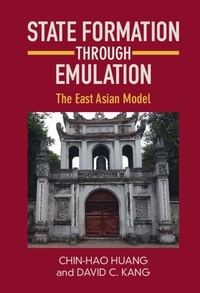
State Formation through Emulation
The East Asian Model
Published on 4. August 2022
Book
Hardback
252 pages
978-1-009-09853-3 (ISBN)
Description
Neither war nor preparations for war were the cause or effect of state formation in East Asia. Instead, emulation of China-the hegemon with a civilizational influence-drove the rapid formation of centralized, bureaucratically administered, territorial governments in Korea, Japan, and Vietnam. Furthermore, these countries engaged in state-building not to engage in conflict or to suppress revolt. In fact, war was relatively rare and there was no balance of power system with regular existential threats-the longevity of the East Asian dynasties is evidence of both the peacefulness of their neighborhood and their internal stability. We challenge the assumption that the European experience with war and state-making was universal. More importantly, we broaden the scope of state formation in East Asia beyond the study of China itself and show how countries in the region interacted and learned from each other and China to develop strong capacities and stable borders.
Reviews / Votes
International Relations needs to move beyond critiques of Eurocentrism to present big, positive alternative ideas. Few if any books in the field achieve this goal as well as State Formation in Historical East Asia. Huang and Kang's fresh, challenging and incredibly important thesis is that state-building in East Asia preceded that in Europe, and was the result of emulation rather than military competition. Jason Sharman, Sir Patrick Sheehy Professor of International Relations, University of Cambridge This innovative analysis demonstrates that state building in Asia was very different from Europe: characterized by mimicry and diffusion, rather than warfare or competition. It is a major and very welcome contribution to the literature on state-building across the world. Anna Grzymala-Busse, Kevin and Michelle Douglas Professor of International Studies, Stanford University Huang and Kang have reconstructed deep historical pathways toward state making in East Asia. They helpfully highlight shared traits that distinguish these states as a group from those formed in Europe. State Formation Through Emulation: The East Asian Model helps to reduce the persistent asymmetry of knowledge about European and East Asian state making dynamics. The book points us toward to a future moment when historically contextualized state making dynamics across different world regions can be scrutinized for the distinctive features these diverse states bring into their subsequent encounters with each other. R. Bin Wong, R. Bin Wong, Director of the UCLA Asia Institute and Distinguished Professor of History, University of California, Los AngelesMore details
Language
English
Place of publication
Cambridge
United Kingdom
Edition type
New edition
Product notice
sewn/stitched
Cloth over boards
Illustrations
Worked examples or Exercises
Dimensions
Height: 229 mm
Width: 152 mm
Thickness: 16 mm
Weight
508 gr
ISBN-13
978-1-009-09853-3 (9781009098533)
Copyright in bibliographic data and cover images is held by Nielsen Book Services Limited or by the publishers or by their respective licensors: all rights reserved.
Schweitzer Classification
Other editions
Additional editions
Book
08/2022
Cambridge University Press
€35.00
Shipment within 15-20 days
E-Book
07/2022
Cambridge University Press
€28.99
Available for download
E-Book
07/2022
Cambridge University Press
€28.99
Available for download
Persons
Chin-Hao Huang is assistant professor of political science and head of studies for global affairs at Yale-NUS College in Singapore. His research and teaching focus on China's foreign relations, the international relations of East Asia, and international security. His books include Power, Restraint, and China's Rise (2022) and Identity in the Shadow of a Giant: How the Rise of China is Changing Taiwan (2021).
Content
1. Introduction: The East Asian Model of State Formation; 2. Theories of State Formation and Diffusion; 3. Phase 1 and Onwards: Hegemony, Bureaucracy, and Confucianism; 4. The Absence of Bellicist Pressures in State Formation, 400 - 800 CE; 5. Phase II: State Formation in Korea and Japan, 400 - 800 CE; 6. Korea and Japan over the Centuries; 7. Vietnam emerges, 10th - 14th Centuries; 8. Epistemic Communities and Regional Connections; 9. Who Doesn't Emulate? The Borderlands of the Central Asian Steppe; 10. Conclusion: East Asian Developmental States in the 20th Century. Appendix; References; Index.