

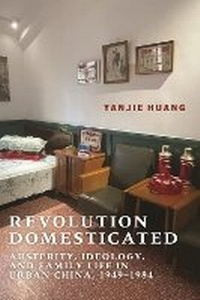
Revolution Domesticated
Austerity, Ideology, and Family Life in Urban China, 1949-1984
Will be published approx. on 15. December 2026
Book
Paperback/Softback
376 pages
978-0-231-22376-8 (ISBN)
Description
During the Mao era, Chinese urban families were subjected to decades of austerity in the name of continuous revolution. In the 1960s and 1970s, they bore the economic costs of political campaigns aimed at transforming daily life. Under Deng Xiaoping, however, a new vision took hold: a stable, moderately well-off family, strikingly reminiscent of Confucian ideals that only a few years before had been consigned to the prerevolutionary past.
Drawing on Mao-era family letters, grassroots archives, and oral history, this book shows how revolutionary austerity transformed urban families and shaped China's transition to a new economic order. Yanjie Huang pinpoints the unintended consequences of Maoist policies, arguing that urbanites turned inward to the domestic sphere of the family in order to weather the compulsory sacrifices of the Great Leap Forward and the Cultural Revolution. Sweeping visions of collective social transformation helped foster tightly knit, inward-looking nuclear families focused on rearing a single child. Tracing how Shanghai families found survival strategies for economic hardships, Huang argues that the interaction between the urban household and grassroots ideology contributed to the post-Mao turn to developmentalism. From a groundbreaking bottom-up perspective that weaves together economic, political, and social history, Revolution Domesticated provides a new understanding-rooted in everyday life-of the origins of China's epochal post-Mao transformations.
Drawing on Mao-era family letters, grassroots archives, and oral history, this book shows how revolutionary austerity transformed urban families and shaped China's transition to a new economic order. Yanjie Huang pinpoints the unintended consequences of Maoist policies, arguing that urbanites turned inward to the domestic sphere of the family in order to weather the compulsory sacrifices of the Great Leap Forward and the Cultural Revolution. Sweeping visions of collective social transformation helped foster tightly knit, inward-looking nuclear families focused on rearing a single child. Tracing how Shanghai families found survival strategies for economic hardships, Huang argues that the interaction between the urban household and grassroots ideology contributed to the post-Mao turn to developmentalism. From a groundbreaking bottom-up perspective that weaves together economic, political, and social history, Revolution Domesticated provides a new understanding-rooted in everyday life-of the origins of China's epochal post-Mao transformations.
Reviews / Votes
This book's rich source base offers rare access to the lived experience of ideological transformation: It captures the moral weight of revolutionary sacrifice, the tensions between familial obligation and political loyalty, and the quiet reconstitution of domestic life in the post-Mao years. Huang skillfully moves between fine-grained microhistory and larger structural change, crafting a narrative that is both historically grounded and analytically ambitious. -- Yiching Wu, author of <i>The Cultural Revolution at the Margins: Chinese Socialism in Crisis</i>More details
Series
Language
English
Place of publication
New York
United States
Target group
Professional and scholarly
Product notice
Paperback (trade)
Illustrations
9 b&w illustrations, 16 tables
Dimensions
Height: 229 mm
Width: 152 mm
ISBN-13
978-0-231-22376-8 (9780231223768)
Copyright in bibliographic data and cover images is held by Nielsen Book Services Limited or by the publishers or by their respective licensors: all rights reserved.
Schweitzer Classification
Person
Yanjie Huang is a Presidential Young Professor in the Department of Chinese Studies at the National University of Singapore. He is coauthor of Market in State: The Political Economy of Domination in China (2018).