

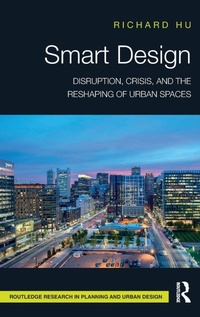
Smart Design
Disruption, Crisis, and the Reshaping of Urban Spaces
1st Edition
Published on 25. November 2021
Book
Hardback
168 pages
978-0-367-42176-2 (ISBN)
Description
This book tackles the emerging smart urbanism to advance a new way of urban thinking and to explore a new design approach. It unravels several urban transformations in dualities: economic relationality and centrality, technological flattening and polarisation, and spatial division and fusion. These dualities are interdependent; concurrent, coexisting, and contradictory, they are jointly disrupting and reshaping many aspects of contemporary cities and spaces.
The book draws on a suite of international studies, experiences, and observations, including case studies in Beijing, Singapore, and Boston, to reveal how these processes are impacting urban design, development, and policy approaches. The COVID-19 pandemic has accelerated many changes already in motion, and provides an extreme circumstance for reflecting on and imagining urban spaces. These analyses, thoughts, and visions inform an urban imaginary of smart design that incorporates change, flexibility, collaboration, and experimentation, which together forge a paradigm of urban thinking. This paradigm builds upon the modernist and postmodernist urban design traditions and extends them in new directions, responding to and anticipating a changing urban environment.
The book proposes a smart design manifesto to stimulate thought, trigger debate, and, hopefully, influence a new generation of urban thinkers and smart designers. It will be of interest to scholars, students, and practitioners in the fields of urban design, planning, architecture, urban development, and urban studies.
The book draws on a suite of international studies, experiences, and observations, including case studies in Beijing, Singapore, and Boston, to reveal how these processes are impacting urban design, development, and policy approaches. The COVID-19 pandemic has accelerated many changes already in motion, and provides an extreme circumstance for reflecting on and imagining urban spaces. These analyses, thoughts, and visions inform an urban imaginary of smart design that incorporates change, flexibility, collaboration, and experimentation, which together forge a paradigm of urban thinking. This paradigm builds upon the modernist and postmodernist urban design traditions and extends them in new directions, responding to and anticipating a changing urban environment.
The book proposes a smart design manifesto to stimulate thought, trigger debate, and, hopefully, influence a new generation of urban thinkers and smart designers. It will be of interest to scholars, students, and practitioners in the fields of urban design, planning, architecture, urban development, and urban studies.
Reviews / Votes
The spatial character of any city is constantly evolving driven by the social, economic, and political trends afforded by emerging technological developments. Innovations in information technology since the beginning of this century and learning from the new ways of working developed during the COVID-19 crisis have opened a world of new possibilities for future urban life. Richard Hu places smart urbanism and smart space into the socio-political context of cities competing for global eminence. In doing so he expertly draws on an extensive body of research and his own experiences in describing the changes taking place in the spatial distribution of activities and the use of public space. Smart design involves imagining the future. Hu's manifesto points the way forward.Jon Lang, Emeritus Professor of Urban Design, University of New South Wales
Smart technologies are reshaping urban form and function more quickly and thoroughly than current urban design and planning approaches. At a time when climate change, migration, and digitalisation challenge our long-standing ways of working and living, we need new smart design approaches that go beyond existing paradigms. Richard Hu expertly takes up this important topic, carefully exploring diverse international examples. As Hu appropriately concludes: to engage with the needs and opportunities of today, we need a smart design manifesto!
Carola Hein, Professor and Head of the History of Architecture and Urban Planning, Delft University of Technology
In this stimulating and provocative book, Richard Hu undertakes an ambitious aim: to influence a new generation of urban thinkers and smart designers. His timing could not be better. COVID-19 is accelerating change and disrupting the norms upon which our current thinking about urban design was founded. Hu combines his own experiences from different fields of practice and academia to imagine a new paradigm of smart design in urban thinking, serving as a captivating guide and thoughtful provocateur. While he offers no simple solutions to urban complexities and contradictions, he instead gives us something much more useful: a smart design manifesto which offers a new way of thinking.
Riccardo Mascia, AIA, Executive Committee, HOK
More details
Series
Language
English
Place of publication
London
United Kingdom
Publishing group
Taylor & Francis Ltd
Target group
College/higher education
Professional and scholarly
Postgraduate and Professional
Illustrations
12 s/w Zeichnungen, 3 s/w Tabellen, 16 s/w Photographien bzw. Rasterbilder, 28 s/w Abbildungen
3 Tables, black and white; 12 Line drawings, black and white; 16 Halftones, black and white; 28 Illustrations, black and white
Dimensions
Height: 240 mm
Width: 161 mm
Thickness: 15 mm
Weight
446 gr
ISBN-13
978-0-367-42176-2 (9780367421762)
Copyright in bibliographic data and cover images is held by Nielsen Book Services Limited or by the publishers or by their respective licensors: all rights reserved.
Schweitzer Classification
Other editions
Additional editions
Book
05/2023
1st Edition
Routledge
€64.90
Shipment within 10-20 days
E-Book
11/2021
1st Edition
Routledge
€59.49
Available for download
E-Book
11/2021
1st Edition
Routledge
€59.49
Available for download
Person
Richard Hu is an award-winning urban planner, and an educator and scholar. His work and interests integrate urban design, urban science, and urban policy to address contemporary urban transformations and challenges, with a focus on the Asia-Pacific area. He is the author of The Shenzhen Phenomenon (2020).
Content
1. Smart urbanism 2. Relationality and centrality 3. Flattening and polarisation 4. Division and fusion 5. Reimagining urban spaces in COVID-19 6. Towards a smart design manifesto