

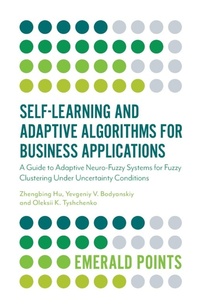
Self-Learning and Adaptive Algorithms for Business Applications
A Guide to Adaptive Neuro-Fuzzy Systems for Fuzzy Clustering Under Uncertainty Conditions
Published on 25. June 2019
Book
Paperback/Softback
120 pages
978-1-83867-174-7 (ISBN)
Description
In today's data-driven world, more sophisticated algorithms for data processing are in high demand, mainly when the data cannot be handled with the help of traditional techniques. Self-learning and adaptive algorithms are now widely used by such leading giants that as Google, Tesla, Microsoft, and Facebook in their projects and applications.
In this guide designed for researchers and students of computer science, readers will find a resource for how to apply methods that work on real-life problems to their challenging applications, and a go-to work that makes fuzzy clustering issues and aspects clear. Including research relevant to those studying cybernetics, applied mathematics, statistics, engineering, and bioinformatics who are working in the areas of machine learning, artificial intelligence, complex system modeling and analysis, neural networks, and optimization, this is an ideal read for anyone interested in learning more about the fascinating new developments in machine learning.
In this guide designed for researchers and students of computer science, readers will find a resource for how to apply methods that work on real-life problems to their challenging applications, and a go-to work that makes fuzzy clustering issues and aspects clear. Including research relevant to those studying cybernetics, applied mathematics, statistics, engineering, and bioinformatics who are working in the areas of machine learning, artificial intelligence, complex system modeling and analysis, neural networks, and optimization, this is an ideal read for anyone interested in learning more about the fascinating new developments in machine learning.
Reviews / Votes
This guide explains how to apply methods using systems built by a combination of the neural network approach and fuzzy logic (neuro-fuzzy systems) to solve practical data classification problems in business. It describes methods aimed at handling the main types of uncertainties in data, using adaptive methods of fuzzy clustering; the use of Kohonen maps and their ensembles for fuzzy clustering tasks; and simulation results of these neuro-fuzzy architectures, their learning methods, self-organization, and clustering procedures. -- Annotation (c)2019 * (protoview.com) *More details
Series
Language
English
Place of publication
Bingley
United Kingdom
Target group
Professional and scholarly
Dimensions
Height: 198 mm
Width: 129 mm
Thickness: 7 mm
Weight
137 gr
ISBN-13
978-1-83867-174-7 (9781838671747)
Copyright in bibliographic data and cover images is held by Nielsen Book Services Limited or by the publishers or by their respective licensors: all rights reserved.
Schweitzer Classification
Other editions
Additional editions
Zhengbing Hu | Yevgeniy V. Bodyanskiy | Oleksii Tyshchenko
Self-Learning and Adaptive Algorithms for Business Applications
A Guide to Adaptive Neuro-Fuzzy Systems for Fuzzy Clustering Under Uncertainty Conditions
E-Book
06/2019
1st Edition
Emerald Publishing Limited
€41.99
Available for download
Persons
Zhengbing Hu is an Associate Professor, School of Educational Information Technology, Huazhong Normal University, China.
Yevgeniy V. Bodyanskiy is a Professor at the Department of Artificial Intelligence, Kharkiv National University of Radioelectronics.
Oleksii Tyshchenko is a Researcher at the Institute for Research and Applications of Fuzzy Modeling, University of Ostrava, Czech Republic.
Yevgeniy V. Bodyanskiy is a Professor at the Department of Artificial Intelligence, Kharkiv National University of Radioelectronics.
Oleksii Tyshchenko is a Researcher at the Institute for Research and Applications of Fuzzy Modeling, University of Ostrava, Czech Republic.
Content
Introduction 1. Review of the Problem Area
2. Adaptive Methods of Fuzzy Clustering
3. Kohonen Maps and their Ensembles for Fuzzy Clustering Tasks
4. Simulation Results and Solutions for Practical Tasks
Conclusion
2. Adaptive Methods of Fuzzy Clustering
3. Kohonen Maps and their Ensembles for Fuzzy Clustering Tasks
4. Simulation Results and Solutions for Practical Tasks
Conclusion