

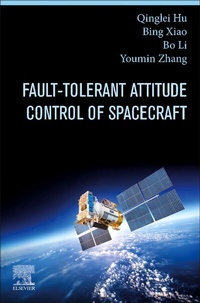
Fault-Tolerant Attitude Control of Spacecraft
Published on 18. June 2021
Book
Paperback/Softback
304 pages
978-0-323-89863-8 (ISBN)
Description
Fault-Tolerant Attitude Control of Spacecraft presents the fundamentals of spacecraft fault-tolerant attitude control systems, along with the most recent research and advanced, nonlinear control techniques. This book gives researchers a self-contained guide to the complex tasks of envisaging, designing, implementing and experimenting by presenting designs for integrated modeling, dynamics, fault-tolerant attitude control, and fault reconstruction for spacecraft. Specifically, the book gives a full literature review and presents preliminaries and mathematical models, robust fault-tolerant attitude control, fault-tolerant attitude control with actuator saturation, velocity-free fault tolerant attitude control, finite-time fault-tolerant attitude tracking control, and active fault-tolerant attitude contour.
Finally, the book looks at the future of this interesting topic, offering readers a one-stop solution for those working on fault-tolerant attitude control for spacecraft.
Finally, the book looks at the future of this interesting topic, offering readers a one-stop solution for those working on fault-tolerant attitude control for spacecraft.
More details
Language
English
Place of publication
Philadelphia
United States
Target group
Professional and scholarly
Illustrations
125 illustrations (100 in full color); Illustrations
Dimensions
Height: 229 mm
Width: 152 mm
Weight
450 gr
ISBN-13
978-0-323-89863-8 (9780323898638)
Copyright in bibliographic data and cover images is held by Nielsen Book Services Limited or by the publishers or by their respective licensors: all rights reserved.
Schweitzer Classification
Other editions
Additional editions
Qinglei Hu | Bing Xiao | Bo Li
Fault-Tolerant Attitude Control of Spacecraft
E-Book
06/2021
Elsevier
€155.00
Available for download
Persons
Qinglei Hu is a Professor in the School of Automation Science and Electrical Engineering, at Beihang University, China. He has made fundamental contributions to spacecraft control systems and mechatronics, and pioneered the application of fault tolerant attitude control algorithms in spacecraft, unmanned aerial vehicles, and missiles. He has published over 150 papers. Bing Xiao is an Associate Professor in the School of Automation, at Northwestern Polytechnical University, in China. His work focuses on spacecraft fault tolerant systems design. He has been elected as a senior member of the Chinese Youth Automation Committee, a platform for leading automation researchers in China. He has published over 70 papers. Bo Li is an Assistant Professor with the Shanghai Maritime University in Shanghai, China. He received his PhD from Harbin Institute of Technology. His research focuses include spacecraft attitude control, control allocation, fault diagnosis and fault-tolerant control, and optimal control and optimization methods. He has published over 30 papers. Youmin Zhang is Professor, Mechanical, Industrial and Aerospace Engineering, at Concordia Institute of Aerospace Design and Innovation (CISDI) at Concordia University, Canada. He received his PhD from Northwestern Polytechnical University in China. He has published four books, and over 500 papers and chapters.
Author
Professor, School of Automation Science and Electrical Engineering, Beihang University, China
Associate Professor, School of Automation, Northwestern Polytechnical University, China
Assistant Professor, Shanghai Maritime University, Shanghai, China
Professor, Mechanical, Industrial and Aerospace Engineering, Concordia Institute of Aerospace Design and Innovation (CISDI), Concordia University, Canada
Content
1. Overview
2. Preliminaries
3. Robust fault-tolerant attitude control
4. Fault-tolerant attitude control with actuator saturation
5. Fault-tolerant velocity-free attitude control
6. Fault-tolerant finite-time attitude-tracking control
7. Active fault-tolerant attitude control
8. Conclusions and future work
2. Preliminaries
3. Robust fault-tolerant attitude control
4. Fault-tolerant attitude control with actuator saturation
5. Fault-tolerant velocity-free attitude control
6. Fault-tolerant finite-time attitude-tracking control
7. Active fault-tolerant attitude control
8. Conclusions and future work