

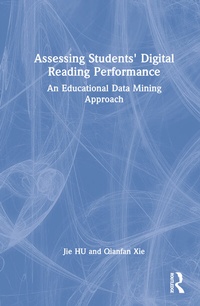
Assessing Students' Digital Reading Performance
An Educational Data Mining Approach
1st Edition
Published on 30. December 2022
Book
Hardback
230 pages
978-1-032-39730-6 (ISBN)
Description
This book provides a systematic study of the Programme for International Student Assessment (PISA) based on big data analysis, aiming to examine the contextual factors relevant to students' digital reading performance.
The author first introduces the research landscape of educational data mining (EDM) and reviews the PISA framework since its launch and how it has become an important metric to assess the knowledge and skills of students from across the globe. With a focus on methodology and its applications, the book explores extant scholarship on the dynamic model of educational effectiveness, multi-level factors of digital reading performance, and the application of EDM approaches. The core chapter on the methodology examines machine learning algorithms, hierarchical linear modeling, mediation analysis, and data extraction and processing for the PISA dataset. The findings give insights into the influencing factors of students' digital reading performance, allowing for further investigations on improving students' digital reading literacy and more attention to the advancement of education effectiveness.
The book will appeal to scholars, professionals, and policymakers interested in reading education, educational data mining, educational technology, and PISA, as well as students learning how to utilize machine learning algorithms in examining the mass global database.
The author first introduces the research landscape of educational data mining (EDM) and reviews the PISA framework since its launch and how it has become an important metric to assess the knowledge and skills of students from across the globe. With a focus on methodology and its applications, the book explores extant scholarship on the dynamic model of educational effectiveness, multi-level factors of digital reading performance, and the application of EDM approaches. The core chapter on the methodology examines machine learning algorithms, hierarchical linear modeling, mediation analysis, and data extraction and processing for the PISA dataset. The findings give insights into the influencing factors of students' digital reading performance, allowing for further investigations on improving students' digital reading literacy and more attention to the advancement of education effectiveness.
The book will appeal to scholars, professionals, and policymakers interested in reading education, educational data mining, educational technology, and PISA, as well as students learning how to utilize machine learning algorithms in examining the mass global database.
More details
Language
English
Place of publication
London
United Kingdom
Publishing group
Taylor & Francis Ltd
Target group
College/higher education
Professional and scholarly
Academic, Postgraduate, Professional, Professional Training, Undergraduate Advanced, and Undergraduate Core
Illustrations
22 s/w Zeichnungen, 8 s/w Tabellen, 1 s/w Photographie bzw. Rasterbild, 23 s/w Abbildungen
8 Tables, black and white; 22 Line drawings, black and white; 1 Halftones, black and white; 23 Illustrations, black and white
Dimensions
Height: 234 mm
Width: 156 mm
Weight
453 gr
ISBN-13
978-1-032-39730-6 (9781032397306)
Copyright in bibliographic data and cover images is held by Nielsen Book Services Limited or by the publishers or by their respective licensors: all rights reserved.
Schweitzer Classification
Other editions
Additional editions
Book
12/2022
1st Edition
Routledge
€55.00
Shipment within 10-20 days
E-Book
12/2022
1st Edition
Routledge
€49.99
Available for download
E-Book
12/2022
1st Edition
Routledge
€49.99
Available for download
Person
Jie HU is Professor of the Department of Linguistics at the School of International Studies at Zhejiang University, China. Her research interests include PISA/PIRLS Reading Test, Digital Reading, and Educational Technology.
Content
1. Introduction 2. Literature review 3. Methodology 4. Results 5. Discussion 6. Conclusion and limitation