

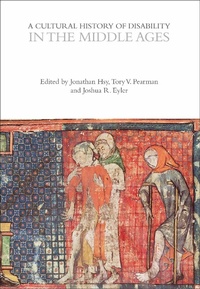
A Cultural History of Disability in the Middle Ages
Published on 18. April 2024
Book
Paperback/Softback
200 pages
978-1-350-43675-6 (ISBN)
Description
The Middle Ages was an era of dynamic social transformation, and notions of disability in medieval culture reflected how norms and forms of embodiment interacted with gender, class, and race, among other dimensions of human difference. Ideas of disability in courtly romance, saints' lives, chronicles, sagas, secular lyrics, dramas, and pageants demonstrate the nuanced, and sometimes contradictory, relationship between cultural constructions of disability and the lived experience of impairment.
An essential resource for researchers, scholars, and students of history, literature, visual art, cultural studies, and education, A Cultural History of Disability in the Middle Ages explores themes and topics such as atypical bodies; mobility impairment; chronic pain and illness; blindness; deafness; speech; learning difficulties; and mental health.
An essential resource for researchers, scholars, and students of history, literature, visual art, cultural studies, and education, A Cultural History of Disability in the Middle Ages explores themes and topics such as atypical bodies; mobility impairment; chronic pain and illness; blindness; deafness; speech; learning difficulties; and mental health.
Reviews / Votes
This volume stands as a testament to the work being done to connect medieval history to the broader field of disability studies to create a better understanding of disabilities as a transhistorical social construct. * Cerae: An Australasian Journal of Medieval and Early Modern Studies *More details
Series
Language
English
Place of publication
London
United Kingdom
Publishing group
Bloomsbury Publishing PLC
Target group
College/higher education
Illustrations
19 b/w
Dimensions
Height: 171 mm
Width: 245 mm
Thickness: 13 mm
Weight
386 gr
ISBN-13
978-1-350-43675-6 (9781350436756)
Copyright in bibliographic data and cover images is held by Nielsen Book Services Limited or by the publishers or by their respective licensors: all rights reserved.
Schweitzer Classification
Persons
Jonathan Hsy is Associate Professor of English at The George Washington University, USA. His books include Trading Tongues: Merchants, Multilingualism, and Medieval Literature (2013) and he has published widely on disability issues.
Tory V. Pearman is Associate Professor of English at Miami University, USA. Her previous books include Women and Disability in Medieval Literature (2010) and Disability and Knighthood in Malory's Morte Darthur (2019).
Joshua R. Eyler is Director of Faculty Development and Lecturer in Writing and Rhetoric at the University of Mississippi, USA. His books include How Humans Learn: The Science and Stories behind Effective College Teaching (2018) and Disability in the Middle Ages: Reconsiderations and Reverberations (2010).
Tory V. Pearman is Associate Professor of English at Miami University, USA. Her previous books include Women and Disability in Medieval Literature (2010) and Disability and Knighthood in Malory's Morte Darthur (2019).
Joshua R. Eyler is Director of Faculty Development and Lecturer in Writing and Rhetoric at the University of Mississippi, USA. His books include How Humans Learn: The Science and Stories behind Effective College Teaching (2018) and Disability in the Middle Ages: Reconsiderations and Reverberations (2010).
Content
List of Illustration
Notes of Contributors
Series Preface
Introduction: Disabilities in Motion, Jonathan Hsy, George Washington University, USA Tory V. Pearman, Miami University, Hamilton, USA and Joshua R. Eyler, Rice University, USA
Chapter 1: Atypical Bodies: Seeking after Meaning in Physical Difference, John P. Sexton, Bridgewater State University, USA
Chapter 2: Mobility Impairments: The Social Horizons of Disability in the Middle Ages, Richard H. Godden, Louisiana State University, USA
Chapter 3: Chronic Pain and Illness: Reinstating Crip-Chronic Histories to Forge Affirmative Disability Futures, Alicia Spencer-Hall, Queen Mary, University of London, UK
Chapter 4: Blindness: Evolving Religious and Secular Constructions and Responses, Edward Wheatley, Loyola University Chicago, USA
Chapter 5: Deafness: Reading Invisible Signs, Julie Singer, Washington University in St. Louis, USA
Chapter 6: Speech: Medieval Representations of Speech Impairments, Kisha G. Tracy, Fitchburg State University, USA
Chapter 7: Learning Difficulties: Ideas about Intellectual Diversity in Medieval Thought and Culture, Eliza Buhrer, Colorado School of Mines, USA
Chapter 8: Mental Health Issues: Folly, Frenzy, and the Family, Aleksandra Pfau, Hendrix College, USA
Author and Editor Biographies
References
Index
Notes of Contributors
Series Preface
Introduction: Disabilities in Motion, Jonathan Hsy, George Washington University, USA Tory V. Pearman, Miami University, Hamilton, USA and Joshua R. Eyler, Rice University, USA
Chapter 1: Atypical Bodies: Seeking after Meaning in Physical Difference, John P. Sexton, Bridgewater State University, USA
Chapter 2: Mobility Impairments: The Social Horizons of Disability in the Middle Ages, Richard H. Godden, Louisiana State University, USA
Chapter 3: Chronic Pain and Illness: Reinstating Crip-Chronic Histories to Forge Affirmative Disability Futures, Alicia Spencer-Hall, Queen Mary, University of London, UK
Chapter 4: Blindness: Evolving Religious and Secular Constructions and Responses, Edward Wheatley, Loyola University Chicago, USA
Chapter 5: Deafness: Reading Invisible Signs, Julie Singer, Washington University in St. Louis, USA
Chapter 6: Speech: Medieval Representations of Speech Impairments, Kisha G. Tracy, Fitchburg State University, USA
Chapter 7: Learning Difficulties: Ideas about Intellectual Diversity in Medieval Thought and Culture, Eliza Buhrer, Colorado School of Mines, USA
Chapter 8: Mental Health Issues: Folly, Frenzy, and the Family, Aleksandra Pfau, Hendrix College, USA
Author and Editor Biographies
References
Index