

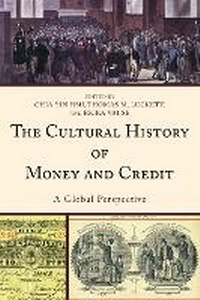
The Cultural History of Money and Credit
A Global Perspective
Published on 26. September 2017
Book
Paperback/Softback
198 pages
978-1-4985-0594-9 (ISBN)
Description
In the wake of the financial crisis in 2008, historians have turned with renewed urgency to understanding the economic dimension of historical change. In this collection, nine scholars present original research into the historical development of money and credit during the nineteenth and twentieth centuries and explore the social and cultural significance of financial phenomena from a global perspective. Together with an introduction by the editors, chapters emphasize themes of creditworthiness and access to credit, the role of the state in the loan market, modernization, colonialism, and global connections between markets.
The first section of the volume, "Creditworthiness and Credit Risks," examines microfinancial markets in South India and Sri Lanka, Brazil, and the United States, in which access to credit depended largely on reputation, while larger investors showed a strong interest in policing economic behavior and encouraging thrift among market participants. The second section, "The Loan Market and the State," concerns attempts by national governments to regulate the lending activities of merchants and banks for social ends, from the liberal regime of nineteenth-century Switzerland to the far more statist policies of post-revolutionary Mexico, and U.S. legislation that strove to eliminate discrimination in lending. The third section, "Money, Commercial Exchange, and Global Connections," focuses on colonial and semicolonial societies in the Philippines, China, and Zimbabwe, where currency reform and the development of organized financial markets engendered conflict over competing models of economic development, often pitting the colony against the metropole.
This volume offers a cultural history by considering money and credit as social relations, and explores how such relations were constructed and articulated by contemporaries. Chapters employ a variety of methodologies, including analyses of popular literature and the viewpoints of experts and professionals, investigations of policy measures and emerging social practices, and interpretations of quantitative data.
The first section of the volume, "Creditworthiness and Credit Risks," examines microfinancial markets in South India and Sri Lanka, Brazil, and the United States, in which access to credit depended largely on reputation, while larger investors showed a strong interest in policing economic behavior and encouraging thrift among market participants. The second section, "The Loan Market and the State," concerns attempts by national governments to regulate the lending activities of merchants and banks for social ends, from the liberal regime of nineteenth-century Switzerland to the far more statist policies of post-revolutionary Mexico, and U.S. legislation that strove to eliminate discrimination in lending. The third section, "Money, Commercial Exchange, and Global Connections," focuses on colonial and semicolonial societies in the Philippines, China, and Zimbabwe, where currency reform and the development of organized financial markets engendered conflict over competing models of economic development, often pitting the colony against the metropole.
This volume offers a cultural history by considering money and credit as social relations, and explores how such relations were constructed and articulated by contemporaries. Chapters employ a variety of methodologies, including analyses of popular literature and the viewpoints of experts and professionals, investigations of policy measures and emerging social practices, and interpretations of quantitative data.
Reviews / Votes
The essays that explore creditworthiness and credit risks are the most successfully theorized, in part because this section draws on the existing work on honor and reputation, particularly of Laurence Fontaine. . . This volume is rich in historical insights and provides some common themes. * Pacific Historical Review * Credit, also known as debt, shapes peoples' lives and social relations in countless ways, and debt crises have enormous unexplored historical significance. Chia Yin Hsu, Thomas M. Luckett, and Erika Vause open a path for historians into this terrain and demonstrate how the world of global economics connects to the worlds of daily life. -- Mark Metzler, University of Texas at Austin By embedding credit and finance in their political, social, and cultural contexts, this book allows us to make our understanding of the economy much more complex. Together, the diversity of case studies-ranging from nineteenth-century reactions to bankruptcy in Switzerland to the financial crisis in twentieth-century colonial Zimbabwe-and an analysis that pays attention to the social and political stakes and to the nature of the agency actors can mobilized in very different historical contexts, offer ways to understand better the making of economic decisions which, finally, is what truly matters. -- Laurence Fontaine, Centre Maurice Halbwachs, CNRS-ENS-EHESS ParisMore details
Language
English
Place of publication
United States
Publishing group
Bloomsbury Publishing Plc
Target group
College/higher education
Illustrations
5 Tables
Dimensions
Height: 232 mm
Width: 151 mm
Thickness: 15 mm
Weight
304 gr
ISBN-13
978-1-4985-0594-9 (9781498505949)
Copyright in bibliographic data and cover images is held by Nielsen Book Services Limited or by the publishers or by their respective licensors: all rights reserved.
Schweitzer Classification
Other editions
Additional editions
Chia Yin Hsu | Thomas M. Luckett | Erika Vause
The Cultural History of Money and Credit
A Global Perspective
E-Book
12/2015
1st Edition
Bloomsbury eBooks US
€44.49
Available for download
Persons
Chia Yin Hsu is associate professor of history at Portland State University.
Thomas M. Luckett is associate professor of history and former Chair of the Department of History at Portland State University.
Erika Vause is assistant professor of history at Florida Southern College.
Thomas M. Luckett is associate professor of history and former Chair of the Department of History at Portland State University.
Erika Vause is assistant professor of history at Florida Southern College.
Content
Part 1: Creditworthiness and Credit Risks
Chapter 1: Between Promise and Peril: Credit and Debt at the Pearl Fisheries of South India and Sri Lanka, c. 1800, Sam Ostroff
Chapter 2: Lenders and Borrowers in a Non-Capitalist Economy: Rio de Janeiro in the Early Nineteenth Century, Monica Martins
Chapter 3: Microfinance and the Progressive Generation, David Hochfelder
Part 2: The Loan Market and the State
Chapter 4: The Boundaries of Debt: Bankruptcy between Local Practices and Liberal Rule in Nineteenth-Century Switzerland, Mischa Suter
Chapter 5: Invention Figures and Imagining Shrubs: Bank Bureaucrats' Lack of Field Experience in Mexico, 1930s-1940s, Nicole Mottier
Chapter 6: Consumer Credit as a Civil Right in America, 1968-1976, Enrico Beltramini
Part 3: Money, Commercial Exchange, and Global Connections
Chapter 7: Philippine Colonial Money and the Futures of Spanish Empire, Allan E. S. Lumba
Chapter 8: Dubious Figures: Speculation, Calculation, and Credibility in Early Twentieth-Century Chinese Stock Exchanges, Bryna Goodman
Chapter 9: Money and Autonomy in a Settler Colony: The Politics of Monetary Regulation in Colonial Zimbabwe, 1930s-1965, Admire Mseba
Chapter 1: Between Promise and Peril: Credit and Debt at the Pearl Fisheries of South India and Sri Lanka, c. 1800, Sam Ostroff
Chapter 2: Lenders and Borrowers in a Non-Capitalist Economy: Rio de Janeiro in the Early Nineteenth Century, Monica Martins
Chapter 3: Microfinance and the Progressive Generation, David Hochfelder
Part 2: The Loan Market and the State
Chapter 4: The Boundaries of Debt: Bankruptcy between Local Practices and Liberal Rule in Nineteenth-Century Switzerland, Mischa Suter
Chapter 5: Invention Figures and Imagining Shrubs: Bank Bureaucrats' Lack of Field Experience in Mexico, 1930s-1940s, Nicole Mottier
Chapter 6: Consumer Credit as a Civil Right in America, 1968-1976, Enrico Beltramini
Part 3: Money, Commercial Exchange, and Global Connections
Chapter 7: Philippine Colonial Money and the Futures of Spanish Empire, Allan E. S. Lumba
Chapter 8: Dubious Figures: Speculation, Calculation, and Credibility in Early Twentieth-Century Chinese Stock Exchanges, Bryna Goodman
Chapter 9: Money and Autonomy in a Settler Colony: The Politics of Monetary Regulation in Colonial Zimbabwe, 1930s-1965, Admire Mseba