

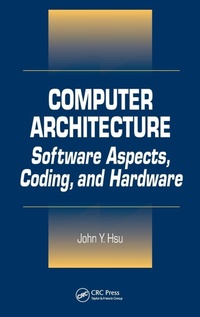
Computer Architecture
Software Aspects, Coding, and Hardware
1st Edition
Published on 18. January 2001
Book
Hardback
432 pages
978-0-8493-1026-3 (ISBN)
Description
With the new developments in computer architecture, fairly recent publications can quickly become outdated. Computer Architecture: Software Aspects, Coding, and Hardware takes a modern approach. This comprehensive, practical text provides that critical understanding of a central processor by clearly detailing fundamentals, and cutting edge design features. With its balanced software/hardware perspective and its description of Pentium processors, the book allows readers to acquire practical PC software experience. The text presents a foundation-level set of ideas, design concepts, and applications that fully meet the requirements of computer organization and architecture courses.
The book features a "bottom up" computer design approach, based upon the author's thirty years experience in both academe and industry. By combining computer engineering with electrical engineering, the author describes how logic circuits are designed in a CPU. The extensive coverage of a micprogrammed CPU and new processor design features gives the insight of current computer development.
Computer Architecture: Software Aspects, Coding, and Hardware presents a comprehensive review of the subject, from beginner to advanced levels. Topics include:
o Two's complement numbers o Integer overflow
o Exponent overflow and underflow o Looping
o Addressing modes o Indexing
o Subroutine linking o I/O structures
o Memory mapped I/O o Cycle stealing
o Interrupts o Multitasking
o Microprogrammed CPU o Multiplication tree
o Instruction queue o Multimedia instructions
o Instruction cache o Virtual memory
o Data cache o Alpha chip
o Interprocessor communications o Branch prediction
o Speculative loading o Register stack
o JAVA virtual machine o Stack machine principles
The book features a "bottom up" computer design approach, based upon the author's thirty years experience in both academe and industry. By combining computer engineering with electrical engineering, the author describes how logic circuits are designed in a CPU. The extensive coverage of a micprogrammed CPU and new processor design features gives the insight of current computer development.
Computer Architecture: Software Aspects, Coding, and Hardware presents a comprehensive review of the subject, from beginner to advanced levels. Topics include:
o Two's complement numbers o Integer overflow
o Exponent overflow and underflow o Looping
o Addressing modes o Indexing
o Subroutine linking o I/O structures
o Memory mapped I/O o Cycle stealing
o Interrupts o Multitasking
o Microprogrammed CPU o Multiplication tree
o Instruction queue o Multimedia instructions
o Instruction cache o Virtual memory
o Data cache o Alpha chip
o Interprocessor communications o Branch prediction
o Speculative loading o Register stack
o JAVA virtual machine o Stack machine principles
More details
Language
English
Place of publication
Bosa Roca
United States
Publishing group
Taylor & Francis Inc
Target group
Professional and scholarly
Professional
Illustrations
130 s/w Abbildungen, 5 s/w Photographien bzw. Rasterbilder, 34 s/w Tabellen
34 Tables, black and white; 5 Halftones, black and white; 130 Illustrations, black and white
Dimensions
Height: 240 mm
Width: 161 mm
Thickness: 28 mm
Weight
810 gr
ISBN-13
978-0-8493-1026-3 (9780849310263)
Copyright in bibliographic data and cover images is held by Nielsen Book Services Limited or by the publishers or by their respective licensors: all rights reserved.
Schweitzer Classification
Other editions
Additional editions
E-Book
12/2017
1st Edition
CRC Press
€73.49
Available for download
E-Book
12/2017
CRC Press
€73.99
Available for download
Person
Content
Introduction to Computers. Number Systems. Basic Computer Principles. Assembly Language Principles. Computer Architecture-General Features. Microprogrammed CPU. Superscalar Machine Principles. Vector and Multiple-Processor Machines. Processor Design Case Studies. Stack Machine Principles.