

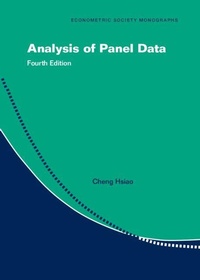
Analysis of Panel Data
4th Edition
Published on 7. July 2022
Book
Hardback
538 pages
978-1-316-51210-4 (ISBN)
Description
Now in its fourth edition, this comprehensive introduction of fundamental panel data methodologies provides insights on what is most essential in panel literature. A capstone to the forty-year career of a pioneer of panel data analysis, this new edition's primary contribution will be the coverage of advancements in panel data analysis, a statistical method widely used to analyze two or higher-dimensional panel data. The topics discussed in early editions have been reorganized and streamlined to comprehensively introduce panel econometric methodologies useful for identifying causal relationships among variables, supported by interdisciplinary examples and case studies. This book, to be featured in Cambridge's Econometric Society Monographs series, has been the leader in the field since the first edition. It is essential reading for researchers, practitioners and graduate students interested in the analysis of microeconomic behavior.
Reviews / Votes
A masterful new edition of Hsiao's classic text on panel data. This is a superbly comprehensive and accessible source for panel data with modern approaches to inference and identification, helpful to econometricians and other quantitative social scientists. Esfandiar Maasoumi, Emery University The latest edition of Cheng Hsiao's panel data monograph is most welcome to the econometrics profession. Benefitting from Professor Hsiao's deep understanding and insight, it has, since its first edition, not only become required reading for students, researchers and practitioners, but surely deserves no small credit for the huge growth of interest and activity in panel data. In this 4th edition, Professor Hsiao has very successfully built on the foundations of the earlier ones. Peter M. Robinson, London School of Economics Professor Hsiao has done it again. This edition provides a lucid and comprehensive account of often complex problems, ranging from the analysis of panel data models with interactive effects, heterogeneity, spatial dependence, simultaneous dynamic models, to program evaluation - many areas to which he himself has made significant and lasting contributions. I have learned a great deal from the past three editions, and I very much look forward to the fourth edition and strongly recommend it to both students and research scholars of panel data alike. Hashem Pesaran, John Elliot University of Southern California Cheng Hsiao's Analysis of Panel Data has undoubtedly become the classic text book reference on panel data econometric methods. It is to be recommended for the clarity and deepness of its exposition, its wide coverage of the abundant and rapidly developing specialized literature, and its remarkable capacity to focus on what is most essential in this literature. Jacques Mairesse, College de FranceMore details
Series
Edition
4th Revised edition
Language
English
Place of publication
Cambridge
United Kingdom
Target group
College/higher education
Edition type
Revised edition
Illustrations
Worked examples or Exercises
Dimensions
Height: 250 mm
Width: 175 mm
Thickness: 33 mm
Weight
1097 gr
ISBN-13
978-1-316-51210-4 (9781316512104)
Copyright in bibliographic data and cover images is held by Nielsen Book Services Limited or by the publishers or by their respective licensors: all rights reserved.
Schweitzer Classification
Other editions
Additional editions
Cheng Hsiao
Analysis of Panel Data
Book
07/2022
4th Edition
Cambridge University Press
€59.30
Shipment within 15-20 days
Cheng Hsiao
Analysis of Panel Data
E-Book
07/2022
4th Edition
Cambridge University Press
€40.99
Available for download
Cheng Hsiao
Analysis of Panel Data
E-Book
05/2022
Cambridge University Press
€40.99
Available for download
Previous edition
Cheng Hsiao
Analysis of Panel Data
Book
12/2014
3rd Edition
Cambridge University Press
€111.50
No shipping information available
Person
Cheng Hsiao is Professor of Economics at the University of Southern California.
Content
Preface; 1. Introduction; 2. Static models with additive effects; 3. Dynamic models with additive effects; 4. Static simultaneous models with additive effects; 5. Dynamic system; 6. Qualitative choice models; 7. Limited dependent and sample section models; 8. Some nonlinear models; 9. Miscellaneous topics; 10. Interactive effects models; 11. Spatial models and cross-sectional dependent data; 12. Program evaluation; 13. Varying coefficients models; 14. Big data analysis.