

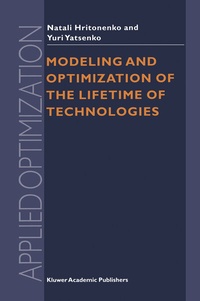
Modeling and Optimization of the Lifetime of Technologies
Published on 30. June 1996
Book
Hardback
XXXVI, 252 pages
978-0-7923-4014-0 (ISBN)
Description
Modern economic growth is characterized by structural changes based on the introduction of new technologies into economics. The replacement and renova tion of technologies in industrial environments undergoing technical change is clearly one of the key aspects of economic development. The mathematical modeling of evolutionary economics under technical change (TC) has been rigorously considered by many authors during last decades. There is a wide variety of economic approaches and models describing different aspects of technical change. Among these are the models of embodied technical progress [19], [35], [70], [129], endogenous growth models [94], [102], the models of technological innovations [31], [32], [41], and others. The perspective self organization evolutionary approach is developed in [20], [38], [122], [123], [124], [126], which unites the aspects of diffusion of new technologies, technological and behavioral diversity of firms, learning mechanisms, age-dependent effects, and other important features of real-life economics. On the whole, an interest in evolutionary economics has brought considerable progress in the description and conceptualization of the sources, characteristics, direction and effects of technical change [125]. However, the modeling and control of technology lifetime under technical change has received rather little attention in mathematical economics in con trary to other aspects of technical progress. The lifetime of technologies has rarely been formally treated as a part of more general mathematical theory of economic dynamics. A problem which is still to be resolved consists in establishing the rational strategies of technologies' replacement under various assumptions on the behavior of technical change.
More details
Series
Edition
1996 ed.
Language
English
Place of publication
New York
United States
Target group
College/higher education
Professional and scholarly
Research
Product notice
sewn/stitched
Cloth over boards
Illustrations
XXXVI, 252 p.
Dimensions
Height: 234 mm
Width: 156 mm
Thickness: 18 mm
Weight
585 gr
ISBN-13
978-0-7923-4014-0 (9780792340140)
DOI
10.1007/978-1-4613-3446-0
Schweitzer Classification
Other editions
Additional editions
N.V. Hritonenko | Yuri P. Yatsenko
Modeling and Optimization of the Lifetime of Technologies
Book
10/2011
1st Edition
Springer
€106.99
Shipment within 7-9 days
Content
I Integral Dynamical Models of Evolving Systems.- 1 Integral Dynamical Models in Control Theory.- 2 Integral Dynamical Models of Economic Systems.- 3 Integral Dynamical Models in Mathematical Ecology.- II Analysis of One-Sector Integral Dynamical Models.- 4 Basic Optimization Problem in One-Sector Model.- 5 Asymptotical Behavior of Optimal Trajectories and Turnpike Theorems.- 6 Other Optimization Problems in One-Sector Models.- III Analysis of Multi-Sector Integral Dynamical Models.- 7 The Volterra Integral Equations with Sought-For Lower Limits of Integration.- 8 Optimization in Two-Sector Models.- 9 Optimization of Industry Conversion Rates.- 10 Optimization in Three-Sector Model with Endogenous Technical Change.- 11 Optimization in Multi-Sector Models.- 12 Optimization of Technological Renovation in Hierarhical Ecological-Economic System.- IV Applied Problems of Integral Dynamical Models.- 13 Numerical Algorithms for Integral Dynamical Models.- 14 Application of Integral Models to Optimization of Technological Renovation.- 15 Open Problems and Perspectives of Integral Models.- References.