

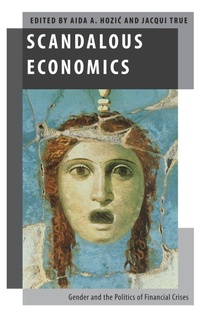
Scandalous Economics
Gender and the Politics of Financial Crises
Published on 21. April 2016
Book
Hardback
352 pages
978-0-19-020423-5 (ISBN)
Description
Of all of the lies, fragile alliances, and predatory financial dealings that have been revealed in the wake of the Global Financial Crisis of 2008, we have yet to come to terms with the ways in which structural inequalities around gender and race factor into (and indeed make possible) the current economic order. Scandalous Economics is about "silences" - the astonishing neglect of gender and race in explanations of the Global Financial Crisis. But, it is also about "noises" - the sexual scandals and gendered austerity policies that have relegated public debate, and the crisis itself, into political oblivion.
While feminist economists and movements such as Occupy Wall Street have pointed to the distributional inequalities that are an effect of financial deregulation, scholars haven't really grappled with the representational inequalities inherent in the way we view the politics of the market. For example, capitalism won't be made more equitable simply by appointing women to leadership positions within financial firms or corporations. And the next crisis will not be averted if our understandings of gendered inequalities are framed by sexual scandals in media and popular culture. We need to look at the activities and the privileges of the advantaged - the "TED women" of the crisis -- as much as the victimization of the disadvantaged - to fully grasp the interplay between gender and economy in this fragile age of restoration. Scandalous Economics breaks new ground by doing precisely this. It argues that normalization of the post-GFC economic order in the face of its obvious breakdown(s) has been facilitated by co-optation of feminist and queer perspectives into national and international responses to the crisis.
Scandalous Economics builds upon the Occupy movement and other critical analysis of the GFC to comprehensively examine gendered material, ideational and representational dimensions that have served to make the crisis and its effects, 'the new normal' in Europe and America as well as Latin America and Asia.
While feminist economists and movements such as Occupy Wall Street have pointed to the distributional inequalities that are an effect of financial deregulation, scholars haven't really grappled with the representational inequalities inherent in the way we view the politics of the market. For example, capitalism won't be made more equitable simply by appointing women to leadership positions within financial firms or corporations. And the next crisis will not be averted if our understandings of gendered inequalities are framed by sexual scandals in media and popular culture. We need to look at the activities and the privileges of the advantaged - the "TED women" of the crisis -- as much as the victimization of the disadvantaged - to fully grasp the interplay between gender and economy in this fragile age of restoration. Scandalous Economics breaks new ground by doing precisely this. It argues that normalization of the post-GFC economic order in the face of its obvious breakdown(s) has been facilitated by co-optation of feminist and queer perspectives into national and international responses to the crisis.
Scandalous Economics builds upon the Occupy movement and other critical analysis of the GFC to comprehensively examine gendered material, ideational and representational dimensions that have served to make the crisis and its effects, 'the new normal' in Europe and America as well as Latin America and Asia.
Reviews / Votes
This innovative collection wonderfully illustrates the power of radical feminist theorizing in disclosing the gendered roots, genesis, dynamics, narration, governance and impact of financial crisis and insecurity. Written by established and rising feminist scholars, it roundly rejects the idea that gender is an optional add-on and demonstrates its foundational role in the production and reproduction of exploitation, structured inequalities of power, and the dynamics of neoliberalism. Drawing on diverse methods, highlighting the intersectionality of inequalities, and focusing on different aspects of the financial crisis and related insecurities, they reveal many obscure features of financialization for the scandal that they are and also show how gendered representations of crisis subtly shape the brutal and unequal management of crisis. This is a must for the classroom, the library, and the activists bookshelf. * Bob Jessop, Lancaster University * Reading this book eight years after the financial crash is sobering. True and Hozic's thoughtful authors are raising bright yellow warning banners that read: Do not imagine that the sorts of masculinized presumptions and structures that fueled the global banking and housing nightmares have been relegated to the attic. Their roots go down deeper than any scandal and still are alive and thriving. * Cynthia Enloe, author of Seriously!: Investigating Crashes and Crises as if Women Mattered * Over the past decade, the global financial crisis has been forgotten. Crucial questions regarding subjects, bodies, and practices have been displaced by bloodless macroeconomic and theoretical abstractions, while critical voices and ethical concerns have been co-opted and reduced to matters of technique. This book shows over a series of path-breaking chapters how this great repression happened, demonstrating the need for gendered and feminist analyses which counter analytic amnesia and highlight the everyday realities of embodied practices and subjects. * Wesley Widmaier, Griffith University, Australia *More details
Other editions
Additional editions
Book
04/2016
Oxford University Press Inc
€70.70
Shipment within 15-20 days
E-Book
03/2016
1st Edition
OUP eBook
€27.49
Available for download
E-Book
03/2016
1st Edition
OUP eBook
€21.99
Available for download
Persons
Aida A. Hozic is Associate Professor of International Relations at the University of Florida. Jacqui True is Professor of Politics and International Relations at Monash University.
Content
Acknowledgments
About the Contributors
I. Scandalous Gendering
Chapter 1: Making Feminist Sense of the Global Financial Crisis
Aida Hozic and Jacqui True
Chapter 2: Lehman Brothers and Sisters: Revisiting Gender and After the Financial Crisis
Elisabeth Prugl
Chapter 3: The Global Financial Crisis' Silver Bullet: Women Leaders and Leaning-In
Jacqui True
Chapter 4: Finance, Financialization and the Production of Gender
Adrienne Roberts
II. Scandalous Obfuscations
Chapter 5: Broken Britain: Post-Crisis Austerity and the Trouble with the Troubled Families Program
Daniela Tepe-Belfrage and Johnna Montgomerie
Chapter 6: Constitutionalizing Austerity, Disciplining the Household - Masculine Norms of Competitiveness and the Crisis of Social Reproduction in the Eurozone
Ian Bruff and Stefanie Wohl
Chapter 7: Whose Crisis? Whose Recovery? Lessons Learnt (and Not) from the Asian Crisis
Juanita Elias
Chapter 8: "To double oppression, double rebellion": Women, Capital and Crisis in 'Post-neoliberal' Latin America
Guillermina Seri
III. Scandalous Sex
Chapter 9: Exploits and Exploitations: A Micro and Macro Analysis of the 'DSK Affair'
Celeste Montoya
Chapter 10: We, Neoliberals
Aida Hozic
Chapter 11: Gender, Finance and Embodiments of Crisis
Penny Griffin
IV. Scandalizing Reimaginings
Chapter 12: Global Raciality of Capitalism and 'Primitive' Accumulation: (Un) Making the Death Limit
Anna Agathangelou
Chapter 13: Towards a Queer Political Economy of Crisis
Nicola Smith
Chapter 14: Self-Reproducing Movements and the Enduring Challenge of Materialist Feminism
Wanda Vrasti
Afterword: Gendering the Crisis
Marieke De Goede
References
Index
About the Contributors
I. Scandalous Gendering
Chapter 1: Making Feminist Sense of the Global Financial Crisis
Aida Hozic and Jacqui True
Chapter 2: Lehman Brothers and Sisters: Revisiting Gender and After the Financial Crisis
Elisabeth Prugl
Chapter 3: The Global Financial Crisis' Silver Bullet: Women Leaders and Leaning-In
Jacqui True
Chapter 4: Finance, Financialization and the Production of Gender
Adrienne Roberts
II. Scandalous Obfuscations
Chapter 5: Broken Britain: Post-Crisis Austerity and the Trouble with the Troubled Families Program
Daniela Tepe-Belfrage and Johnna Montgomerie
Chapter 6: Constitutionalizing Austerity, Disciplining the Household - Masculine Norms of Competitiveness and the Crisis of Social Reproduction in the Eurozone
Ian Bruff and Stefanie Wohl
Chapter 7: Whose Crisis? Whose Recovery? Lessons Learnt (and Not) from the Asian Crisis
Juanita Elias
Chapter 8: "To double oppression, double rebellion": Women, Capital and Crisis in 'Post-neoliberal' Latin America
Guillermina Seri
III. Scandalous Sex
Chapter 9: Exploits and Exploitations: A Micro and Macro Analysis of the 'DSK Affair'
Celeste Montoya
Chapter 10: We, Neoliberals
Aida Hozic
Chapter 11: Gender, Finance and Embodiments of Crisis
Penny Griffin
IV. Scandalizing Reimaginings
Chapter 12: Global Raciality of Capitalism and 'Primitive' Accumulation: (Un) Making the Death Limit
Anna Agathangelou
Chapter 13: Towards a Queer Political Economy of Crisis
Nicola Smith
Chapter 14: Self-Reproducing Movements and the Enduring Challenge of Materialist Feminism
Wanda Vrasti
Afterword: Gendering the Crisis
Marieke De Goede
References
Index