

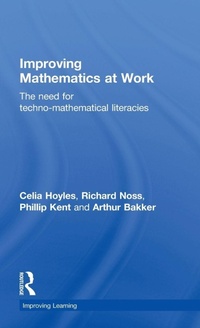
Improving Mathematics at Work
The Need for Techno-Mathematical Literacies
1st Edition
Published on 5. May 2010
Book
Hardback
224 pages
978-0-415-48007-9 (ISBN)
Description
Improving Mathematics at Work questions the mathematical knowledge and skills that matter in the twenty-first century world of work, and studies how the use of mathematics in the workplace is evolving in the rapidly-changing context of new technologies and globalisation. Through a series of case studies from the manufacturing and financial service sectors, the authors argue that there has been a radical shift in the type mathematical skills required for work - a shift not yet fully recognised by the formal education system, or by employers and managers.
Examining how information technology has changed mathematical requirements, the idea of Techno-mathematical Literacies (TmL) is introduced to describe the emerging need to be fluent in the language of mathematical inputs and outputs to technologies and to interpret and communicate with these, rather than merely to be procedurally competent with calculations. The authors argue for careful analyses of workplace activities, looking beyond the conventional thinking about numeracy, which still dominates policy arguments about workplace mathematics. Throughout their study, the authors answer the following fundamental questions:
What mathematical knowledge and skills matter for the world of work today?
How does information technology change the necessary knowledge and the ways in which it is encountered?
How can we develop these essential new skills in the workforce?
With evidence of successful opportunities to learn with TmL that were co-designed and evaluated with employers and employees, this book provides suggestions for the development of TmL through the use of authentic learning activities, and interactive software design. Essential reading for trainers and managers in industry, teachers, researchers and lecturers of mathematics education, and stakeholders implementing evidence-based policy, this book maps the fundamental changes taking place in workplace mathematics.
Examining how information technology has changed mathematical requirements, the idea of Techno-mathematical Literacies (TmL) is introduced to describe the emerging need to be fluent in the language of mathematical inputs and outputs to technologies and to interpret and communicate with these, rather than merely to be procedurally competent with calculations. The authors argue for careful analyses of workplace activities, looking beyond the conventional thinking about numeracy, which still dominates policy arguments about workplace mathematics. Throughout their study, the authors answer the following fundamental questions:
What mathematical knowledge and skills matter for the world of work today?
How does information technology change the necessary knowledge and the ways in which it is encountered?
How can we develop these essential new skills in the workforce?
With evidence of successful opportunities to learn with TmL that were co-designed and evaluated with employers and employees, this book provides suggestions for the development of TmL through the use of authentic learning activities, and interactive software design. Essential reading for trainers and managers in industry, teachers, researchers and lecturers of mathematics education, and stakeholders implementing evidence-based policy, this book maps the fundamental changes taking place in workplace mathematics.
More details
Series
Language
English
Place of publication
London
United Kingdom
Publishing group
Taylor & Francis Ltd
Target group
Professional and scholarly
Product notice
Paper over boards
Illustrations
38 s/w Abbildungen, 6 s/w Tabellen
6 Tables, black and white; 38 Illustrations, black and white
Dimensions
Height: 222 mm
Width: 145 mm
Thickness: 16 mm
Weight
419 gr
ISBN-13
978-0-415-48007-9 (9780415480079)
Copyright in bibliographic data and cover images is held by Nielsen Book Services Limited or by the publishers or by their respective licensors: all rights reserved.
Schweitzer Classification
Other editions
Additional editions
Celia Hoyles | Richard Noss | Phillip Kent
Improving Mathematics at Work
The Need for Techno-Mathematical Literacies
Book
05/2010
1st Edition
Routledge
€59.50
Shipment within 15-20 days
Celia Hoyles | Richard Noss | Phillip Kent
Improving Mathematics at Work
The Need for Techno-Mathematical Literacies
E-Book
04/2010
Routledge
€62.99
Available for download
Celia Hoyles | Richard Noss | Phillip Kent
Improving Mathematics at Work
The Need for Techno-Mathematical Literacies
E-Book
04/2010
Routledge
€63.49
Available for download
Persons
Celia Hoyles is Professor of Mathematics Education, London Knowledge Lab, Institute of Education University of London, UK.
Richard Noss is Professor of Mathematics Education and Co-director of the London Knowledge Lab, Institute of Education University of London, UK.
Philip Kent is a Research Officer, London Knowledge Lab, Institute of Education University of London, UK.
Arthur Bakker is a Research Officer in the TmL project, currently at the Freudenthal Institute, Utrecht University, the Netherlands.
Richard Noss is Professor of Mathematics Education and Co-director of the London Knowledge Lab, Institute of Education University of London, UK.
Philip Kent is a Research Officer, London Knowledge Lab, Institute of Education University of London, UK.
Arthur Bakker is a Research Officer in the TmL project, currently at the Freudenthal Institute, Utrecht University, the Netherlands.
Content
Acknowledgements
1. Introduction
1.1 New Demands on Commerce and Industry
1.2 Information Technology and the Changing Nature of Work
1.3 Background to the Research
1.4 A Description of Key Ideas
1.5 Aims and Methods
2. Manufacturing 1: Modelling and Improving the Work Process in Manufacturing Industry
2.1 Process Improvement in Manufacturing
2.2 Workplace Observations of Process Improvement
2.3 Learning Opportunities for Process Improvement
2.4 Outcomes for Learning and Practice
2.5 Conclusions
3. Manufacturing 2: Using Statistics to Improve the Production Process
3.1 Process Control and Improvement Using Statistics
3.2 Workplace Observations of Statistical Process Control
3.3 Learning Opportunities for Statistical Process Control
3.4 Outcomes for Learning and Practice
3.5 Conclusions
4. Financial Services 1: Pensions and Investments
4.1 The Techno-Mathematics of Pensions and the Work of Customer Services
4.2 Workplace Observations in Pensions and Investments
4.3 Pensions and Investments: Tebos and Learning Opportunities
4.4 Outcomes for Learning and Practice
4.5 Conclusions
5. Financial Services 2: Mortgages
5.1 The Techno-Mathematics of the Current Account Mortgage
5.2 Workplace Observations in Mortgage Sales and Customer Service
5.3 Current Account Mortgages: Tebo and Learning Opportunities
5.4 Outcomes for Learning and Practice
5.5 Conclusions
6. Summary, Reflections and Conclusions
6.1 Key Findings
6.2 Understanding Systems with Models: Pseudo-Mathematical and Techno-Mathematical
6.3 Successes and Challenges
6.4 Conclusions and Implications
Appendix: Details of Fieldwork - Companies and Organisations Which Participated In the Research
Appendix: Further Reading on the Techno-Mathematical Literacies Research
Bibliography
1. Introduction
1.1 New Demands on Commerce and Industry
1.2 Information Technology and the Changing Nature of Work
1.3 Background to the Research
1.4 A Description of Key Ideas
1.5 Aims and Methods
2. Manufacturing 1: Modelling and Improving the Work Process in Manufacturing Industry
2.1 Process Improvement in Manufacturing
2.2 Workplace Observations of Process Improvement
2.3 Learning Opportunities for Process Improvement
2.4 Outcomes for Learning and Practice
2.5 Conclusions
3. Manufacturing 2: Using Statistics to Improve the Production Process
3.1 Process Control and Improvement Using Statistics
3.2 Workplace Observations of Statistical Process Control
3.3 Learning Opportunities for Statistical Process Control
3.4 Outcomes for Learning and Practice
3.5 Conclusions
4. Financial Services 1: Pensions and Investments
4.1 The Techno-Mathematics of Pensions and the Work of Customer Services
4.2 Workplace Observations in Pensions and Investments
4.3 Pensions and Investments: Tebos and Learning Opportunities
4.4 Outcomes for Learning and Practice
4.5 Conclusions
5. Financial Services 2: Mortgages
5.1 The Techno-Mathematics of the Current Account Mortgage
5.2 Workplace Observations in Mortgage Sales and Customer Service
5.3 Current Account Mortgages: Tebo and Learning Opportunities
5.4 Outcomes for Learning and Practice
5.5 Conclusions
6. Summary, Reflections and Conclusions
6.1 Key Findings
6.2 Understanding Systems with Models: Pseudo-Mathematical and Techno-Mathematical
6.3 Successes and Challenges
6.4 Conclusions and Implications
Appendix: Details of Fieldwork - Companies and Organisations Which Participated In the Research
Appendix: Further Reading on the Techno-Mathematical Literacies Research
Bibliography