

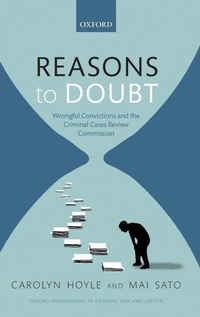
Reasons to Doubt
Wrongful Convictions and the Criminal Cases Review Commission
Published on 31. January 2019
Book
Hardback
406 pages
978-0-19-879457-8 (ISBN)
Description
This book reveals what happens to applications for post-conviction review when those in England, Wales, and Northern Ireland who believe they are wrongfully convicted apply to the Criminal Cases Review Commission, the only body that can refer a case back to the Court of Appeal once appellants opportunities for direct appeal are exhausted. While the Court is obliged to hear all such referrals, the Commission can only refer a case where it believes there is a real possibility that the Court will quash the conviction. The first empirical study of all stages of decision-making within the Commission, this book starts from the premise that the test applied by the Commission (the real possibility test) is not inflexible. Though created by statute and refined through case law, it must be determined on a case-by-case basis, drawing too on cultural and structural variables, alongside fresh evidence gathered by the Commission.
Through in-depth analysis of case files and interviews, Hoyle and Sato scrutinize the Commissions operational practices, its working rules and assumptions, considering how these influence its understanding of the real possibility test. Situating their rich empirical data within a framework of the Commissions social, organizational, and legal contexts, this book demonstrates that in its open-ended investigations there is considerable scope for discretion; for thorough exploration of all possible avenues or for choosing a more superficial consideration of a case. It emerges that while structured internal guidance, drawing heavily on Court jurisprudence, shapes decision-making, creating consistency in approach, there remains some variability across cases, over time, that can be accounted for by the different professional backgrounds and personalities of Commission staff.
Through in-depth analysis of case files and interviews, Hoyle and Sato scrutinize the Commissions operational practices, its working rules and assumptions, considering how these influence its understanding of the real possibility test. Situating their rich empirical data within a framework of the Commissions social, organizational, and legal contexts, this book demonstrates that in its open-ended investigations there is considerable scope for discretion; for thorough exploration of all possible avenues or for choosing a more superficial consideration of a case. It emerges that while structured internal guidance, drawing heavily on Court jurisprudence, shapes decision-making, creating consistency in approach, there remains some variability across cases, over time, that can be accounted for by the different professional backgrounds and personalities of Commission staff.
Reviews / Votes
Reasons to Doubt: Wrongful Convictions and the Criminal Case Review Commission is a careful work of scholarship ... for readers with a genuine interest in the role and impact of individual discretion in institutional decisionmaking, this book will be well worth your time. * Peter Aadoson, Canadian Law Library Review * This book is essential reading for those interested in miscarriages of justice and the ability of the CCRC to provide a remedy through investigation and referral to the CACD. Although it may not end academic criticism of the CCRC, it will at least ensure that such criticism is more empirically informed and thereby much sounder. * Richard Nobles, British Journal of Criminology * The authors' work represents a substantial contribution to the field of criminal justice scholarship by providing the first in-depth empirical examination of decision making at the CCRC, giving a unique insight into an organisation that has become subject to increasing scrutiny in the last decade. ... there is no doubt that this monograph will be of significant use to other criminal justice researchers in this field. * H. C. Greenwood, Howard Journal of Crime & Justice * Appealing against such convictions through the Criminal Cases Review Commission, which is often considered a "last hope", is a daunting prospect for any appellate lawyer, and Carolyn Hoyle and Mai Sato's Reason to Doubt is both an academically rigorous examination of the workings of the much-criticised and hideously underfunded body, and an invaluable guide to applicants and their lawyers to the little-known machinery of the commission. This is essential reading for anyone concerned with miscarriages of justice. * Matthew Scott, The Times [The best crime and legal books to read in the sun] * This is an important book in a number of respects. In terms of thoroughness of analysis of the subject, it is hard to find a rival. ... This book is recommended reading for those primarily concerned with criminal appeals and miscarriages of justice. * Paul Dargue, International Journal of Clinical Legal Education * This book about the Criminal Cases Review Commission (CCRC) is a treasure trove of information. Lawyers who represent applicants to the CCRC may find it especially of interest, offering insights that could help their work. * Michael Zander QC, LSE * a major piece of research ... The book is a vital contribution in shining light on a watchdog that isnt widely understood and yet goes to the heart of the integrity of our justice system. * Jon Robins, New Law Journal *More details
Series
Language
English
Place of publication
Oxford
United Kingdom
Target group
Professional and scholarly
Dimensions
Height: 240 mm
Width: 161 mm
Thickness: 26 mm
Weight
772 gr
ISBN-13
978-0-19-879457-8 (9780198794578)
Copyright in bibliographic data and cover images is held by Nielsen Book Services Limited or by the publishers or by their respective licensors: all rights reserved.
Schweitzer Classification
Other editions
Additional editions
Carolyn Hoyle | Mai Sato
Reasons to Doubt
Wrongful Convictions and the Criminal Cases Review Commission
E-Book
01/2019
1st Edition
OUP eBook
€70.99
Available for download
Carolyn Hoyle | Mai Sato
Reasons to Doubt
Wrongful Convictions and the Criminal Cases Review Commission
E-Book
01/2019
1st Edition
OUP eBook
€78.49
Available for download
Persons
Carolyn Hoyle is Professor of Criminology at the University of Oxford, and Fellow of Green Templeton College.
She teaches and researches on the death penalty - in all jurisdictions - on wrongful convictions, and on other aspects of victimization.
Mai Sato is Fellow at the School of Regulation and Global Governance, Australia National University
She teaches and researches on the death penalty - in all jurisdictions - on wrongful convictions, and on other aspects of victimization.
Mai Sato is Fellow at the School of Regulation and Global Governance, Australia National University
Content
1: Responding to Wrongful Convictions
2: The Criminal Cases Review Commission: Under-Researched But Under Scrutiny
3: Understanding Discretion at the Commission: A Socio-Legal Approach
4: From Application to Conclusion: How Law, Policy, and Culture Shape Organizational Decision-Making
5: The Nature of Applications to the Commission
6: Triage: the Screening Process-In or Out?
7: Managing Uncertainty in Forensic and Expert Evidence Cases
8: Complainant Credibility in Sexual Offence Cases
9: Responding to Applicants' Allegations of Policing Without Integrity
10: Responding to Applicants' Claims of Inadequate Defence
11: Working Cooperatively with Other Criminal Justice Institutions
12: Managing Efficiency and Thoroughness in Case Review
13: 'Post-Decision Decision-Making': Further Submissions and Reapplications
14: Last Chance for Justice
Appendix
References
2: The Criminal Cases Review Commission: Under-Researched But Under Scrutiny
3: Understanding Discretion at the Commission: A Socio-Legal Approach
4: From Application to Conclusion: How Law, Policy, and Culture Shape Organizational Decision-Making
5: The Nature of Applications to the Commission
6: Triage: the Screening Process-In or Out?
7: Managing Uncertainty in Forensic and Expert Evidence Cases
8: Complainant Credibility in Sexual Offence Cases
9: Responding to Applicants' Allegations of Policing Without Integrity
10: Responding to Applicants' Claims of Inadequate Defence
11: Working Cooperatively with Other Criminal Justice Institutions
12: Managing Efficiency and Thoroughness in Case Review
13: 'Post-Decision Decision-Making': Further Submissions and Reapplications
14: Last Chance for Justice
Appendix
References