

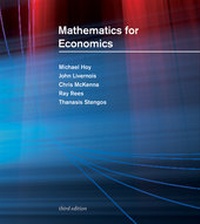
Mathematics for Economics
3rd Edition
Published on 4. March 2011
Book
Hardback
974 pages
978-0-262-01507-3 (ISBN)
Description
A new edition of a comprehensive undergraduate mathematics text for economics students.This text offers a comprehensive presentation of the mathematics required to tackle problems in economic analyses. To give a better understanding of the mathematical concepts, the text follows the logic of the development of mathematics rather than that of an economics course. The only prerequisite is high school algebra, but the book goes on to cover all the mathematics needed for undergraduate economics. It is also a useful reference for graduate students. After a review of the fundamentals of sets, numbers, and functions, the book covers limits and continuity, the calculus of functions of one variable, linear algebra, multivariate calculus, and dynamics. To develop the student's problem-solving skills, the book works through a large number of examples and economic applications. This streamlined third edition offers an array of new and updated examples. Additionally, lengthier proofs and examples are provided on the book's website. The book and the web material are cross-referenced in the text. A student solutions manual is available, and instructors can access online instructor's material that includes solutions and PowerPoint slides. Visit http://mitpress.mit.edu/math_econ3 for complete details.
More details
Series
Edition
third edition
Language
English
Place of publication
Cambridge
United States
Publishing group
MIT Press Ltd
Target group
College/higher education
Interest Age: From 18 years
Edition type
New edition
Product notice
Cloth over boards
Dimensions
Height: 229 mm
Width: 203 mm
Thickness: 48 mm
Weight
1701 gr
ISBN-13
978-0-262-01507-3 (9780262015073)
Copyright in bibliographic data and cover images is held by Nielsen Book Services Limited or by the publishers or by their respective licensors: all rights reserved.
Schweitzer Classification
Other editions
Additional editions
Michael Hoy | John Livernois | Chris Mckenna
Mathematics for Economics
Book
03/2011
3rd Edition
MIT Press
€71.80
No shipping information available
Previous edition

Michael Hoy | John Livernois | Chris Mckenna
Mathematics for Economics
Book
07/2001
2nd Edition
MIT Press
€77.94
Shipment within 10-20 days
Persons
Michael Hoy is a faculty member in the Economics Department at the University of Guelph.
John Livernois is a faculty member in the Economics Department at the University of Guelph, Ontario.
Chris McKenna is a faculty member in the Economics Department at the University of Guelph, Ontario.
Ray Rees is a faculty member at the Ludwig Maximilians University, Munich.
Thanasis Stengos is a faculty member in the Economics Department at the University of Guelph, Ontario.
John Livernois is a faculty member in the Economics Department at the University of Guelph, Ontario.
Chris McKenna is a faculty member in the Economics Department at the University of Guelph, Ontario.
Ray Rees is a faculty member at the Ludwig Maximilians University, Munich.
Thanasis Stengos is a faculty member in the Economics Department at the University of Guelph, Ontario.
Content
Preface Part I Introduction and Fundamentals 1 Introduction 3 1.1 What Is an Economic Model? 3 1.2 How to Use This Book 8 1.3 Conclusion 9 2 Review of Fundamentals 11 2.1 Sets and Subsets 11 2.2 Numbers 23 2.3 Some Properties of Point Sets in Rn 31 2.4 Functions 41 3 Sequences, Series, and Limits 61 3.1 Definition of a Sequence 61 3.2 Limit of a Sequence 65 3.3 Present-Value Calculations 69 3.4 Properties of Sequences 79 3.5 Series 84 Part II Univariate Calculus and Optimization 4 Continuity of Functions 103 4.1 Continuity of a Function of One Variable 103 4.2 Economic Applications of Continuous and Discontinuous Functions 113 5 The Derivative and Differential for Functions of One Variable 127 5.1 Definition of a Tangent Line 127 5.2 Definition of the Derivative and the Differential 134 5.3 Conditions for Differentiability 141 5.4 Rules of Differentiation 147 5.5 Higher Order Derivatives: Concavity and Convexity of a Function 175 5.6 Taylor Series Formula and the Mean-Value Theorem 185 6 Optimization of Functions of One Variable 195 6.1 Necessary Conditions for Unconstrained Maxima and Minima 196 6.2 Second-Order Conditions 211 6.3 Optimization over an Interval 220 Part III Linear Algebra 7 Systems of Linear Equations 235 7.1 Solving Systems of Linear Equations 236 7.2 Linear Systems in n-Variables 250 8 Matrices 267 8.1 General Notation 267 8.2 Basic Matrix Operations 273 8.3 Matrix Transposition 288 8.4 Some Special Matrices 293 9 Determinants and the Inverse Matrix 301 9.1 Defining the Inverse 301 9.2 Obtaining the Determinant and Inverse of a 3×3 Matrix 318 9.3 The Inverse of an n×n Matrix and Ist Properties 324 9.4 Cramer's Rule 329 10 Some Advanced Topics in Linear Algebra 347 10.1 Vector Spaces 347 10.2 The Eigenvalue Problem 363 10.3 Quadratic Forms 378 Part IV Multivariate Calculus 11 Calculus for Functions of n-Variables 393 11.1 Partial Differentiation 393 11.2 Second-Order Partial Derivatives 407 11.3 The First-Order Total Differential 415 11.4 Curvature Properties: Concavity and Convexity 436 11.5 More Properties of Functions with Economic Applications 451 11.6 Taylor Series Expansion* 464 12 Optimization of Functions of n-Variables 473 12.1 First-Order Conditions 474 12.2 Second-Order Conditions 484 12.3 Direct Restrictions on Variables 491 13 Constrained Optimization 503 13.1 Constrained Problems and Approaches to Solutions 504 13.2 Second-Order Conditions for Constrained Optimization 516 13.3 Existence, Uniqueness, and Characterization of Solutions 520 14 Comparative Statics 529 14.1 Introduction to Comparative Statics 529 14.2 General Comparative-Statics Analysis 540 14.3 The Envelope Theorem 554 15 Concave Programming and the Kuhn-Tucker Conditions 567 15.1 The Concave-Programming Problem 567 15.2 Many Variables and Constraints 575 Part V Integration and Dynamic Methods 16 Integration 585 16.1 The Indefinite Integral 585 16.2 The Riemann (Definite) Integral 593 16.3 Properties of Integrals 605 16.4 Improper Integrals 613 16.5 Techniques of Integration 623 17 An Introduction to Mathematics for Economic Dynamics 633 17.1 Modeling Time 634 18 Linear, First-Order Difference Equations 643 18.1 Linear, First-Order, Autonomous Difference Equations 643 18.2 The General, Linear, First-Order Difference Equation 656 19 Nonlinear, First-Order Difference Equations 665 19.1 The Phase Diagram and Qualitative Analysis 665 19.2 Cycles and Chaos 673 20 Linear, Second-Order Difference Equations 681 20.1 The Linear, Autonomous, Second-Order Difference Equation 681 20.2 The Linear, Second-Order Difference Equation with aVariableTerm 708 21 Linear, First-Order Differential Equations 715 21.1 Autonomous Equations 715 21.2 Nonautonomous Equations 731 22 Nonlinear, First-Order Differential Equations 739 22.1 Autonomous Equations and Qualitative Analysis 739 22.2 Two Special Forms of Nonlinear, First-Order Differential Equations 748 23 Linear, Second-Order Differential Equations 753 23.1 The Linear, Autonomous, Second-Order Differential Equation 753 23.2 The Linear, Second-Order Differential Equation with aVariableTerm 772 24 Simultaneous Systems of Differential and Difference Equations 781 24.1 Linear Differential Equation Systems 781 24.2 Stability Analysis and Linear Phase Diagrams 803 24.3 Systems of Linear Difference Equations 825 25 Optimal Control Theory 845 25.1 The Maximum Principle 848 25.2 Optimization Problems Involving Discounting 860 25.3 Alternative Boundary Conditions on x(T ) 872 25.4 Infinite-Time Horizon Problems 886 25.5 Constraints on the Control Variable 899 25.6 Free-Terminal-Time Problems (T Free) 909 Answers 921 Index 953