

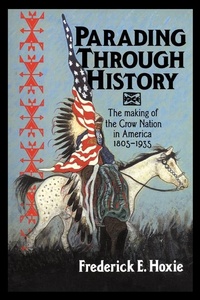
Parading through History
The Making of the Crow Nation in America 1805-1935
Published on 28. March 1997
Book
Paperback/Softback
408 pages
978-0-521-48522-7 (ISBN)
Description
This history of the Crow Indians links their nineteenth-century nomadic life and their modern existence. The Crows not only withstood the dislocation and conquest that was visited upon them after 1805, but acted in the midst of these events to construct a modern Indian community - a nation. Their efforts sustained the pride and strength reflected in Chief Plenty Coups' statement in 1925 that he did 'not care at all what historians have to say about Crow Indians,' as well as their community's faith in the beauty of its traditions and its inventions. Frederick Hoxie demonstrates that contact with outsiders drew the Crows together and tested their ability to adapt their traditions to new conditions. He emphasizes political life, but also describes changes in social relations, religious beliefs and economic activities. His final chapter discusses the significance of the Crow experience for American history in general.
Reviews / Votes
"...Hoxie's work is a welcome addition to our understanding of how native people adjusted to the advance of American society and its capitalistic economy." American Historical Review "...Hoxie has carefully researched archival evidence and has applied his field work on the Crow Reservation in order to present a better understanding of Crow survival amidst historical change. This book is strongly recommended..." Western Historical Quarterly "Frederick E. Hoxie makes an important contribution to our understanding of the West and its original inhabitants. Wonderfully written, hugely informative, Parading Through History will go down as the history of the Crow Nation." James Welch, author of Killing Custer "Parading through History" is an important and thought-provoking work. Frederick Hoxie presents a story of the perseverance and adaptation that led to the construction of a modern Indian community....Parading through History deepens our understanding of Crow history and answers a long-felt need to examine how this people creatively adapted to changing circumstances while retaining a distinctive crow identity. It also raises many exciting new questions in Crow history." Martha Foster, American Indian Culture and Research Journal "Hoxie provides a unique view of tribal structure....Parading through History is highly recommended reading. Well written and researched, it offers a significant new approach to tribal history, one that other scholars are sure to follow." Robert A. Trennert, Montana Reviews "Parading through History is the most penetrating and intellectually challenging book available on modern Crow history and politics....It is an essential book for any further examination and analysis of Crow history and intercultural dynamics." C. Adrian HeidenreichMore details
Series
Language
English
Place of publication
Cambridge
United Kingdom
Target group
Professional and scholarly
Product notice
Paperback (trade)
Illustrations
24 Halftones, unspecified
Dimensions
Height: 234 mm
Width: 156 mm
Thickness: 22 mm
Weight
617 gr
ISBN-13
978-0-521-48522-7 (9780521485227)
Copyright in bibliographic data and cover images is held by Nielsen Book Services Limited or by the publishers or by their respective licensors: all rights reserved.
Schweitzer Classification
Other editions
Additional editions
Book
08/1995
Cambridge University Press
€61.90
Article exhausted; check for reprint
Previous edition
Book
08/1995
Cambridge University Press
€61.90
Article exhausted; check for reprint
Person
Content
Prologue: why are there no Indians in the twentieth century? Part I. Into History, 1805-1890: 1. Immigration in reverse; 2. Parading into history; 3. Life in a tightening circle; 4. Refugees at the agency; 5. A new home; Part II. The Making of a Nation, 1890-1920: 6. Searching for structure: Crow families in transition; 7. New gods in Crow country: the development of religious pluralism; 8. Leaders in a new arena; 9. Making a living: the Crow economy, 1890-1920; Part III. Being Crow 1920-1935: 10. Stability and dependency in the 1920s; 11. 'Standing for rights: the Crow rejection of the Indian reorganization act'; 12. Crows and other Americans.