

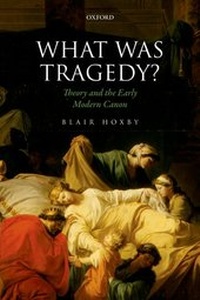
What Was Tragedy?
Theory and the Early Modern Canon
Published on 27. April 2017
Book
Paperback/Softback
376 pages
978-0-19-881059-9 (ISBN)
Description
Twentieth century critics have definite ideas about tragedy. They maintain that in a true tragedy, fate must feel the resistance of the tragic hero's moral freedom before finally crushing him, thus generating our ambivalent sense of terrible waste coupled with spiritual consolation. Yet far from being a timeless truth, this account of tragedy only emerged in the wake of the French Revolution.
What Was Tragedy? demonstrates that this account of the tragic, which has been hegemonic from the early nineteenth century to the present despite all the twists and turns of critical fashion in the twentieth century, obscured an earlier poetics of tragedy that evolved from 1515 to 1795. By reconstructing that poetics, Blair Hoxby makes sense of plays that are "merely pathetic, not truly tragic," of operas with happy endings, of Christian tragedies, and of other plays that advertised themselves as tragedies to early modern audiences and yet have subsequently been denied the palm of tragedy by critics. In doing so, Hoxby not only illuminates masterpieces by Shakespeare, Calderon, Corneille, Racine, Milton, and Mozart, he also revivifies a vast repertoire of tragic drama and opera that has been relegated to obscurity by critical developments since 1800. He suggests how many of these plays might be reclaimed as living works of theater. And by reconstructing a lost conception of tragedy both ancient and modern, he illuminates the hidden assumptions and peculiar blind-spots of the idealist critical tradition that runs from Schelling, Schlegel, and Hegel, through Wagner, Nietzsche, and Freud, up to modern post-structuralism.
What Was Tragedy? demonstrates that this account of the tragic, which has been hegemonic from the early nineteenth century to the present despite all the twists and turns of critical fashion in the twentieth century, obscured an earlier poetics of tragedy that evolved from 1515 to 1795. By reconstructing that poetics, Blair Hoxby makes sense of plays that are "merely pathetic, not truly tragic," of operas with happy endings, of Christian tragedies, and of other plays that advertised themselves as tragedies to early modern audiences and yet have subsequently been denied the palm of tragedy by critics. In doing so, Hoxby not only illuminates masterpieces by Shakespeare, Calderon, Corneille, Racine, Milton, and Mozart, he also revivifies a vast repertoire of tragic drama and opera that has been relegated to obscurity by critical developments since 1800. He suggests how many of these plays might be reclaimed as living works of theater. And by reconstructing a lost conception of tragedy both ancient and modern, he illuminates the hidden assumptions and peculiar blind-spots of the idealist critical tradition that runs from Schelling, Schlegel, and Hegel, through Wagner, Nietzsche, and Freud, up to modern post-structuralism.
Reviews / Votes
What Was Tragedy? reflects recent interest in reception studies, as some of its chapters diligently consider the performance history and success of a variety of theatrical texts, some now forgotten (as is the case of Stefonio's Crispus), some relegated to a secondary position within the corpus of extremely canonical authors (as is the case of Shakespeare's Antony and Cleopatra). * Marta Albala Pelegrin, Bulletin of the Comediantes * One of this year's greatest scholarly achievements ... Combining literary and intellectual history, philosophy, and formal analysis, Hoxby recovers a largely lost early modern poetics of tragedy ... What Was Tragedy? has many implications not just for how we understand tragedy in our period, but also for how we conceive of early modern selfhood, how we understand the history of emotions, and how we go about the business of literary periodization. It's a major piece of scholarship. * Kevin Curran, Studies in English Literature 1500-1900 * Scholars of early modernity have long recognized the passions as a central concern of early modern culture. What Was Tragedy? illustrates how this concern was largely subsumed under the universalizing sway of idealism. In so doing, the book addresses a methodological concern within early modern studies about the pitfalls of reducing this period to the terms of modernity. * Anna Rosensweig, Eighteenth-Century Fiction * Hoxby exhibits a powerful disciplinary, linguistic, and chronological reach, and asks fundamental questions about secular and sacred drama, the Renaissance and the Enlightenment, and early modern and post-Romantic thought. For its combination of imaginative, omnivorous research and an argument that has already caused excited discussion here at RSA, the committee found this an extraordinary piece of work. * The Phyllis Goodhart Gordan Book Prize of the Renaissance Society of America Honorable Mention * Hoxby (Stanford Univ.) has written an intriguing work that attempts to establish what the genre of tragedy meant before idealists such as Schelling, Schlegel, and Hegel created the definition now accepted. * J. D. Sharpe, CHOICE * This is an important book, and Hoxbys call to attend to and describe what was actually performed as tragedy in the period restores vitality and variation to the canon. Ultimately, he affords us a much clearer view of the masterwork over which the period labored. * Alex Eric Hernandez, Modern Philology * Hoxby makes a very compelling case for attending more carefully to works that might answer to the name of tragedy produced in Europe between 1515 and 1795 ... Hoxbys book is a superb achievement, and treats us to nuanced and sensitive readings * Paul A. Kottman * In this densely learned book, Blair Hoxby sets himself the worthy and formidable task of scraping away the mores of German Idealists so that early modern tragedy might be read on its own terms ... it will be a valuable reference for years to come. * Feisal G. Mohamed, Milton Quarterly * The sweep of the book is its greatest recommendation in many respects. Hoxby's deep knowledge of music and music history, world philosophy, and theatre practice provide a worthwhile and perhaps even indispensable addition to the body of work on the nature of tragedy. For the music and theatre scholar, Hoxby's work in answering his past-tense question should prove invaluable for those seeking to answer the same question in the here and now. * Michael Schwartz, Text & Presentation *More details
Language
English
Place of publication
Oxford
United Kingdom
Target group
College/higher education
Illustrations
Numerous black-and-white halftones
Dimensions
Height: 234 mm
Width: 155 mm
Thickness: 21 mm
Weight
574 gr
ISBN-13
978-0-19-881059-9 (9780198810599)
Copyright in bibliographic data and cover images is held by Nielsen Book Services Limited or by the publishers or by their respective licensors: all rights reserved.
Schweitzer Classification
Other editions
Additional editions
Book
10/2015
Oxford University Press
€155.80
Shipment within 15-20 days
Person
Blair Hoxby is Professor of English at Stanford University. After graduating with an A. B. from Harvard University, he studied at Oxford University as a Rhodes Scholar. He then earned his Ph.D. from Yale University. Before arriving at Stanford, he was an Associate Professor of English at Yale and an Associate Professor of History and Literature at Harvard. He is the author of Mammon's Music: Literature and Economics in the Age of Milton and the co-editor of Milton in the Long Restoration. He is writing a book on baroque theater and editing essay collections on tragedy in the Trans-Atlantic Enlightenment, on tragedy during the European Enlightenment, and on opera and tragedy from the seventeenth to the eighteenth centuries.
Content
THE PHILOSOPHY OF THE TRAGIC AND THE POETICS OF TRAGEDY; THE WORLD WE HAVE LOST