

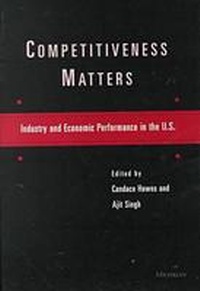
Competitiveness Matters
Industry and Economic Performance in the U.S.
Will be published approx. on 6. April 2000
Book
Hardback
216 pages
978-0-472-10983-8 (ISBN)
Description
This book argues, against the current view, that competitiveness--that is, the competitiveness of the manufacturing sector--matters to the long-term health of the U.S. economy and particularly to its long-term capacity to raise the standard of living of its citizens. The book challenges the arguments popularized most recently by Paul Krugman that
competitiveness is a dangerous obsession that distracts us from the question most central to solving the problem of stagnant real income growth, namely, what causes productivity growth, especially in the service sector.
The central argument is that, if the U.S. economy is to achieve full employment with rising real wages, it is necessary to enhance the competitiveness of its tradable goods sector. The book shows that current account deficits cannot be explained by macroeconomic mismanagement but are rather the consequence of an uncompetitive manufacturing sector. It finds that the long-term health of the manufacturing sector requires not only across-the-board policies to remedy problems of low or inefficient investment, but also sectoral policies to address problems that are strategic to resolving the balance of payments problems. Lessons are drawn from the experience of some European and Asian countries.
This book will be of interest to economists, political scientists, and business researchers concerned with the place of the manufacturing sector in overall health of the U.S. economy, with issues of industrial policy and industrial restructuring, and with the conditions for rising standards of living.
Candace Howes is Associate Professor, Barbara Hogate Ferrin Chair, Connecticut College. Ajit Singh is Professor of Economics, Queens College, Cambridge.
competitiveness is a dangerous obsession that distracts us from the question most central to solving the problem of stagnant real income growth, namely, what causes productivity growth, especially in the service sector.
The central argument is that, if the U.S. economy is to achieve full employment with rising real wages, it is necessary to enhance the competitiveness of its tradable goods sector. The book shows that current account deficits cannot be explained by macroeconomic mismanagement but are rather the consequence of an uncompetitive manufacturing sector. It finds that the long-term health of the manufacturing sector requires not only across-the-board policies to remedy problems of low or inefficient investment, but also sectoral policies to address problems that are strategic to resolving the balance of payments problems. Lessons are drawn from the experience of some European and Asian countries.
This book will be of interest to economists, political scientists, and business researchers concerned with the place of the manufacturing sector in overall health of the U.S. economy, with issues of industrial policy and industrial restructuring, and with the conditions for rising standards of living.
Candace Howes is Associate Professor, Barbara Hogate Ferrin Chair, Connecticut College. Ajit Singh is Professor of Economics, Queens College, Cambridge.
More details
Language
English
Place of publication
Ann Arbor
United States
Target group
Professional and scholarly
Illustrations
18 drawings, 19 tables
Dimensions
Height: 229 mm
Width: 152 mm
ISBN-13
978-0-472-10983-8 (9780472109838)
Copyright in bibliographic data and cover images is held by Nielsen Book Services Limited or by the publishers or by their respective licensors: all rights reserved.
Schweitzer Classification
Persons
Candace Howes is Associate Professor, Barbara Hogate Ferrin Chair, Connecticut College.
Ajit Singh is Professor of Economics, Queens College, Cambridge.
Ajit Singh is Professor of Economics, Queens College, Cambridge.