

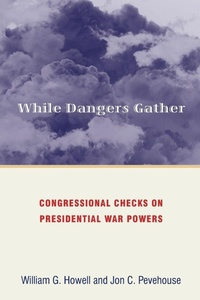
While Dangers Gather
Congressional Checks on Presidential War Powers
Published on 26. August 2007
Book
Paperback/Softback
384 pages
978-0-691-13462-8 (ISBN)
Description
Nearly five hundred times in the past century, American presidents have deployed the nation's military abroad, on missions ranging from embassy evacuations to full-scale wars. The question of whether Congress has effectively limited the president's power to do so has generally met with a resounding "no." In While Dangers Gather, William Howell and Jon Pevehouse reach a very different conclusion. The authors--one an American politics scholar, the other an international relations scholar--provide the most comprehensive and compelling evidence to date on Congress's influence on presidential war powers. Their findings have profound implications for contemporary debates about war, presidential power, and Congress's constitutional obligations. While devoting special attention to the 2003 invasion of Iraq, this book systematically analyzes the last half-century of U.S. military policy. Among its conclusions: Presidents are systematically less likely to exercise military force when their partisan opponents retain control of Congress.
The partisan composition of Congress, however, matters most for proposed deployments that are larger in size and directed at less strategically important locales. Moreover, congressional influence is often achieved not through bold legislative action but through public posturing--engaging the media, raising public concerns, and stirring domestic and international doubt about the United States' resolve to see a fight through to the end.
The partisan composition of Congress, however, matters most for proposed deployments that are larger in size and directed at less strategically important locales. Moreover, congressional influence is often achieved not through bold legislative action but through public posturing--engaging the media, raising public concerns, and stirring domestic and international doubt about the United States' resolve to see a fight through to the end.
Reviews / Votes
Co-Winner of the 2008 Richard E. Neustadt Award, Presidency Research Section of the American Political Science Association Winner of the 2007 D. B. Hardeman Prize, Lyndon Baines Johnson Foundation "[The authors] argue that when it comes to 'wars of choice,' Congress's partisan composition influences whether the U.S. sends troops abroad, how likely the nation is to respond to a foreign crisis with force, and how long the decision to respond takes...To understand how Congress wields its influence during the lead-up to war, Howell surveyed the range of congressional actions--hearings, investigations, nonbinding resolutions, public criticisms. In the final section of the book, he connect[s] those activities to foreign-affairs media coverage."--Laura Stuart, Chicago Magazine "Howell and Pevehouse's research is an excellent addition to a stream of literature that has left woefully unconsidered the effects of domestic politics in general and the institution of Congress in particular on the international relations process... Their book shows that Congress can, and apparently does, have substantial effects on how the president crafts foreign policy. Future scholars would be well advised to continue to walk down the path paved by this well crafted addition to the American foreign policy literature."--Walt Jatkowski, APSA Booknotes "Taken in its entirety, the outstanding scholarship presented in While Dangers Gather offers critical insight into the domestic politics of war and provides an interesting case in favor of divided government as an apparent check on presidents' proclivity to engage in war."--Jeffrey S. Peake, Presidential Studies Quarterly "The book is refreshingly straightforward in presentation."--Michael D. Ramsey, Review of PoliticsMore details
Language
English
Place of publication
New Jersey
United States
Target group
Professional and scholarly
College/higher education
Product notice
Paperback (trade)
Illustrations
1 halftone. 8 line illus. 30 tables.
Dimensions
Height: 234 mm
Width: 156 mm
Thickness: 19 mm
Weight
547 gr
ISBN-13
978-0-691-13462-8 (9780691134628)
Copyright in bibliographic data and cover images is held by Nielsen Book Services Limited or by the publishers or by their respective licensors: all rights reserved.
Schweitzer Classification
Other editions
Additional editions
William G. Howell | Jon Pevehouse
While Dangers Gather
Congressional Checks on Presidential War Powers
E-Book
06/2015
1st Edition
Princeton University Press
€206.95
Available for download
William G. Howell | Jon Pevehouse
While Dangers Gather
Congressional Checks on Presidential War Powers
Book
08/2007
Princeton University Press
€86.66
Article exhausted; check different version
Persons
William G. Howell and Jon C. Pevehouse are associate professors at the University of Chicago's Irving B. Harris School of Public Policy. Howell is the author of "Power without Persuasion: The Politics of Direct Presidential Action" (Princeton). Pevehouse is the author of, most recently, "Democracy from Above"
Content
List of Figures vii List of Tables ix Preface xi Acknowledgments xxv Part One: Background and Theory 1 Chapter 1: Possibilities of Congressional Influence 3 Chapter 2: Conditions that Abet Congressional Influence 33 Part Two: Testing Claims about Congressional Influence 51 Chapter 3: Trends in Military Deployments 53 Chapter 4: Responding to "Opportunities" to Use Military Force (with Douglas L. Kriner) 75 Chapter 5: Studies in Domestic Politics and the Use of Force 114 Part Three: One Causal Pathway 153 Chapter 6: Congress and the Media (with Douglas L. Kriner) 155 Chapter 7: The Media and Public Opinion 192 Chapter 8: Conclusion 222 Appendix A: Tables Relating to Chapter 3 243 Appendix B: Text and Tables Relating to Chapter 4 245 Appendix C: Table Relating to Chapter 6 259 Appendix D: Table Relating to Chapter 7 260 Notes 263 References 307 Index 323